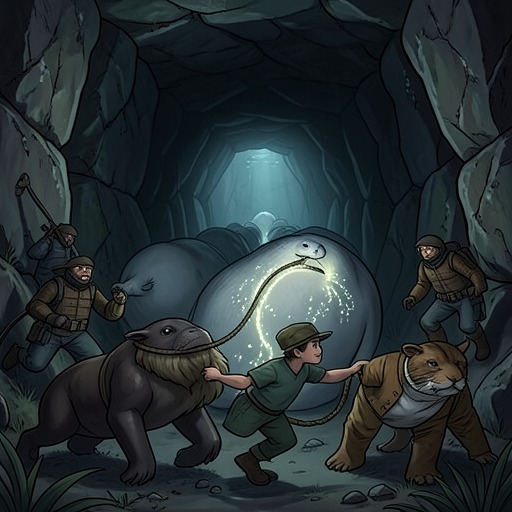
Kotick's discovery of the Sea Cow's tunnel
The Jungle BookKotick's discovery of the Sea Cow's tunnel is the decisive turning point in Kotick's search for a safe rookery. What begins as an exhausting pursuit across unfamiliar waters becomes a carefully verified refuge: a hidden coast reached through a long underwater passage, supplied with fish and beaches suited to seal nurseries, and protected by cliffs, shoals, fog-hidden islands, and the absence of human access. The discovery gives Kotick more than a place to live; it gives him evidence with which to challenge the habits of the seal people and a possible answer to the slaughter that threatens them.
The Search and the Encounter
Kotick reaches the discovery during his last exploration after returning to Novastoshnah as a full-grown sea-catch. He has delayed settling down, and even his mother, Matkah, has urged him to marry. Instead, he sets out westward after a great shoal of halibut, whose pursuit carries him toward Copper Island. He needs at least one hundred pounds of fish a day to remain in condition, so the journey is not idle wandering: feeding, endurance, and the search for a livable future are joined together.
At midnight, while sleeping on the hollows of the ground swell, Kotick is startled by immense creatures browsing in shallow water. They are unlike any animal he has known: between twenty and thirty feet long, without hind flippers, and equipped with shovel-like tails and an extra joint in each foreflipper. Kotick recognizes them only when he remembers the Burgomaster gull's earlier cry at Walrus Islet. He has found Sea Cow at last. The recognition changes the journey from solitary exploration into a chance to follow creatures whose movements may preserve knowledge of a safer world.
The Sea Cow cannot speak. Its six neck bones, rather than seven, are said to prevent speech, though its extra foreflipper joint permits a clumsy telegraphic code. Kotick questions the herd in every language he has learned during his travels, but receives no verbal answer. Instead, he follows its slow northward movement, watching the animals pause for bowing councils and initially judging them foolish. His impatience gradually gives way to respect when he realizes that they are following a warm current, using knowledge of the sea that is not immediately legible to him.
Passage Beneath the Cliff
The Sea Cow herd usually travels only forty or fifty miles a day, stopping to feed at night and keeping close to shore. Kotick swims around, above, and below the animals, unable to hurry them even half a mile. Their slowness becomes part of the revelation: the route is not a direct dash toward a visible island but a patient ecological passage whose safety depends on current, coastline, and concealment.
One night the herd suddenly sinks through the shining water and begins to swim quickly. It heads toward a coastal cliff that descends into deep water and plunges into a dark opening twenty fathoms beneath the surface. Kotick follows through the tunnel. The dive is long enough for him to badly want fresh air, and when he finally rises gasping into open water at the far end, the physical ordeal confirms the passage's exceptional secrecy. The route is so concealed that only a Sea Cow or a seal would have imagined its existence; even after emerging, Kotick can scarcely believe that he has passed beneath the cliffs.
Kotick immediately dives again to establish the tunnel's mouth and races through it southward. This second passage is important because the discovery is not left as a lucky glimpse. He tests the route in both directions, learns how it connects the hidden coast with the waters he knows, and prepares himself to answer questions when he returns. Exploration becomes verification, and verification becomes the basis for leadership.
The Hidden Rookery
Beyond the tunnel, the Sea Cow have spread out along beaches that Kotick considers the finest he has ever seen. Long stretches of smooth-worn rock run for miles, perfectly suited to seal nurseries. Behind them lie hard-sand playgrounds sloping inland, rollers in which seals can dance, long grass in which they can roll, and sand dunes to climb. The place offers not merely concealment but a complete habitat for seal life, combining breeding ground, recreation, and access to the sea.
Kotick first assures himself that the fishing is good. He then surveys the coast and counts low sandy islands partly hidden in rolling fog. Offshore, bars, shoals, and rocks form a barrier that would prevent a ship from approaching within six miles of the beach. Between the islands and the mainland is deep water leading toward perpendicular cliffs, beneath which lies the tunnel's mouth. The geography turns the rookery into a natural defense system: distance hinders ships, cliffs hinder land access, and the underwater entrance hides the route from ordinary search.
The absence of humans is as significant as the abundance of fish. Kotick judges the place to be Novastoshnah ten times better, but with the crucial difference that men cannot descend the cliffs and ships would be smashed by the offshore shoals. The new rookery therefore answers the precise danger that has made his search necessary. It is not simply remote; its structure makes hunting difficult. A place that protects seals through terrain can succeed where argument and tradition have failed.
Return and Rejection
Kotick spends enough time exploring the country to answer every question, although he is eager to return to the seal he has left behind. He then makes the journey home in six days, swimming without slowness. The first seal he meets after hauling out above Sea Lion's Neck is the one who has been waiting for him, and she understands from his expression that he has finally found the island he sought. The discovery thus carries an intimate consequence as well as a communal one: Kotick returns not only with a map of safety but with news that affects his future companionship and settlement.
The response of the seal people is immediate disbelief. The holluschickie, Sea Catch, Kotick's father, and the other seals laugh when he describes the refuge. A young seal objects that Kotick cannot arrive from an unknown place and order everyone away, insisting that the others have fought for their nurseries while Kotick has preferred prowling through the sea. His discovery is therefore not accepted as self-authenticating truth. The seals measure authority by inherited struggle and local custom, whereas Kotick's authority rests on exploration, observation, and a future danger they do not yet wish to confront.
This rejection gives the discovery its larger narrative force. Kotick has found the material solution, but not yet the social means of making it effective. The tunnel can be entered by a seal, the beaches can support a rookery, and the shoals can repel ships; none of these facts can move a community that mistakes familiarity for security. The hidden passage marks a shift from endangered permanence to possible migration, while the laughter at home shows how difficult it is to convert knowledge into collective action.
Significance of the Discovery
The event is a discovery plot built from pursuit, testing, and return. Kotick follows an unfamiliar herd, deciphers its movement, passes through a dangerous and concealed route, examines the resources and defenses of the destination, and comes back prepared to persuade the seals. The sequence changes the value at stake from vulnerability to possibility: before the tunnel, safety is an unproved hope; after it, safety exists as a place that Kotick has physically reached and evaluated.
The tunnel also reorganizes space and power. Novastoshnah is an exposed public beach whose excellence attracts vast seasonal gatherings, while the new rookery is defined by concealment and controlled access. The route beneath the cliff makes the sea itself a boundary and a passage at once. What appears to be an impassable coast from above becomes traversable below, so survival depends on knowing how to move through the environment rather than merely occupying its familiar surface.
Kotick's discovery finally reveals the difference between individual foresight and communal readiness. He has learned from travel that the seal people have not learned from repeated danger: a safe home must be found before the old one becomes uninhabitable. Yet the ending refuses an easy triumph. Kotick returns with the answer, but the seals laugh at the messenger. The refuge is real; acceptance remains to be won. In that tension, the event becomes the foundation for Kotick's later struggle to make a whole people abandon inherited exposure for a safer future.