Kotick's search for a safe rookery
The Jungle BookKotick's search for a safe rookery is the central quest of his resistance to the slaughter of the seal people. After seeing the killing grounds and discovering that his companions regard the violence as an ordinary part of life, Kotick refuses to accept endurance as the only possible future. His search becomes both a physical passage across the world's oceans and a test of whether inherited hope can survive repeated evidence of human destruction.
The Wound That Begins the Quest
Kotick's purpose takes shape after he returns from the killing grounds at Novastoshnah. No one there sympathizes with his attempt to find a quieter home: the other seals insist that men have always driven the holluschickie and that anyone unwilling to see ugly things should have stayed away. Their judgment is sharpened by the fact that none of them witnessed the slaughter. Kotick has therefore acquired a knowledge his society does not share, and his being a white seal makes him appear still more exceptional and isolated.
Sea Catch tells his son to grow up, become a large seal, establish a nursery on the beach, and wait until he is strong enough to fight for himself. Matkah likewise urges him to play in the sea and says that he will never be able to stop the killing. Kotick answers neither argument with a debate. He leaves the beach that autumn, alone and driven by the conviction that somewhere there must be a firm, quiet island where men cannot reach the seals. His quest begins as a rejection of resignation: the existing rookery offers belonging, but it also offers a future organized around repeated slaughter.
A Five-Season Passage Across Threatened Seas
Kotick searches for Sea Cow, if such a being exists, and for a refuge that can support a seal nursery. He travels from the North to the South Pacific, sometimes swimming as much as three hundred miles in a day and a night. The journey is not presented as a single triumphant expedition but as a chain of hazards and failed discoveries. He narrowly escapes the Basking Shark, the Spotted Shark, and the Hammerhead, while encountering many other sea creatures, including an old, stumpy-tailed albatross who directs him toward Kerguelen Island.
Kerguelen almost kills him. In a sleet storm filled with lightning and thunder, Kotick is nearly smashed against black cliffs; even after he survives the gale, he sees signs that seals once occupied the island and were later destroyed. This pattern becomes the governing fact of his travels. A beach may be hard and well sloped for seals, yet smoke from a whaler appears on the horizon, revealing that men are nearby and that blubber is being boiled down. Or the island may bear the remains of an earlier colony, proving that human arrival has already emptied it and may be followed by return.
The scope of the search steadily expands. Over five seasons, with four months of rest each year at Novastoshnah, Kotick visits the Galapagos, the Georgia Islands, the Orkneys, Emerald Island, Little Nightingale Island, Gough's Island, Bouvet's Island, the Crozets, and a small island south of the Cape of Good Hope. He also reaches Cape Corrientes, where only a few hundred diseased-looking seals remain on a rock, and they tell him that men come there too. The geographical variety matters less than the repetition: across distant waters, the seal people report the same history of arrival, killing, and abandonment.
Failure, Memory, and the Last Encouragement
The repeated destruction nearly breaks Kotick's heart. He turns around the Horn toward his own beaches and prepares to return to Novastoshnah, deciding that if he is driven to the killing pens with the holluschickie, he will no longer care. The retreat is not a discovery of safety but the emotional consequence of finding no place untouched by the same human system. His private mission has reached the point at which endurance seems easier than hope.
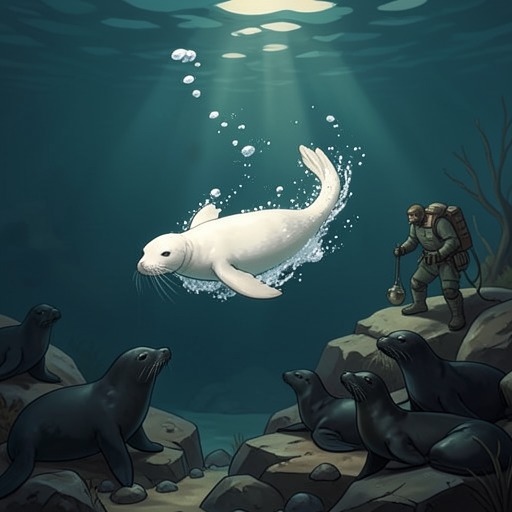
On the northward journey he hauls out on a green, wooded island and finds an ancient seal who is dying. Kotick catches fish for him and tells him all his sorrows. The old seal identifies himself as the last survivor of the Lost Rookery of Masafuera and gives the search a history larger than Kotick's own life. In the days when men killed seals by the hundred thousand, the beaches carried a story that one day a white seal would come from the North and lead the seal people to a quiet place. The old seal will not live to see that day, but he tells Kotick to try once more.
This counsel changes the meaning of the journey. Until then, Kotick's whiteness has marked him as a solitary oddity, while his search has seemed to others an absurd attempt to find imaginary islands. The dying survivor turns both facts into signs of a possible role. Kotick responds by recalling that he is the only white seal ever born on the beaches and the only seal, black or white, who has thought of seeking new islands. The recognition restores his energy without pretending that the evidence has become favorable. His hope is not based on a safe island already found; it is renewed because a communal memory has given his singularity a purpose.
Return and the Refusal to Settle
When Kotick returns to Novastoshnah the following summer, he is no longer a young holluschick. He has become a full-grown sea-catch with a heavy, curly white mane, as large and fierce as Sea Catch. Matkah asks him to marry and settle down, offering the conventional life that Sea Catch had earlier prescribed. Kotick asks for another season instead. His answer shows that the quest has changed from youthful impulse into a deliberate obligation: strength, maturity, and social standing have not displaced his objective.
His final image in this stage is the recurring natural measure of the seventh wave, which travels farthest up the beach. The image gives his persistence a rhythm drawn from the sea rather than from human schedules or institutions. Kotick has already endured five seasons of exploration, danger, ridicule, and disappointment; nevertheless, he treats the next attempt as the wave that may carry farther than those before it. The search therefore ends provisionally, not with the discovery of refuge, but with a renewed decision to continue toward it.
Significance of the Quest
The search combines a quest plot with an ecological history of displacement. Kotick is not looking for adventure for its own sake. He is seeking a place where ordinary life—nurseries, beaches, and communal reproduction—will not be converted into an opportunity for killing. Each island functions as evidence in a larger investigation: good geography is insufficient when human exploitation follows, and distance alone cannot guarantee safety.
The journey also exposes the difference between witnessing and custom. The seals who did not see the slaughter can fold it into routine, while Kotick's direct knowledge makes routine intolerable. His isolation is consequently the source of his leadership. He is mocked because he imagines alternatives, yet the old survivor's prophecy reveals that the apparently foolish white seal may be the answer to a need the whole seal people have been unable to articulate. The quest's decisive movement is thus inward as well as outward: Kotick travels through threatened waters, nearly loses faith, receives a recovered collective memory, and returns with his exceptional identity transformed into a responsibility.