Little Toomai and Kala Nag
The Jungle BookLittle Toomai and Kala Nag are bound by a partnership that joins human inheritance to elephant intelligence. The boy has been raised under the elephant's shadow, and Kala Nag's strength, memory, and judgment make him more than a beast of labor: he is Little Toomai's companion, protector, teacher, and guide into a world hidden from human observers. Their relationship reaches its decisive expression when Kala Nag carries the boy from the elephant lines into the Garo hills, enabling him to witness the elephants' dance and receive the name Toomai of the Elephants.
Identity and Inherited Bond
Little Toomai is the ten-year-old eldest son of Big Toomai, a driver whose family has served Kala Nag across generations. Big Toomai says that Kala Nag has watched three generations of the family feed and groom him and may live to see a fourth. The elephant was taken when Toomai's grandfather, Toomai of the Elephants, was present, and the family has treated him as part of its continuing household and working tradition rather than as an anonymous Government animal.
Kala Nag is an immense, experienced elephant, ten feet high at the shoulders, with tusks cut short and bound with copper. He is trained for the Keddah, where he enters the violent confusion of captured wild elephants, selects the largest and fiercest tusker, and hammers him into submission while men rope the others. He has also survived encounters with wounded tigers. His power makes the intimacy between him and a small child seem dangerous, yet the story repeatedly shows that Kala Nag distinguishes between threat, command, and trust.
Familiarity and Mutual Authority
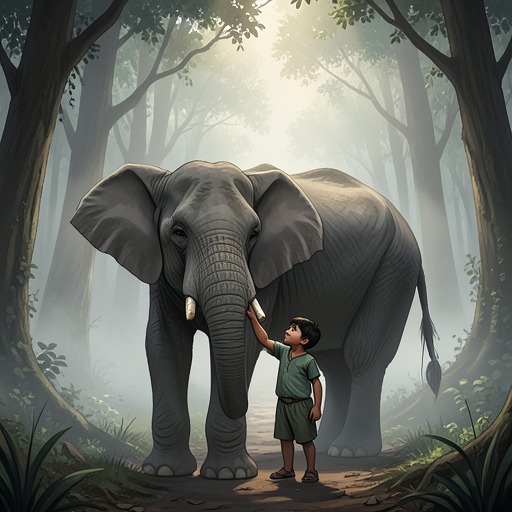
Little Toomai's authority over Kala Nag comes from daily contact rather than physical force. He was born beneath the elephant's shadow, played with the end of his trunk before he could walk, and took him to water as soon as he was able to walk. Kala Nag obeys the boy's shrill orders as readily as those of an adult and would not dream of harming him. Little Toomai therefore speaks to him with the teasing confidence of a child addressing a familiar elder, calling him a fat old pig and making him lift his feet one after another.
The boy also imagines a future in which their partnership continues beyond ordinary camp labor. He pictures Kala Nag bought by a rich ruler to carry a gold howdah and walk in royal processions, with himself seated on the elephant's neck and holding a silver ankus. Yet Little Toomai immediately values jungle work more highly than ceremonial display. His fantasy reveals that he does not merely want ownership or prestige; he wants to remain where Kala Nag's abilities and his own courage have meaning.
The relationship is reciprocal in a way that separates it from simple obedience. Little Toomai claims that Kala Nag fears him, but the boy's confidence rests on a long history of care and recognition. Kala Nag knows the child's voice, accepts his handling, and responds to him as a particular person. The boy, in turn, reads the elephant's silences and bodily changes closely, noticing when he stands alert, when he becomes restless, and when his attention turns toward the hills.
The Keddah and the Test of Trust
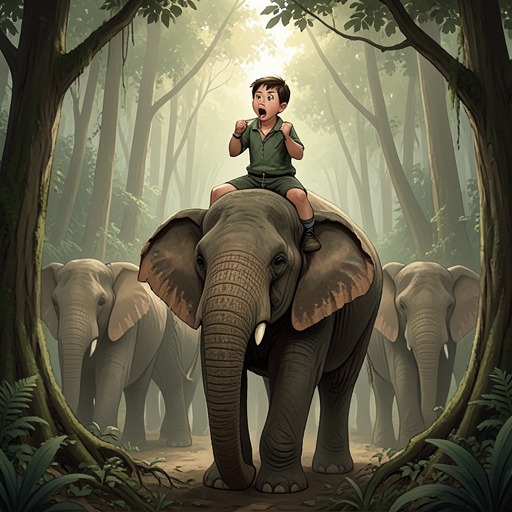
The bond is tested during the capture of wild elephants. Little Toomai climbs a shaking stockade post and shouts encouragement to Kala Nag above trumpeting, crashing ropes, and the struggles of the animals. When he sees a driver trying to secure a kicking calf, he abandons his safe position, slips among the elephants, and throws up the loose end of a rope. Kala Nag immediately catches him in his trunk and hands him to Big Toomai, preventing the child from being trampled.
This rescue combines protection with discipline. Big Toomai slaps Little Toomai and returns him to the post, then scolds him the next morning for trying to catch elephants on his own. Kala Nag does not punish the boy; he removes him from immediate danger. The incident shows that the elephant's trust is not passive. He recognizes when Little Toomai's courage has become recklessness and intervenes with the precise physical control that his immense strength permits.
Little Toomai's daring also brings him to the attention of Petersen Sahib, the head of the Keddah operations. The boy is frightened because Petersen Sahib represents the highest human authority he knows, but the encounter begins the process by which his private relationship with Kala Nag becomes publicly recognized. What the camp first sees as childish disobedience will eventually be interpreted as evidence of an exceptional bond.
The Night Journey and the Elephant Dance
After a night alarm, the elephants in the lines rise and strain against their pickets. Kala Nag stands facing the Garo hills, unusually silent and attentive. Big Toomai tells his son to watch him if he grows restless, then goes to sleep. When the grass string around Kala Nag's leg snaps, the elephant leaves the pickets quietly. Little Toomai follows barefoot and calls for him to take the boy along.
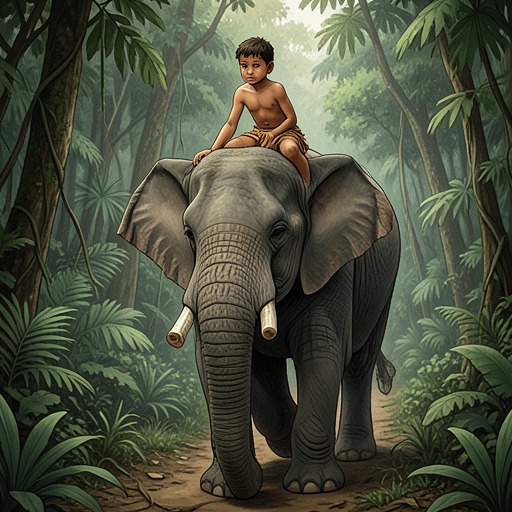
Kala Nag turns back, takes three strides toward Little Toomai, lowers his trunk, and swings him onto his neck. This gesture is the clearest expression of their partnership: the boy does not force his way into the journey, and the elephant does not simply tolerate his pursuit. Kala Nag returns for him, lifts him, and carries him into the forest before the camp can stop them.
The elephant then moves almost soundlessly through the Garo forest, uphill and away from human control. Little Toomai cannot determine the direction by the stars, but he recognizes that the route has already been made by many elephants. Kala Nag joins the hidden procession and brings the boy to a circular clearing three or four acres wide, its earth stamped hard as brick and its trees polished where elephant bodies have rubbed against them. Wild males, mothers, calves, young elephants, scarred old bulls, and animals marked by earlier battles gather there, moving like ghosts inside the circle.
Little Toomai understands that the elephant-folk have come for their dance. Kala Nag's knowledge of the route and his willingness to carry the child make the revelation possible. The elephant is therefore not merely transport for a human witness; he is the mediator through whom the hidden community of wild elephants becomes visible. His trust allows Little Toomai to cross the boundary between the managed camp and the elephants' own night world.
Recognition and Lasting Significance
Kala Nag returns to camp with Little Toomai after the boy has witnessed the dance. The elephant is footsore, while the child is gray-faced, covered with leaves, and drenched with dew. Little Toomai collapses after telling Petersen Sahib what he has seen, but his account is confirmed by the numerous tracks leading to the trampled dance ground. The journey thus changes the meaning of their relationship in the eyes of the human community: what had looked like disobedience becomes a unique form of access and knowledge.
At the ensuing feast, Machua Appa lifts the boy above his head and declares that he shall no longer be called Little Toomai but Toomai of the Elephants. The new name recognizes both the boy's achievement and Kala Nag's part in it. Machua Appa calls the boy a future great tracker and says that the elephants will know him and spare him even in the Keddah. Kala Nag is named among the elephants who salute him, together with Pudmini, and the entire line raises its trunks in the Salaamut of the Keddah.
The relationship therefore produces a double recognition. Little Toomai is accepted by the human elephant catchers as an initiated forester, while the story presents him as favored by the elephant-folk. Kala Nag remains a working animal within a system of capture and Government service, but his choice to return for the boy and lead him into the forest gives him a measure of agency beyond that system. Their partnership joins command with care, danger with protection, and inherited human skill with an elephant world that remains partly beyond human possession.