Little Toomai sees the elephants dance
The Jungle BookLittle Toomai sees the elephants dance in the Garo hills after Kala Nag breaks free from his night pickets and carries the boy into the forest. The event is decisive because it grants Little Toomai an extraordinary knowledge of the elephant world: alone, hidden from human observers, he sees scores of wild and camp elephants gather, stamp a clearing into a dance-ground, and vanish at dawn. His testimony is initially marked by exhaustion and disbelief, but the physical traces left behind confirm what he has witnessed and turn him into the human who has seen what no other person has seen.
Causes and Departure
Little Toomai’s journey begins in the elephant camp after nightfall. The animals have been chained by their hind legs to stout pickets, while the new elephants are secured with extra ropes. Kala Nag, however, reacts to a distant wild elephant’s call. When the other elephants rise and trumpet, Kala Nag stands facing the Garo hills with his ears spread and his head raised, no longer responding to the ordinary commands of his keepers. Big Toomai therefore tells Little Toomai to watch him if he becomes restless.
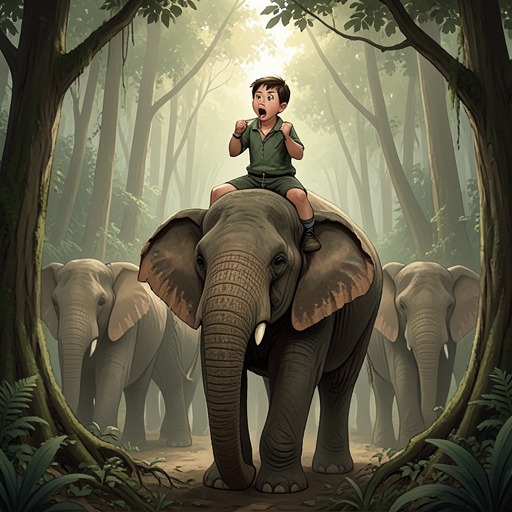
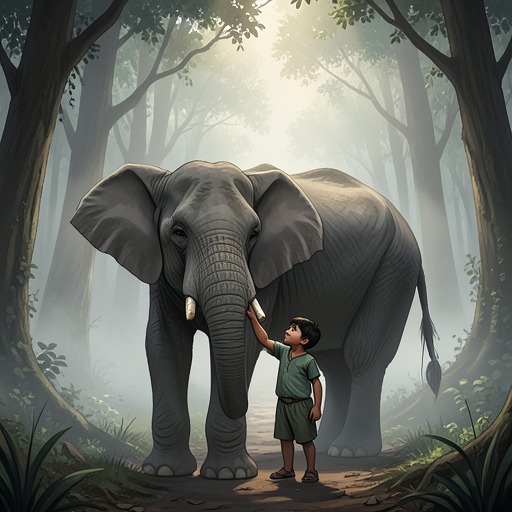
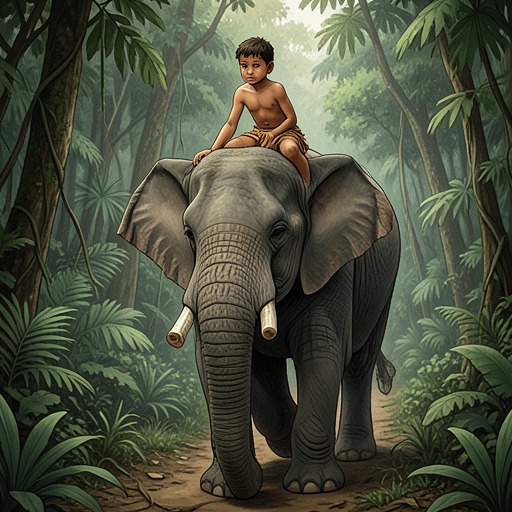
The restraint fails quietly. Little Toomai hears the coir string snap, and Kala Nag rolls out of the pickets with the slow, silent movement of a cloud leaving a valley. The boy follows barefoot, calling for the elephant to take him along. Kala Nag returns, lowers his trunk, lifts Little Toomai onto his neck, and enters the forest before the child has properly settled himself. The camp answers with one furious burst of trumpeting, then falls silent, leaving the boy and the elephant to move beyond human supervision.
The Night Journey
Kala Nag first travels uphill through the dense Garo forest, almost soundlessly despite his size. At the crest, Little Toomai looks over treetops and mist-covered country and senses the forest as a living, crowded presence. The descent is more violent: creepers hang from Kala Nag’s tusks, saplings strike his flanks, and the elephant drives through the undergrowth with the force of a runaway gun. Little Toomai lies close against the great neck, afraid that a swinging branch will sweep him away.
At the bottom of the valley, Kala Nag crosses a river in cold mist. The boy hears splashing and trumpeting upstream and downstream, then recognizes the gathering as the elephant dance. The path on the far bank has already been made by many elephants only minutes earlier. A wild tusker emerges behind them, and the procession climbs toward the hill amid crashing branches and repeated trumpetings. The route is therefore not a random escape but a movement toward a place known and shared by the elephant people.
The Secret Dance-Ground
At the hilltop, Kala Nag stops among trees surrounding an irregular clearing three or four acres wide. The ground has been stamped hard as brick, with the bark rubbed from central trees and no green blade remaining inside the circle. Under moonlight the earth appears iron-gray, while the elephants stand as black silhouettes. More and more animals enter from the surrounding forest, moving noisily through the undergrowth but almost like ghosts once they pass between the trees.
Little Toomai sees an entire social range gathered there: white-tusked wild males, slow-footed females with calves beneath them, young elephants displaying newly emerging tusks, old females with anxious faces, scarred bulls, and an elephant marked by a broken tusk and the deep claw-scrapes of a tiger. The assembly includes escapees from human camps. Pudmini, Petersen Sahib’s pet elephant, arrives with her chain broken, and another animal bears deep rope galls from earlier restraint. Their presence makes the dance a meeting place not only for wild elephants but also for animals temporarily released from human ownership.
Kala Nag enters the crowd, clucking and gurgling as the elephants communicate and move together. Little Toomai remains on his neck, knowing that the animals will not reach up to pull a human from a tame elephant during such a gathering. Even so, darkness intensifies his isolation. A trunk touches his knee, the elephants press and shift around Kala Nag, and he realizes that there is no route back through the assembly. Unlike a Keddah drive, with torchlight and shouting, this is a ceremony conducted beyond human arrangements and without human protection.
The Stamping and Its Meaning
The dance begins with a collective trumpet and then a deepening rhythm. Kala Nag lifts one forefoot and then the other, striking the earth in a steady one-two pattern. Hundreds of heavy feet join the movement until the sound resembles a war drum at the mouth of a cave. The ground rocks beneath Little Toomai, dew falls from the trees, and the boy covers his ears against the immense vibration passing through his body.
The movement alternates between stamping on hard earth and crushing vegetation. The elephants surge forward for a few strides, bruising green growth, then resume the heavier booming. The ceremony lasts about two hours, long enough for Little Toomai to ache in every nerve while dawn approaches. The narrative makes the dance physical rather than ornamental: it is a collective act that changes the landscape itself, converting thick grass and cane into trash, then slivers, fibers, and finally hard earth.
At sunrise the booming stops as if light were an order. Within moments the elephants have disappeared, leaving only Kala Nag, Pudmini, and the rope-marked animal. The clearing has visibly expanded. Trees stand newly exposed in the center, and the jungle grass has been rolled back at the edges. The altered ground becomes material proof that the night’s event was not merely a frightened child’s interpretation of distant noises; the elephants have literally made a larger room with their feet.
Testimony and Consequences
Kala Nag returns to camp two hours later, footsore, while Pudmini is mired to the shoulders. Little Toomai is gray-faced, drenched with dew, and covered with leaves. He tries to salute Petersen Sahib, announces that he has seen the elephant dance, and faints from Kala Nag’s neck. After recovering in Petersen Sahib’s hammock with milk and medicine, he tells the assembled hunters that witnesses can verify his account by following the tracks to the dance-ground.
His credibility rests on precise physical details. He identifies the expanded clearing and the many trails leading toward it, explaining that the elephants created the additional space by stamping. The hunters therefore do not receive only a marvelous story; they receive a claim anchored in a transformed place and a visible pattern of tracks. The event shifts Little Toomai’s status from an eager camp child to an exceptional observer of elephants.
The recognition culminates in the salute of the Keddah: the elephants raise their trunks and produce the crashing trumpet-peal ordinarily reserved for the Viceroy of India. The salute is given for Little Toomai because he has seen what no human had seen before, the nocturnal dance of the elephants alone in the heart of the Garo hills. The event thus joins secrecy, endurance, and testimony: the elephant world keeps its gathering beyond human sight, but the child’s accidental passage creates a bridge between that hidden society and human knowledge.