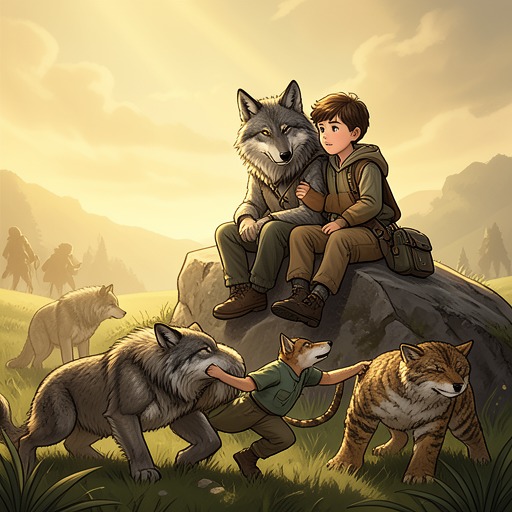
Look well, O Wolves!
The Jungle Book“Look well, O Wolves!” is the formal cry by which the Seeonee Wolf Pack is commanded to observe, identify, and judge. Spoken first at the full-moon Council Rock and repeated after Mowgli’s return with Shere Khan’s hide, the expression links communal law to public witnessing: what the wolves see determines who may belong, while what they later see forces them to confront the consequences of their earlier choices.
Meaning and First Use
At the Pack Meeting, Akela calls the wolves to inspect the cubs brought before the Council. The command is not casual encouragement but a ritual instruction grounded in the Law of the Jungle. Mothers push their cubs into the moonlight so that none is overlooked, while senior wolves approach each animal, examine it carefully, and return silently to the circle. The repeated call makes recognition a collective act rather than a private claim by a parent.
The expression becomes decisive when Father Wolf places Mowgli, called “Mowgli the Frog,” in the center of the Council Rock. Mowgli is still absorbed in playing with moonlit pebbles, unaware that his future is being decided around him. Shere Khan demands that the man-cub be surrendered, but Akela answers by returning the Pack to its own procedure: “Look well, O Wolves!” The command rejects the tiger’s authority and insists that the Free People must judge according to their own law.
Law, Scrutiny, and Acceptance
The Pack’s law requires at least two members other than the cub’s parents to speak for a disputed cub. When no wolf initially answers Akela’s question, Mother Wolf prepares for the fight she expects will follow. Baloo then speaks for Mowgli, and Bagheera adds both his advocacy and the offer of a newly killed bull. The wolves accept the bargain, and their renewed cry of “Look well—look well, O Wolves!” accompanies the inspection that admits Mowgli into the Pack.
The expression therefore carries both surveillance and protection. The cub must be seen before he can be recognized, but recognition also places him under the Pack’s protection: once accepted and identified, he may run freely, and the law forbids a grown wolf from killing him before his first buck. The repeated command gives visible form to a social order in which judgment is public, regulated, and binding.
Return to the Council Rock
Years later, the words return under radically altered circumstances. After Mowgli kills Shere Khan, he brings the tiger’s skin to the Council Rock. Bagheera greets him as “Little Brother,” and together they climb the rock. Mowgli spreads the hide over the flat stone where Akela once sat, fixes it with four slivers of bamboo, and Akela lies down upon it before calling the old Council cry: “Look—look well, O Wolves.”
The repetition is deliberately exact. The same place, ritual, and command that once exposed Mowgli to the Pack’s judgment now expose Shere Khan’s defeat to the wolves. The hide is not merely a trophy; it is visible proof that Mowgli has kept his word. The command makes the Pack look at the material consequence of the conflict that had begun with Shere Khan’s demand for the man-cub.
Memory, Disorder, and Refusal
The wolves answer the summons largely from habit, because Akela’s deposition has left the Pack without a leader. They have hunted and fought as they pleased, and the survivors who come to the rock bear the physical marks of that lawlessness: some are lame from traps, some limp from shot wounds, some are mangy from bad food, and many are missing. Their damaged bodies turn the act of looking into an unwelcome inventory of failed freedom.
Mowgli then asks, “Look well, O Wolves. Have I kept my word?” The wolves answer yes, and one tattered wolf asks both Akela and Mowgli to lead them again, claiming that the Pack is weary of disorder and wishes to become the Free People once more. Bagheera refuses the proposed restoration. He warns that fullness may bring back the old madness and reminds them that their freedom was won in their own struggle. His response exposes the expression’s ambiguity: seeing clearly does not guarantee obedience, repentance, or permanent reform.
Narrative Significance
“Look well, O Wolves!” frames Mowgli’s relationship with the Pack through two public scenes of recognition. At the first Council, the words place an apparently helpless human child under communal examination and help secure his admission. At the later Council, they summon the same community to witness the fulfillment of Mowgli’s promise and the ruin of the enemy who once claimed him.
The expression also gives the story a recurring architecture of witness. Akela’s voice turns looking into law; the wolves’ response turns sight into collective judgment; Mowgli’s question turns the inherited ritual toward personal accountability. Its final resonance is therefore neither simple triumph nor simple restoration. The Pack can see its past, its injuries, and Shere Khan’s hide, yet the warning from Bagheera shows that vision alone cannot cure the instability of a society that calls itself free.