Messua
The Jungle BookMessua is the village woman who receives Mowgli when he returns from the jungle and becomes his human mother in everything but biological fact. Her recognition of his resemblance to her lost son, Nathoo, gives Mowgli a place in human society, while her later attempt to protect him during the villagers’ attack reveals a loyalty stronger than fear of the crowd.
Recognition and Adoption
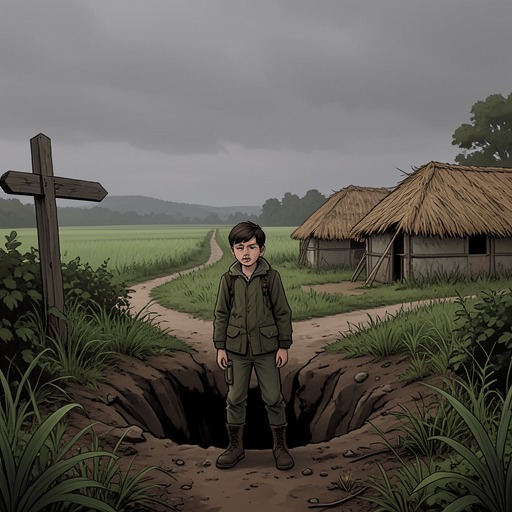
Messua first appears among the villagers examining Mowgli’s body and identity. The priest interprets the white scars on his arms and legs as wolf bites and presents him as a wolf-child who has escaped from the jungle. Messua and the other women respond with pity, but her response is also personal: she observes that Mowgli has the same appearance as her son, who was taken by a tiger. A second woman examines him more closely and confirms that, although he is thinner, he has the very look of her missing boy. Messua therefore sees in the supposed jungle outsider a possible return of the child she lost.
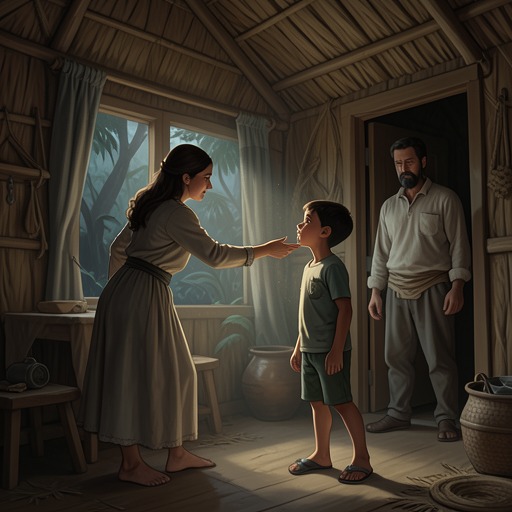
The priest exploits that possibility for his own advantage. Because Messua is married to the richest villager, he solemnly declares that what the jungle took, the jungle has restored, and urges her to take the boy into her house. Messua accepts Mowgli not because the priest proves his identity, but because her maternal recognition makes the claim emotionally credible. She gives him milk and bread, touches his head, and calls him Nathoo, testing whether some memory of his former life remains. When Mowgli does not respond, she notices that his feet have never worn shoes, yet still concludes that he is very like her lost son and declares that he shall be her son.
A Home Between Worlds
Messua’s hut offers Mowgli his first direct experience of human domestic life. It contains a red lacquered bedstead, a large earthen grain chest, copper cooking pots, a Hindu image, and a real looking glass. These objects establish a sharply different world from the jungle and make Messua’s household a threshold between Mowgli’s animal upbringing and his attempted return to human society.
Mowgli is uneasy under a roof, but the hut does not become an absolute prison because he can see that its thatch could be torn away and that the window has no fastenings. His first concern is not comfort but competence: he recognizes that a man who cannot understand human speech is as helpless among people as a human would be in the jungle. Messua consequently becomes the immediate source of his human education. By imitating each word she pronounces, Mowgli learns the names of many things in the hut before nightfall. Her care and his extraordinary ability together begin his passage into human language without erasing the knowledge he gained from the wolves.
Maternal Loyalty Under Threat
Messua’s attachment to Mowgli persists even after the village turns against him. When he appears with the herd, the priest and crowd denounce him first as a wolf and then, through another accusation, as a sorcerer who can change himself into a beast. Messua runs toward the herd and calls him her son. She does not accept the charge that he is a wizard; instead, she recognizes that he has avenged Nathoo’s death.
Her defense places her in immediate danger. The crowd orders her to return and threatens to stone her, making the village’s collective fear more powerful than evidence or gratitude. Messua nevertheless warns Mowgli to leave because the villagers may kill him. Her words combine protection with grief: she cannot save him by persuading the crowd, but she can try to prevent his death by urging him away. In this moment she acts neither as a passive mother nor as a representative of village authority; she chooses the endangered child over the judgment of the community.
Separation and Significance
A stone strikes Mowgli in the mouth as he attempts to send Messua back to safety. He answers her with farewell and insists that he is no wizard, while reminding her that he has paid for her son’s life. The exchange closes their brief shared household and turns their relationship into a painful separation. Messua has given Mowgli food, shelter, a name, and a first route into human speech; Mowgli, for his part, has avenged the death associated with her lost child and tries to protect her from the mob.
Messua’s narrative importance lies in the contrast between recognition and classification. The priest uses Mowgli’s ambiguous identity to display his own supposed wisdom and to serve the interests of the powerful household, whereas Messua responds to the same ambiguity through care. She cannot establish that Mowgli is literally Nathoo, and the text does not resolve that question through biological proof. What she establishes instead is a genuine maternal relationship grounded in resemblance, grief, choice, and protection. Her loyalty also exposes the limits of the village’s human boundary: the community calls Mowgli both animal and sorcerer, but Messua treats him as a son even when that recognition makes her a target.