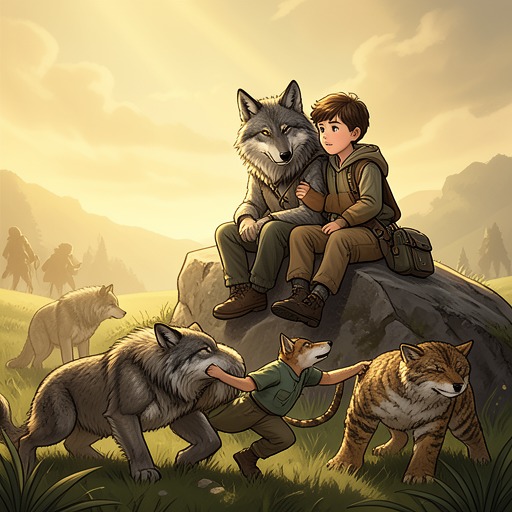
Mowgli and Akela
The Jungle BookMowgli and Akela is a relationship of guardianship in which the aging leader of the Seeonee Wolf Pack protects a human child not by ignoring the Pack’s law but by insisting that the law be honored. Akela recognizes Mowgli as a brother in conduct and obligation, while Mowgli answers that protection with trust, practical loyalty, and a decisive effort to restore Akela’s dignity after the Pack turns against him.
Acceptance Under the Jungle Law
The relationship begins at Council Rock, where the Pack must inspect its cubs and decide whether Mowgli, known as Mowgli the Frog, may belong among the Free People. The Law of the Jungle requires that cubs be presented to the Pack Council at the full moon, and that any disputed cub be spoken for by at least two members who are neither father nor mother. Akela presides over this public procedure as the great gray Lone Wolf, a leader whose authority rests on strength, cunning, and knowledge of the manners of men.
When Shere Khan claims that the man-cub belongs to him, Akela refuses to let the tiger’s demand replace the Pack’s own judgment. He repeatedly commands the wolves to look well, turning the inspection into a test of collective responsibility rather than a surrender to intimidation. The dispute is not merely about Mowgli’s species. It asks whether the Free People will remain governed by their own rules or become an audience for Shere Khan’s appetite.
Akela’s protection is initially procedural and communal. He does not pretend that Mowgli’s human origin is irrelevant; instead, he keeps attention fixed on what the child has done within the Pack. Years later, when Shere Khan and his supporters demand Mowgli’s expulsion, Akela states that Mowgli has eaten the Pack’s food, slept with it, driven game for it, and broken no word of the Law of the Jungle. On that basis, he calls Mowgli a brother in all but blood and condemns the proposed killing as a violation of Pack honor.
Protection During the Pack’s Crisis
Akela’s defense of Mowgli becomes most powerful when his own authority has failed. After twelve seasons of leading the Pack without allowing a wolf to be trapped or maimed, he misses a kill because the plot against him has been arranged to expose his weakness. Under the Jungle Law, a leader who misses his kill becomes the Dead Wolf and may be challenged to death one wolf at a time. Akela openly acknowledges this judgment and offers the Pack the right to end his life.
Yet the Pack does not immediately attack him. Its silence reveals that the old leader still commands moral authority even after losing formal power. Shere Khan uses the moment to redirect the wolves’ fear toward Mowgli, calling him a man and demanding that he be handed over. Akela answers that Mowgli has fulfilled the obligations of Pack membership, while Shere Khan’s influence has encouraged cowardice, cattle-killing, and the snatching of village children. Akela’s defense therefore links Mowgli’s safety to a larger struggle over what kind of community the Pack will be.
Akela offers a sacrifice rather than a threat. He says that, if the Pack lets Mowgli return to his own place, Akela will not bare a tooth when his time comes to die. His promise would save the Pack three lives and spare it the shame of killing a brother against whom there is no fault. The offer shows the distinctive form of his guardianship: he treats leadership as a duty to preserve the Pack’s honor, even when the Pack has forgotten that honor and even when his own death is certain.
Alliance Against Shere Khan
Years later, when Mowgli is preparing to kill Shere Khan, Akela reappears as an active ally rather than a merely remembered protector. Mowgli develops a plan involving the buffalo herd and the ravine of the Waingunga. Gray Brother brings a wise helper from a hidden place, and the huge gray head that rises from the hole is Akela’s. Mowgli greets him with immediate recognition and assigns him a precise task: divide the herd so that the cows and calves remain together while the bulls and plow buffaloes form a separate group.
Akela and Gray Brother run through the herd in a chain-like formation, separating the animals with such efficiency that the scene emphasizes Akela’s continuing tactical intelligence. The cows gather around their calves and become dangerous because they are defending them; the bulls look more imposing but are less dangerous without calves to protect. When the animals try to rejoin, Mowgli gives Akela further orders to break them apart and scatter them. Their cooperation is disciplined rather than sentimental: Mowgli supplies the plan, and Akela’s experience makes the plan possible.
The buffalo stampede kills Shere Khan. Mowgli judges the death a dog’s death, because the tiger never receives the chance to show fight, but he immediately understands that the corpse must have a public meaning. He begins skinning the ten-foot tiger with the knife he now carries around his neck, intending to place the hide on Council Rock. Akela’s assistance thus helps convert Mowgli’s private revenge into a public reckoning with the enemy who once claimed ownership of him.
Return to Council Rock
After the tiger’s death, Akela joins Mowgli and Bagheera at Council Rock. Mowgli spreads Shere Khan’s striped hide over the flat stone where Akela once sat, fastening it with four slivers of bamboo. Akela lies down upon the hide and gives the old summons, calling the wolves to look well exactly as he had called when Mowgli was first brought before the Pack. The repeated summons creates a direct link between Mowgli’s entrance into the Pack and the fulfillment of the promise made during that first judgment.
The Pack has been without a leader since Akela’s deposition. Its remaining wolves have hunted and fought as they pleased; some are lame from traps, some carry shot wounds, some are mangy from bad food, and many are missing. Their ruined condition makes visible the cost of abandoning the discipline Akela represented. They nevertheless answer his call by habit and come to see Shere Khan’s hide hanging from the rock.
Mowgli asks whether he has kept his word, and the wolves answer yes. One tattered wolf then asks Akela to lead again and calls on Mowgli to lead as well, because the Pack is sick of lawlessness and wishes to be the Free People once more. Bagheera rejects this appeal, warning that freedom may bring back the same madness when the wolves are full-fed. The scene does not restore the old order in a simple way: Akela’s moral stature is reaffirmed, but the Pack’s political failure cannot be undone merely by recalling its former leader.
Meaning of the Bond
Akela’s guardianship gives Mowgli a place within the Pack while also teaching him that belonging depends on law, witness, and reciprocal obligation. He protects Mowgli at the full-moon inspection, defends him when Shere Khan manipulates the Pack’s fear, and later helps him carry out the action that answers Shere Khan’s long hostility. Mowgli, in turn, does not leave Akela as a figure of the past. He remembers him, summons him for the buffalo operation, follows his judgment, and places Shere Khan’s hide where Akela’s authority once stood.
Their bond also exposes the difference between legitimate leadership and mere power. Akela’s authority is exercised through inspection, rule, restraint, and willingness to sacrifice himself for the Pack’s honor. Shere Khan’s influence works through appetite, intimidation, and the promise of dividing the community against a vulnerable outsider. Mowgli’s survival depends on the first kind of authority, and Shere Khan’s death reveals the consequence of the second.
The relationship finally becomes a record of institutional memory. The words Look well, O Wolves return at the end with altered force: first they examine whether a defenseless man-cub may be admitted; later they direct the Pack toward the evidence of its enemy’s defeat and its own disintegration. Akela’s presence across both scenes makes him the guardian of that continuity. Even when the Pack rejects his leadership, his conduct preserves the standard by which its lawlessness can be recognized.