Mowgli and Bagheera
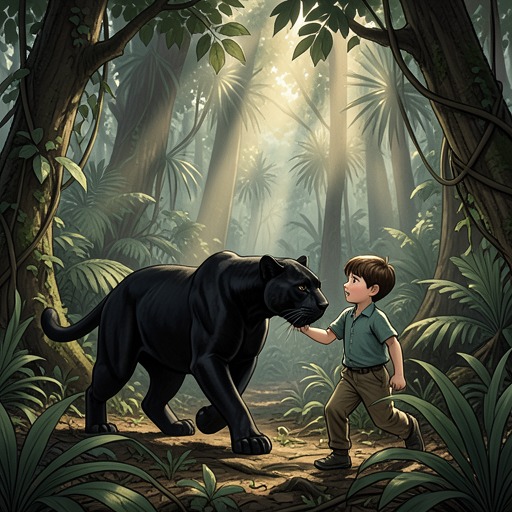
The Jungle BookMowgli and Bagheera is one of the central protective relationships in the jungle stories. Bagheera is not merely Mowgli’s advocate in a moment of danger: he is the companion who recognizes the man-cub’s exceptional nature, works within the Law of the Jungle to preserve his life, prepares him for the Pack’s future hostility, and stands with him through rescue, vengeance, and return. Their bond joins affection to practical foresight. Bagheera repeatedly sees the danger before Mowgli does, while Mowgli answers that protection with trust, loyalty, and decisive action.
The Panther Who Secures Mowgli’s Place
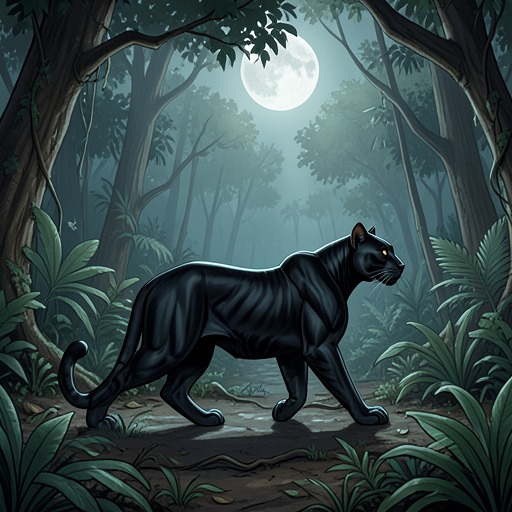
Bagheera enters Mowgli’s story at the Council Rock as a black shadow dropping into the circle of the Free People. His appearance embodies the authority that makes his intervention effective: he is known as cunning, bold, and reckless, yet his voice is soft and his manner controlled. Although he acknowledges that he has no right to speak in the wolves’ assembly, he invokes the Law of the Jungle, which permits a doubtful new cub to be bought at a price when the matter is not one of killing.
Bagheera turns that legal provision into a personal guarantee. He argues that killing a naked cub would be shameful, adds that the cub might provide better sport when grown, and offers a newly killed bull as the price of Mowgli’s acceptance. The wolves immediately shift from suspicion to appetite and assent, asking where the bull is and agreeing that Mowgli may run with the Pack. The bargain is therefore both formal and intimate: Bagheera does not simply express sympathy, but spends his own possession and standing to make Mowgli legally safe among the wolves. Shere Khan’s continuing roar in the night confirms the importance of the decision, since the tiger is furious that the man-cub has not been handed over.
Protection Through Knowledge and Warning
Bagheera’s guardianship continues after the Council. He keeps watch over the changing balance within the Seeonee Wolf Pack and understands that Shere Khan’s danger is political as well as physical. As Akela grows older and weaker, the lame tiger cultivates the younger wolves by flattering them and questioning their obedience to a dying leader and a man-cub. Bagheera, whose eyes and ears are everywhere, knows that this resentment is gathering around Mowgli.
He repeatedly tells Mowgli that Shere Khan will one day kill him, but Mowgli initially treats the threat lightly. He trusts the Pack, Bagheera, and Baloo, and dismisses Shere Khan as loud talk. Bagheera refuses to let that confidence become carelessness. He explains that the wolves hate Mowgli because they cannot meet his eyes, because he is wise, because he has removed thorns from their feet, and, above all, because he is a man. The warning exposes the paradox of Mowgli’s position: the skills that make him useful and admired also reveal that he does not belong to the wolves in the ordinary way.
Bagheera then identifies the immediate crisis. When Akela misses his next kill, he predicts, the Pack will turn against both Akela and Mowgli and call a Council at the Rock. His answer is the Red Flower, the jungle’s indirect name for fire. Bagheera sends Mowgli to the men’s huts to obtain it, because the creatures’ fear of fire will give the boy a stronger defense than even Bagheera, Baloo, or his remaining friends in the Pack. Mowgli asks whether Shere Khan is truly behind the danger; once Bagheera swears that he is, Mowgli promises to repay the tiger in full. Bagheera’s warning thus changes passive trust into purposeful resistance.
Teacher, Ally, and Rescuer
Bagheera’s relationship with Mowgli also includes instruction and companionship. During the period when Baloo teaches the Law of the Jungle, Bagheera visits to see how his pupil is progressing, purring with his head against a tree while Mowgli recites the day’s lesson. The scene places Bagheera beside the formal teacher even when Baloo carries the title. Mowgli’s education is collective, but Bagheera supplies the watchful, mobile intelligence that the lessons alone cannot provide.
When the Bandar-log abduct Mowgli, Bagheera’s protective role becomes physical. He climbs with extraordinary effort, though the thin branches break beneath his weight and leave his claws full of bark. Furious and grieving, he reproaches Baloo for failing to warn the man-cub and insists that speed may still save him. The rescue reveals the limits as well as the force of his care: Bagheera can fight and climb, but he cannot recover Mowgli without help.
That help comes through Kaa. Bagheera identifies himself without humility, explains that the Bandar-log have stolen their man-cub, and makes clear that Mowgli is loved by both himself and Baloo. After the battle, Bagheera remains concerned with escape rather than triumph. He gasps that Mowgli must be taken out of the trap and urges them to leave before the monkeys attack again. Kaa’s command holds the city still long enough for the rescuers to act, but Bagheera’s first instinct remains the same as at the Council Rock: preserve Mowgli’s life.
Loyalty Confirmed by the Promise Against Shere Khan
The relationship reaches its clearest symbolic confirmation after Mowgli kills Shere Khan. When Mowgli returns with the tiger’s skin, Mother Wolf recognizes the fulfillment of the old prophecy that the hunter would become the hunted. Bagheera then comes running to Mowgli’s bare feet and tells him that the jungle had been lonely without him. The words show that Mowgli’s absence has affected Bagheera personally, not merely disrupted the Pack’s safety.
Together they climb Council Rock. Mowgli spreads Shere Khan’s skin over the flat stone where Akela once sat and fixes it with four slivers of bamboo. Akela lies upon the skin and gives the old Council call, the same call heard when Mowgli was first brought before the wolves. Bagheera’s presence connects the two moments: he helped purchase Mowgli’s admission at the beginning, and he stands beside him when Mowgli returns with proof that the threatened enemy has been defeated.
The Pack that answers is damaged and diminished. Since Akela’s deposition it has hunted and fought without a leader; many wolves are lame from traps, wounded by shots, mangy from bad food, or missing altogether. Against that wreckage, Shere Khan’s striped hide becomes a visible record of Mowgli’s kept promise. Mowgli asks whether he has kept his word, and the wolves answer yes while Gray Brother and Akela howl between the verses of his improvised song. Bagheera’s protection has therefore culminated not in dependence, but in Mowgli’s demonstrated power to act and return.
Meaning of the Protective Bond
Bagheera’s care is defined by a productive tension between shelter and preparation. He buys Mowgli’s acceptance, watches over him, and risks himself in the rescue from the Bandar-log; yet he never tries to keep Mowgli permanently innocent or helpless. He teaches by presence, warns without softening the danger, and gives Mowgli the means to confront the hostility produced by his human identity.
Their relationship also crosses the boundary between species without erasing it. Bagheera remains a panther, and Mowgli remains a man-cub, but the Law of the Jungle gives their loyalty a recognized structure. The bull that purchases Mowgli, the fire called the Red Flower, the lessons recited under Bagheera’s supervision, and the tiger skin displayed at Council Rock form a chain of concrete acts through which affection becomes obligation. Bagheera sees what Mowgli is before the wolves can accept it, and Mowgli’s trust allows that recognition to become survival. Their bond is consequently both a defense against exclusion and a preparation for the moment when Mowgli must prove himself beyond the protection of the Pack.