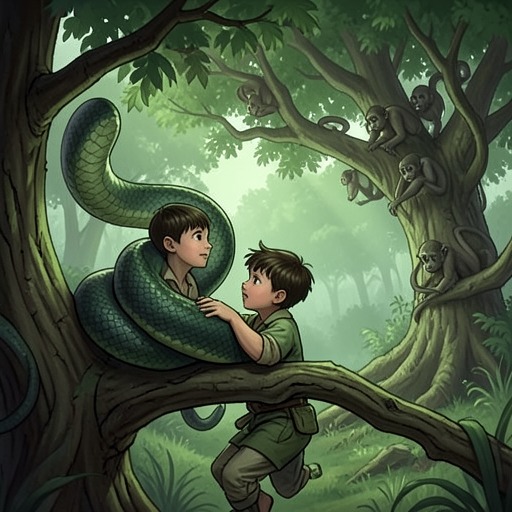
Mowgli and Kaa
The Jungle BookMowgli and Kaa form an alliance in which rescue becomes reciprocity. Kaa is not part of Mowgli’s wolf family or of the hunting tribes that ordinarily surround him, yet he becomes indispensable when the Bandar-log abduct Mowgli. Their relationship joins Kaa’s ancient power and strategic intelligence to Mowgli’s learned courtesy, courage, and ability to move between the worlds of humans and the Jungle People.
Origins in Jungle Knowledge
Baloo turns to Kaa because the Bandar-log fear him more than any other creature. When Mowgli is taken, Baloo recalls that the monkeys, despite living in the trees, are afraid of Kaa because he can climb as they do, steal young monkeys at night, and make his name itself a source of terror. Kaa’s reputation rests on stealth, patience, and physical power: generations of monkeys have heard of the night thief who can resemble a dead branch or rotten stump until he seizes them, and none is said to have survived his embrace.
The appeal to Kaa is therefore not a casual request for assistance but a calculated crossing of tribal boundaries. Bagheera identifies Kaa as outside his own tribe because he is footless and regarded with suspicion, while Baloo emphasizes his age, cunning, and constant hunger. Mowgli’s rescue depends on recognizing that the Jungle’s practical alliances are wider than pack membership. Kaa’s difference is precisely what makes him effective against the Bandar-log.
Mowgli’s place in this alliance has already been prepared by Baloo’s teaching. Before Mowgli’s later expulsion from the Seeonee Wolf Pack and before his revenge on Shere Khan, Baloo teaches him the Law of the Jungle, including the Wood and Water Laws and the proper calls used when hunting beyond one’s own grounds. Mowgli learns how to approach wild bees, warn water-snakes, and ask permission to hunt. That education gives him a language of courtesy recognized beyond the wolf pack, and it later enables him to answer Kaa not as a frightened captive but as a knowledgeable member of the wider Jungle People.
The Alliance at the Cold Lairs
Rann the Kite locates Mowgli among the Bandar-log and reports that the monkeys have carried him beyond the river to their ruined monkey city, the Cold Lairs. He also reports that Mowgli has used the Master Word, allowing the message to reach his allies. Baloo and Bagheera therefore know both where Mowgli is and that the rescue must confront a shifting, disorderly enemy that may remain in the city for an hour, a night, or many nights.
When Kaa reaches the Cold Lairs, the rescue has become a full battle. Baloo fights through the monkeys, while Bagheera is driven into a reservoir and surrounded on the red steps. The noise spreads through the jungle: Mang the Bat carries news of the conflict, Hathi the Wild Elephant responds from afar, and other Monkey-Folk move toward the city. Kaa does not rush blindly into this confusion. He works over the west wall, dislodges a coping stone, and coils and uncoils himself to make certain that his body is ready before striking.
Kaa’s attack changes the battle immediately. His first blow, driven by the force of his thirty-foot body, lands in the heart of the crowd surrounding Baloo. The monkeys recognize him and scatter, terrified by the inherited stories of his stealth and embrace. His hiss then holds the distant monkeys in place, leaving the Cold Lairs suspended between panic and silence. Kaa’s power is not merely physical; the fear attached to his name becomes a weapon that disorganizes the entire enemy host.
Even after the monkeys retreat, Mowgli remains trapped behind marble screen-work. Kaa searches for a discolored crack marking a weak point, tests the distance with light taps, and then smashes the barrier with repeated blows. The broken screen opens a path, and Mowgli leaps through to place himself between Baloo and Bagheera, embracing both wounded rescuers. Kaa’s intervention therefore completes the rescue at the exact point where force alone would not have been enough: he first breaks the monkeys’ assault and then removes the physical barrier keeping Mowgli from his friends.
Reciprocal Debt and Recognition
Once free, Mowgli faces Kaa without surrendering his own dignity. Kaa observes that the man-cub is soft-skinned and could be mistaken for a monkey in the twilight, but Mowgli answers with the Snake’s Call, declaring, "We be one blood, thou and I." The words do more than express gratitude. They place Mowgli and Kaa within a shared moral vocabulary that can cross the boundary between a human child and a great python.
Mowgli then promises that his kill will become Kaa’s kill whenever Kaa is hungry. He does not pretend to be a large hunter: he admits that he kills nothing because he is too little, but says that he can drive goats toward creatures able to use them. The promise is consequently practical rather than ceremonial. Mowgli offers the skills he actually possesses, and he adds that if Kaa is ever caught in a trap, he may repay the debt owed to Kaa, Bagheera, and Baloo.
Baloo approves Mowgli’s courteous answer, recognizing that the rescued child has understood how obligation works in the jungle. Kaa responds by resting his head lightly on Mowgli’s shoulder and praising his combination of courage and courtesy. He predicts that these qualities will carry Mowgli far through the jungle, then urges him to leave quickly with his friends and sleep before the moon sets. The exchange transforms Kaa from a summoned weapon into a respected ally whose relationship with Mowgli is founded on mutual acknowledgment.
A Relationship Beyond Tribe
The alliance develops through contrast. Baloo is Mowgli’s teacher, Bagheera his protective panther companion, and Kaa an outsider whose value comes from precisely not belonging to their tribe. Yet Mowgli addresses all three as brothers and masters after the rescue. Kaa’s acceptance confirms that Mowgli’s education has made him legible across different forms of jungle society: he can speak the language of wolves, honor the codes of hunters, and offer a debt to a serpent.
The relationship also reverses the usual structure of rescue. Kaa saves Mowgli through superior age, size, reputation, and tactical control, but Mowgli refuses to remain merely the object of protection. His offer to supply goats and free Kaa from a trap imagines a future in which the small man-cub can become useful to the powerful python. The alliance is thus not ownership or dependence. It is a continuing exchange in which each partner’s distinct capacity matters.
Kaa’s warning that Mowgli should leave before the moon sets also preserves a boundary within the friendship. Kaa has saved him, but he does not invite him to witness what follows in the Cold Lairs. Mowgli is protected not by being absorbed into Kaa’s world, but by being told when to withdraw from it. Their bond therefore combines intimacy with difference: they are united by blood-language and obligation without becoming the same kind of being.
Narrative Significance
Mowgli and Kaa embody the book’s vision of belonging as something made through conduct rather than guaranteed by origin. Mowgli is a man-cub raised among wolves, and his survival depends on learning the rules that govern many species. Kaa’s rescue makes that principle visible in action: the decisive protector is a creature outside the familiar circle, while the rescued child secures the alliance through memory, courtesy, and a promise to return value.
The episode also gives the phrase "We be one blood, thou and I" a concrete relational force. It is not simply a formula for protection; it becomes a bridge between strangers and a statement that shared obligation can be created in crisis. Kaa’s final judgment—"A brave heart and a courteous tongue"—defines the qualities that make Mowgli trustworthy beyond the wolf pack. Their alliance consequently joins physical rescue to moral initiation, showing Mowgli becoming a figure capable of forming bonds across the Jungle People’s divisions.