Mowgli and Messua
The Jungle BookMowgli and Messua are joined by an adoptive relationship that gives Mowgli his first human home while preserving the emotional and ethical ties he learned in the jungle. Messua cannot prove that he is her lost son Nathoo, but she chooses to receive him as her son; Mowgli, in turn, answers her care with protection when the village turns against him. Their bond therefore becomes a meeting point between two forms of belonging rather than a simple replacement of one family by another.
Recognition and Adoption
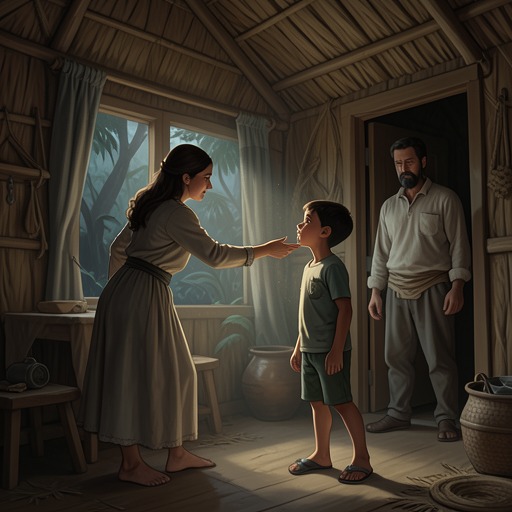
Messua first responds to Mowgli through resemblance and grief. The villagers notice the scars on his arms and legs, interpreting them as wolf bites, while Messua sees in his face the likeness of the boy taken by the tiger. She examines him closely and finds that he is thinner than Nathoo but has the same look. Her recognition is emotionally certain even though it remains factually uncertain: Mowgli does not remember the name Nathoo or the day when she supposedly gave him new shoes, and his feet are hard from a life without human footwear.
The priest turns this uncertainty into a public explanation and a private advantage. Because Messua is married to the richest villager, he declares that what the jungle took, the jungle has restored, and urges her to take the boy into her house while reminding her to honor him. Mowgli experiences the scene as another inspection by a pack, but he also understands that if he is to become a man he must learn the speech of men. Messua's household thus receives him through a mixture of maternal hope, village interpretation, and social opportunism.
Messua's care becomes concrete as soon as Mowgli enters the hut. She gives him milk and bread, lays a hand on his head, and calls him Nathoo, promising that he shall be her son even after his silence shows that he does not know the name. The house contains a bedstead, grain chest, cooking pots, a Hindu image, and a looking glass, all objects unfamiliar to a child raised among the Seeonee Wolf Pack. Mowgli is uneasy beneath a roof and notices that the window has no fastening; yet his anxiety is not a rejection of Messua herself. It is the instinctive caution of someone who has never slept in a human enclosure.
Mowgli Between Two Forms of Family
Messua's home offers affection, but it also requires a new language and a new social identity. Mowgli realizes that his knowledge of the jungle does not make him competent in human society: without man's talk, he feels as helpless as a man would be among the jungle people. He therefore imitates Messua's words and quickly learns the names of many things in the hut. His ability to learn recalls the earlier education given by Baloo, who taught him the Law of the Jungle, the Wood and Water Laws, the speech required around wild bees and water-snakes, and the Strangers' Hunting Call.
The contrast between Messua's household and Mowgli's first family is especially visible at night. He refuses to sleep inside a hut that resembles a panther trap and escapes through the window, choosing clean grass at the edge of the field. Messua's husband advises that Mowgli be allowed to choose, since he has never slept on a bed and will not run away if he has truly been sent as their son. The episode shows that adoption cannot be completed by walls, names, or clothing; Mowgli must be given room to move before he can accept human domestic life.
Messua's maternal claim is also distinct from the wolf pack's kind of kinship. The wolves gave Mowgli a place among their cubs, while Messua supplies human food, shelter, speech, and the possibility of a recovered family history. Neither identity fully erases the other. Even after entering the village, Mowgli remains shaped by jungle knowledge and by the loyalty of Gray Brother, who follows him for twenty miles and warns him that he already smells of wood smoke and cattle. Messua's relationship with him is consequently a fragile bridge: it welcomes the man-cub without making him cease to be a child of the jungle.
Protection and the Village's Reversal
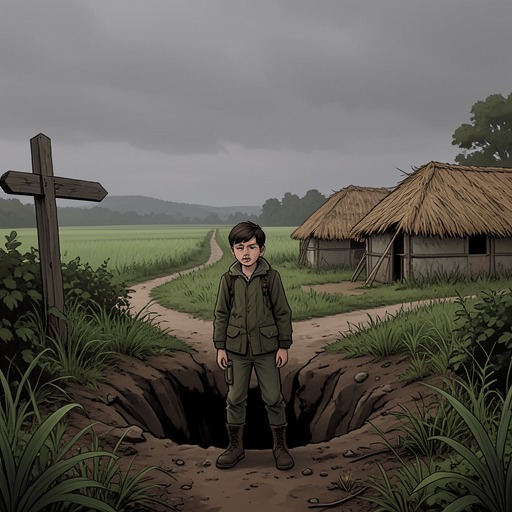
The relationship reaches its clearest moral expression when the village changes from curious acceptance to violent rejection. Messua runs to the herd and calls Mowgli her son while warning him that the villagers accuse him of being a sorcerer who can change into a beast. She does not accept the charge and insists that he has avenged Nathoo's death, but she also understands the immediate danger and tells him to go before the crowd kills him.
Mowgli answers her with both tenderness and distance. After a stone strikes his mouth, he tells Messua to run back and says that he has at least paid for her son's life. He denies that he is a wizard and orders her to leave quickly, because he is about to send the herd through the crowd. His language presents the rescue as repayment rather than as a request for gratitude: Messua once offered him a son’s place, and he now protects the mother whose lost child he believes he has avenged.
The action makes his farewell more than a private separation. Akela brings the herd in, and the buffaloes charge through the gate, scattering the crowd. Mowgli saves Messua not by persuading the villagers but by using the authority and force of the animal world that they fear. The scene reverses the terms of his adoption: the human community disowns him as both wolf and sorcerer, while the jungle identity it condemns becomes the means by which he shields Messua.
Meaning of the Bond
Messua and Mowgli's relationship is defined by recognition without certainty, care without complete assimilation, and loyalty that survives social rejection. Messua's belief that he resembles Nathoo gives Mowgli an opening into human society, but her decision to call him her son matters more than biological proof. She accepts the unknown child because maternal attachment turns resemblance into responsibility.
Mowgli's response is equally complex. He never becomes fully at ease in the hut, and he leaves when human society becomes dangerous, yet he does not abandon Messua to the consequences of his expulsion. His insistence that he has paid for Nathoo's life compresses affection, indebtedness, and justice into one act. The relationship ends not with domestic integration but with a protected farewell: Messua remains the human mother who received him, while Mowgli returns toward the jungle carrying the obligation created by her care.