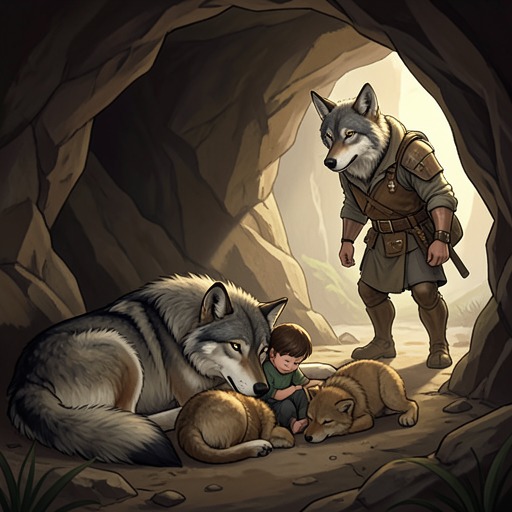
Mowgli and Raksha
The Jungle BookMowgli and Raksha is one of the defining bonds of Mowgli’s life: Raksha, known as Mother Wolf and called “The Demon” as a mark of respect, accepts a naked human child into her litter and makes his survival a matter of her own will. Her protection gives Mowgli his first family, his first place in the jungle, and the earliest form of the loyalty that eventually brings him back to the Council Rock with Shere Khan’s hide.
A Mother’s Claim
Raksha’s relationship with Mowgli begins during a confrontation in the wolf den. Shere Khan’s roar fills the cave, and Raksha springs forward from among her cubs to face the tiger. She does not treat the child as an intruder or a temporary responsibility. Instead, she declares that the man-cub is hers and that he will live to run and hunt with the Pack. Her answer turns a vulnerable foundling into a protected member of a family, while directly challenging Shere Khan’s claim to kill him.
Raksha’s defense is physical, verbal, and territorial at once. Shere Khan may be a dangerous tiger, but Raksha knows that the ground inside the den gives her the advantage, and she is prepared to fight to the death. The tiger withdraws only after recognizing that he cannot safely overcome her there. Her motherhood is therefore established not through sentiment alone but through confrontation: she makes the cave a sanctuary and places her body between Mowgli and the predator who has come to claim him.
Adoption and Belonging
Raksha’s decision is rooted in what she sees in the child. Mowgli has arrived naked, alone, and hungry, yet he is not afraid; he has already pushed one of her own cubs aside. To Raksha, these details are evidence of vitality rather than grounds for rejection. She names him Mowgli, “the Frog,” a name that acknowledges his human nakedness while incorporating him into the language of the wolf family.
Her reasoning also includes the danger that Shere Khan has brought upon the whole den. If the tiger killed the child and escaped toward the Waingunga, the villagers might search the wolves’ lairs in revenge. Raksha nevertheless does not present Mowgli merely as a liability or a political problem. She insists that he is hers. The coming inspection by the Pack Council will determine whether the wolves recognize the cubs, but Raksha’s personal decision comes first: before the Pack can judge Mowgli, she has already accepted him as a son.
This acceptance exists within the Law of the Jungle rather than outside it. Wolf cubs must be brought before the Pack Council when they are old enough to stand, after which they may run freely under the Pack’s protection. Raksha’s maternal act therefore creates the possibility of public belonging. She does not simply hide Mowgli from the wolves; she prepares to place him before the society whose rules will determine his safety.
Love, Prophecy, and Separation
Raksha’s attachment to Mowgli becomes explicit when he is about to leave for the human settlement. She calls him her little naked son and says that she has loved him more than she has loved her own cubs. The statement makes the relationship reciprocal in emotional force even though Mowgli’s human origin remains visible. Raksha does not erase the difference between them; she transforms that difference into an adopted kinship stronger than biological boundaries.
Her love is also prophetic. On the night she first confronts Shere Khan, Raksha predicts that the helpless “little frog” will one day hunt the tiger who has hunted him. Mowgli later repeats the promise in his own voice, telling her that he will return with Shere Khan’s hide and lay it upon the Council Rock. Their bond thus carries a shared narrative line from rescue to reckoning. Raksha names the future before Mowgli can imagine it fully, and Mowgli preserves that future as an obligation to her and to the jungle family that raised him.
When Mowgli descends the hillside alone to meet human society, the separation is painful but not presented as a repudiation. He promises that he will return, while Raksha asks him to come soon because she and Father Wolf are old. The farewell reveals the cost of the identity Raksha has helped create: Mowgli belongs to the wolves, yet his path leads toward men. Their relationship endures through this divided belonging rather than resolving it.
Return with Shere Khan’s Hide
Mowgli’s return to the Council Rock makes Raksha’s first prophecy visible. After being cast out from the Man-Pack, he comes back with two wolves and the skin of Shere Khan, keeping the word he gave in Raksha’s cave. The scene begins at Mother Wolf’s cave, where Raksha walks out stiffly with the cubs behind her and her eyes glow when she sees the hide. Her response is recognition before celebration: she understands that the hunted has become the hunter, exactly as she once foretold.
Raksha calls the achievement well done and recalls the day when Shere Khan forced his head and shoulders into the cave while hunting Mowgli’s life. The memory binds the present victory to the original act of protection. Mowgli’s triumph is not an isolated feat of courage; it completes a promise made between mother and son at the beginning of his life in the jungle.
The return also restores Mowgli to the symbolic center of the wolf community. At the Council Rock, he spreads Shere Khan’s skin over the flat stone where Akela used to sit and fixes it down with four slivers of bamboo. Akela then gives the old call for the wolves to look well. Raksha’s defense has led to Mowgli’s recognition not merely as a tolerated outsider but as someone whose history, loyalty, and action are inscribed in the Pack’s central place.
Narrative Significance
Raksha’s motherhood gives the jungle alternative grounds for kinship. Mowgli is human by birth, but Raksha’s protection, naming, teaching environment, and emotional claim make him a wolf-family child in practice. The relationship challenges the assumption that family must follow species or bloodline, while the Law of the Jungle supplies a social structure capable of recognizing an adopted child.
The bond also establishes a pattern that recurs in Mowgli’s life: separation does not cancel belonging when a promise and a remembered act continue to connect the separated members. Raksha sends him toward the human world without withdrawing her love, and Mowgli returns without abandoning the human kindness he has encountered elsewhere. His return with Shere Khan’s hide therefore carries two meanings at once: it fulfills a son’s promise to his mother, and it proves that the identity Raksha protected can survive exile, conflict, and movement between human and wolf societies.