Mowgli and the Bandar-log
The Jungle BookMowgli and the Bandar-log embody the opposition between a learned place within the Jungle and a restless society that imitates community without sustaining one. The Bandar-log first entice Mowgli by calling him their blood brother and promising that he may become their leader, but they soon seize him for his practical skill and carry him to the Cold Lairs. His captivity reveals the difference between their noisy claims of freedom and the ordered knowledge that has made him capable of surviving among the Jungle People.
First Contact and the Forbidden Association
Baloo confronts Mowgli after learning that the boy has spoken with the Bandar-log. To Baloo, this is a grave breach of the Jungle’s social boundaries: the monkeys are the tree-dwelling people without law, leaders, or a stable speech of their own. They borrow words from others, boast of future greatness, and forget their purposes almost as soon as they announce them. Bagheera reinforces the warning by calling their promises lies, while Mowgli remembers only the immediate kindness that drew him toward them.
Mowgli’s attraction is therefore grounded in a real emotional contrast. After Baloo hurt his head, the monkeys offered him nuts and pleasant food, carried him through the trees, and told him that he was their blood brother except for his missing tail. They also suggested that he would one day lead them. Their invitation appeals to his loneliness and to his similarity to them as a creature who can stand upright, yet it has no dependable structure behind it. The Bandar-log’s friendliness is less a bond than a performance designed to secure attention.
Baloo’s teaching makes the danger legible. Mowgli has been learning the Law of the Jungle, including the Wood and Water Laws, the Strangers’ Hunting Call, and the practical rules that allow different peoples to move through one another’s territories without needless conflict. The monkeys have no equivalent law or call. Their separation from the other Jungle People is not merely a difference of habitat; it is a refusal of the reciprocal discipline by which the rest of the Jungle recognizes limits, obligations, and shared danger.
From Play to Abduction
The Bandar-log initially claim no serious purpose, but their scattered impulses suddenly gather around Mowgli. One monkey decides that the boy should be kept in the tribe because he can weave sticks together into protection from wind. Mowgli possesses this ability almost instinctively, having made small shelters from fallen branches as a woodcutter’s child. The monkeys transform an innocent skill into a pretext for possession, imagining that his usefulness will finally give them a leader and make them the wisest people in the Jungle.
They follow Baloo, Bagheera, and Mowgli until midday, when Mowgli sleeps between the Bear and the Panther, ashamed of his association with them and resolved to abandon it. The decision does not protect him. The next thing he remembers is the Bandar-log’s hard hands gripping his arms and legs, branches sweeping across his face, and the ground dropping away beneath him. Two strong monkeys carry him along their elevated roads, swinging from tree to tree in leaps of roughly twenty feet. The speed exhilarates him even as the height, sudden checks, and cracking branches frighten him; the physical excitement of the journey cannot change the fact that he is a prisoner.
The abduction exposes the monkeys’ characteristic mixture of spectacle and opportunism. They shout that Bagheera has noticed them and that the Jungle People will admire their cunning, treating the rescue attempt itself as proof of their importance. Their tree-roads, running fifty to a hundred feet above the ground, give them a temporary advantage that the ground-dwelling animals cannot easily overcome. Yet the same movement is directionless: they can carry Mowgli swiftly, but they have no coherent purpose beyond keeping him and being seen doing so.
The Cold Lairs and the Failure of Monkey Society
The Cold Lairs are a ruined city on a hill, with broken gates, roofless houses, collapsed battlements, abandoned wells, damaged temples, and a palace whose courtyards and fountains have been split by grass and young trees. The Bandar-log call the ruins their city and despise the Jungle People for living in the forest, although they do not understand what the buildings were made for or how to use them. Their occupation is thus an imitation of civilization without memory: they sit in the former council chamber pretending to be men, gather plaster and bricks only to forget where they have hidden them, muddy the tanks, and turn every shared resource into an occasion for quarrelling.
Mowgli, trained by Baloo, cannot settle into this life. The monkeys drag him into the ruins late in the afternoon, dance instead of resting, and make a speech about his capture as though it were a turning point in their history. They ask him to weave creepers and sticks against rain and cold, but their interest collapses within minutes into tail-pulling, jumping, and coughing. When Mowgli asks for food and invokes the Strangers’ Hunting Call, twenty or thirty monkeys leave to bring nuts and wild pawpaws; they fight on the way and return without enough food to satisfy him. No one answers his call, and his hunger confirms what Baloo had taught him: among the Bandar-log there is neither law nor organized hospitality.
Mowgli concludes that his captivity is partly the consequence of his own error. He would rather face Baloo’s punishment than continue chasing the monkeys’ foolish diversions, and he tries to return to the jungle. The Bandar-log pull him back, pinch him, and insist that he does not understand how happy he is. Their claim of freedom therefore contains coercion. They demand that Mowgli accept their version of happiness while denying him the ability to leave.
The monkeys then gather by the hundreds to praise themselves before him. They call themselves great, free, wonderful, wise, strong, and gentle, repeating their own assertions until repetition becomes their only evidence. Mowgli is valuable not only because he can weave but because he can carry their words back to the Jungle People. Their society depends on an audience: they want recognition from those whose attention they officially scorn. The ruined city becomes an image of that society, a place filled with structures whose purposes have been forgotten and inhabited by creatures who confuse imitation with achievement.
Rescue and the Reversal of Power
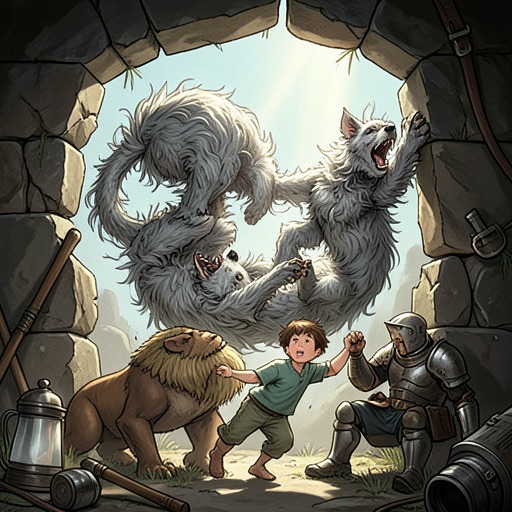
Bagheera and Baloo pursue the abductors to the Cold Lairs, while Kaa approaches from the west wall. Bagheera reaches the terrace during a clouded moon and strikes among the monkeys rather than wasting time biting. The Bandar-log surround him, drag Mowgli toward the broken summer-house, and push him through the hole in its dome. Mowgli survives the fifteen-foot fall because Baloo has taught him how to land, turning his education into an immediate physical advantage even inside the monkeys’ territory.
The rescue becomes a three-way test of strength. Bagheera is overwhelmed by the monkeys’ numbers and falls into a tank, while Baloo is nearly smothered beneath them at the edge of the terrace. In desperation Bagheera gives Kaa’s protection call, “We be of one blood, ye and I,” believing that the snake may have abandoned them. Kaa has not withdrawn. He reaches the wall, gathers his strength, and attacks with the driving blow of his head backed by the weight of his thirty-foot body.
Kaa’s arrival reverses the Bandar-log’s numerical advantage. His first silent strike breaks the crowd around Baloo, and the monkeys scatter at the sound of his name. Their fear has been preserved through generations of stories about Kaa, the night thief who can move like a moss-covered branch and seize the strongest monkey alive. The Bandar-log’s loud self-advertisement collapses before a power they cannot imitate or absorb into their speeches. Kaa’s command then stills even the distant monkeys hurrying to defend the ruins, while Mowgli watches from the summer-house and mocks them with an owl-like hoot.
Consequences and Significance
The immediate consequence is the recovery of Mowgli, but the deeper consequence is renewed recognition of his true affiliations. He does not return from the Cold Lairs with a new social identity; he returns with a sharper understanding of why Baloo’s law, Bagheera’s protection, and Kaa’s alliance matter. When Mowgli leads Baloo and Bagheera away through a gap in the walls, the escape marks the end of the monkeys’ claim over him. Baloo’s fear of ever again making Kaa an ally and Bagheera’s admission that he might have walked down the snake’s throat also show that the rescue has changed the rescuers’ estimate of Kaa’s power.
The relationship between Mowgli and the Bandar-log is therefore not a simple contest between forest and city, or between animal instinct and human skill. It is a conflict over what constitutes a people. The Bandar-log have numbers, speed, voices, and a theatrical desire to be acknowledged, but they lack continuity, memory, law, and reciprocal responsibility. Mowgli’s dangerous curiosity allows him to experience their attractions from within, yet his hunger, isolation, and attempted escape teach him that resemblance is not belonging. The episode’s final movement restores him to the Jungle not by erasing the temptation of the monkeys, but by demonstrating that freedom without discipline can become captivity, while knowledge shared through law can make escape possible.