Mowgli skins Shere Khan and claims the tiger's hide
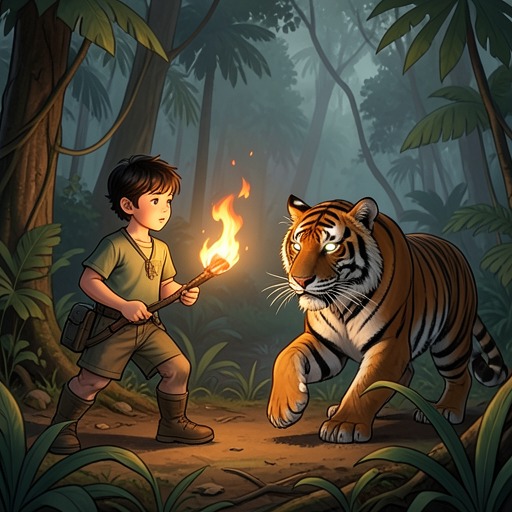
The Jungle BookMowgli skins Shere Khan and claims the tiger's hide as the material proof that he has fulfilled his promise to the wolves. The act follows Shere Khan's death beneath the buffalo herd, but it is more than the disposal of a carcass: by taking the hide to Council Rock, Mowgli converts the tiger's defeat into a public answer to the threat that had shaped his life and into a renewed claim upon the jungle community that once adopted him.
The Death That Makes the Claim Possible
Shere Khan has already been killed when Mowgli reaches the body. Akela and Gray Brother have helped drive the buffaloes, while Mowgli turns Rama and the herd toward the wallows; the tiger receives no further trampling because he is dead, and kites are already approaching. Mowgli nevertheless treats the death as unfinished business. He calls it a dog's death, observes that Shere Khan would never have shown fight, and immediately feels for the knife that he now carries in a sheath around his neck while living among men.
The knife matters because it joins Mowgli's two worlds. He has been raised in the jungle, yet his current life with men has given him a human tool that becomes essential to the recovery of an animal hide. His purpose is practical and ceremonial at once: the hide will look well on Council Rock, where it can be seen by the wolves and associated with the promise he made. The tiger's body is therefore transformed into evidence, a trophy, and an object of collective memory.
The Labor of Skinning the Tiger
Mowgli undertakes work that a boy trained among men would not have imagined doing alone. His knowledge of how an animal's skin is fitted and removed comes from his intimate understanding of animals rather than from human instruction. Even with that knowledge, the task is physically punishing. He slashes, tears, and grunts for an hour, while the wolves lie with their tongues out or come forward to tug at the hide when he orders them.
The scene makes the victory deliberately unglamorous. Shere Khan's defeat may be celebrated as a triumph, but claiming the tiger's hide requires sustained bodily effort, patience, and command. Mowgli's authority is visible in the way the wolves assist him, and the pack's participation begins to restore the social bond that had been threatened by its earlier hostility. The hide is not acquired by magic or ceremony alone; it is won through work performed over the dead tiger's body.
Buldeo interrupts the work carrying a Tower musket. The village children have reported the buffalo stampede, and Buldeo has come angrily to correct Mowgli for failing to guard the herd. He immediately treats the carcass as property that can be converted into money, noting the hundred-rupee reward for the lame tiger and proposing that Mowgli might receive one rupee after the hide is taken to Khanhiwara. When Buldeo bends to singe Shere Khan's whiskers, following the hunters' belief that this prevents the tiger's ghost from haunting them, he attempts to impose both economic ownership and ritual control on the dead animal.
Mowgli refuses that arrangement. While ripping back the skin of a forepaw, he makes clear that he needs the hide for his own use and orders Buldeo to take away the fire. The exchange places two claims against each other: Buldeo's claim rests on village hunting custom and reward, whereas Mowgli's rests on the promise, knowledge, and danger that bind him to Shere Khan. When Buldeo continues to resist, Mowgli tells him to leave and warns him not to meddle with his game again. Akela is present as the authority who can let the frightened man go, and Buldeo retreats toward the village, looking back in fear and later describing the encounter as magic, enchantment, and sorcery.
From Carcass to Proof
Mowgli and the wolves do not finish until nearly twilight. The great, brightly patterned skin must be drawn clear of the body before it can be hidden and carried away, and Mowgli then turns to the practical problem of herding the buffaloes home with Akela's help. The hide's size and weight reinforce the scale of the undertaking: it is not a token snatched from a fallen enemy but the complete remnant of a ten-foot tiger, painstakingly recovered in the open country.
The return to the village turns the private labor into a public crisis. Lights, temple conches, and bells surround the gate, and Mowgli first assumes that the villagers are waiting because he has killed Shere Khan. Instead, stones fly around his ears while the crowd calls him a sorcerer, a wolf's brat, and a jungle demon. Buldeo is urged to shoot, and the villagers claim that the priest must turn Mowgli into a wolf again. The tiger's hide, which should have certified Mowgli's protection of the human settlement, cannot overcome the villagers' fear of his mixed identity.
Mowgli chooses not to retaliate against the village. He leaves with Akela and the hide, explicitly remembering that Messua has been kind to him. Under the rising moon, he crosses the plain at a steady wolf's trot with two wolves at his heels and the bundle on his head. The villagers answer his departure with louder bells and conches; Messua cries, while Buldeo enlarges his account of the jungle until it includes the claim that Akela stood on his hind legs and spoke like a man. Their reaction converts Mowgli's achievement into a story of superstition, while his own conduct remains controlled and deliberate.
The Hide at Council Rock
Near dawn, Mowgli and the two wolves reach the hill of the Council Rock and stop at Mother Wolf's cave. He announces that the Man-Pack has cast him out, but that he has returned with Shere Khan's hide to keep his word. The statement gives the act its ethical center. The hide is not merely a possession rescued from Buldeo; it is the physical form of a promise kept despite expulsion by humans and earlier rejection by wolves.
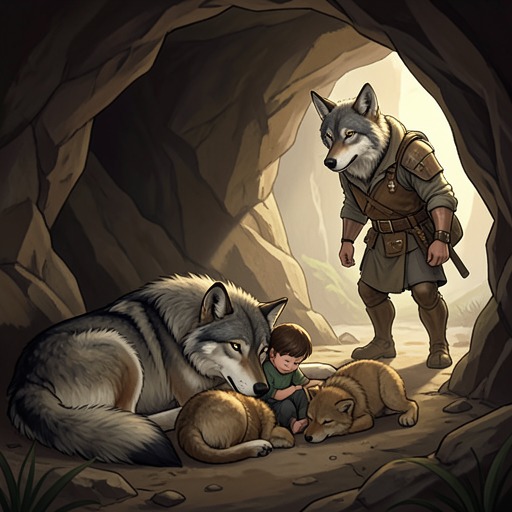
Mother Wolf comes from the cave with the cubs behind her, and her eyes glow when she sees the skin. She recalls the day Shere Khan forced his head and shoulders into the cave while hunting Mowgli's life, and interprets the reversal as the fulfillment of an old prediction: the hunter has become the hunted. Her approval places Mowgli's victory within the long history of the family and makes the tiger's hide a confirmation of Raksha's protective faith in him.
Bagheera then emerges from the thicket and tells Mowgli that the jungle has been lonely without him. Together they climb Council Rock. Mowgli spreads the hide over the flat stone where Akela once sat and pegs it down with four slivers of bamboo. Akela lies upon it and gives the old Council call, "Look—look well, O Wolves," repeating the summons used when Mowgli was first brought before the pack. The repeated call creates a formal circle between beginning and aftermath: the child once presented for judgment returns as the agent who has restored the pack's central memory.
Victory, Exile, and Narrative Meaning
Since Akela's deposition, the pack has lacked a leader and has hunted and fought at its own pleasure. Its surviving members answer Akela's call by habit, but their condition reveals the cost of that disorder: some are lame from traps, some limp from shot wounds, some are mangy from bad food, and many are missing. Against this damaged gathering, Shere Khan's striped hide appears as a stark sign of what Mowgli has accomplished and what the wolves have lost. The skin does not magically repair the pack, but it gives their scattered remnants a common object and a shared account of justice.
Mowgli responds by making up a song and shouting it while leaping across the rattling hide and beating time with his heels. Gray Brother and Akela howl between the verses, and Mowgli asks whether he has kept his word. The wolves answer yes. His song turns the hide from a hunting trophy into oral history: the deed is no longer known only through the dead tiger or the frightened villagers' report, but is remembered through Mowgli's own performance before the pack.
The achievement is consequently double-edged. Mowgli has defeated Shere Khan, preserved the hide for Council Rock, and received recognition from Mother Wolf, Bagheera, Akela, and the surviving wolves. Yet the same act confirms that he belongs nowhere simply. The Man-Pack expels him as a sorcerer, while the wolf community receives him through a ceremony that also recalls his first admission and the pack's decline. His return with the hide is therefore a victory without ordinary reintegration: he keeps faith with the wolves, refuses violence against the village that rejected him, and carries the visible mark of a life formed between human and animal worlds.