Mowgli's adoption into the Seeonee Wolf Pack
The Jungle BookMowgli's adoption into the Seeonee Wolf Pack is the decisive scene in which a naked human child is transformed from a threatened outsider into a protected member of the wolf community. At Council Rock, the Pack does not simply pity Mowgli or overlook his difference: it subjects him to a formal process of inspection, advocacy, payment, and acceptance. The event establishes that belonging in the jungle can be made through law and chosen obligation rather than blood alone, while also planting the conflict that will later return when the Pack's protection weakens and Shere Khan renews his demand for the boy.
Council Rock and the Law of Admission
Father Wolf brings Mowgli, Mother Wolf, and the wolf cubs to the Pack Meeting at Council Rock, a hilltop of stones and boulders where a hundred wolves could hide. Akela, the great gray Lone Wolf, presides over more than forty wolves of different ages and abilities. The meeting is held under a clearly defined rule: when cubs are old enough to stand, they must be shown to the Pack Council, generally at the full moon, so that the wolves can identify them. After inspection, recognized cubs may run freely, and a grown wolf who kills one before it has taken its first buck is subject to death.
The ceremony makes recognition a public act rather than a private decision by the parents. The cubs tumble in the center of the circle while senior wolves examine them silently, and mothers sometimes push their young into the moonlight so that none is overlooked. Akela repeatedly calls on the Pack to look well. Mowgli, called “Mowgli the Frog,” is pushed into this same circle, laughing and playing with pebbles that glitter in the moonlight. His indifference contrasts with the gravity of the wolves' judgment: while he plays, the Pack is deciding whether the law can contain a being who is not of wolf blood.
The question is sharpened by Shere Khan, who roars from behind the rocks that the cub belongs to him and asks what the Free People have to do with a man's cub. The Pack answers that Shere Khan has no authority over its decision. Yet the Law of the Jungle requires more than defiance. If the right of a cub to be accepted is disputed, at least two members who are neither father nor mother must speak for him. When Akela asks who will do so, there is initially no answer, and Mother Wolf prepares for the fight she believes may be unavoidable.
Baloo's Testimony and Bagheera's Price
Baloo supplies the first independent defense. As the only other creature permitted to attend the Pack Council, he has standing within the assembly because he teaches the wolf cubs the Law of the Jungle. He is a brown bear who eats nuts, roots, and honey, and therefore moves among the wolves without competing with them as a meat-eater. Baloo admits that he has no gift for eloquence, but his position as teacher gives his plain statement institutional weight: Mowgli is not harmful, should run with the Pack, and can be entered among the cubs; Baloo himself will teach him.
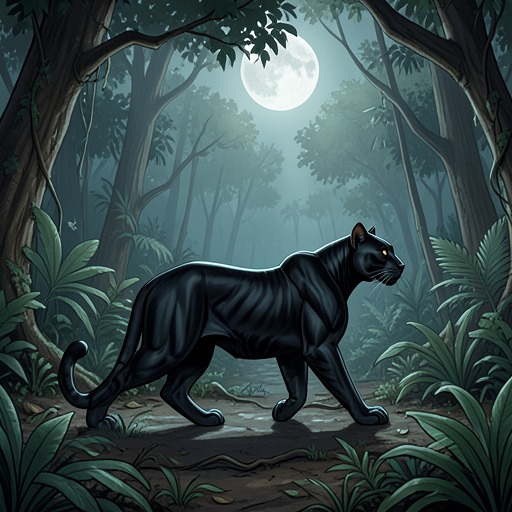
Akela nevertheless requires a second speaker. Bagheera then drops into the circle as a black shadow. Although he has no ordinary right to speak at the Council, he knows the law well enough to identify an exception: when there is a non-lethal doubt about a new cub, the cub's life may be bought at a price, and the law does not restrict who may pay it. His argument turns the question from whether Mowgli resembles the wolves to whether the Pack's own rules permit his admission.
Bagheera makes the price concrete. He offers a fat, newly killed bull lying less than half a mile away in exchange for accepting the man's cub according to the Law. The offer changes the atmosphere immediately. The hungry young wolves accept the legal logic as readily as the meat, and voices argue that a naked “frog” will probably die in the winter rains or scorch in the sun. The bull functions both as payment and as proof that Mowgli's admission need not threaten the Pack's resources. Akela calls the wolves to look well, and the inspection is completed; the wolves then descend the hill for the dead bull.
The final decision therefore combines two kinds of authority. Baloo gives Mowgli a voice within the Pack's moral and educational order, while Bagheera invokes a procedural right and pays the material price required to settle the dispute. The adoption is not presented as an erasure of Mowgli's human origin. It is a lawful incorporation of difference, achieved because the community's rules are flexible enough to recognize a life that blood descent alone would exclude.
Formal Adoption and Life Within the Pack
Akela tells Father Wolf to take Mowgli away and train him as one of the Free People. The narrative states that this is how Mowgli is entered into the Seeonee Wolf Pack: for the price of a bull and on Baloo's good word. The wording gives the event the character of a legal transaction, but the transaction is not merely commercial. The bull satisfies the immediate condition of the law; Baloo's testimony supplies the trust, instruction, and continuing responsibility that make membership sustainable.
The adoption governs the next ten or eleven years of Mowgli's life. Father Wolf teaches him the practical business of the jungle and the meanings carried by its sounds: rustling grass, warm night air, owls, bats, and fish breaking the surface of pools become intelligible signs. Mowgli grows up among wolf cubs who mature into wolves before he is fully grown, creating an unusual family chronology in which his human body develops inside a wolf society.
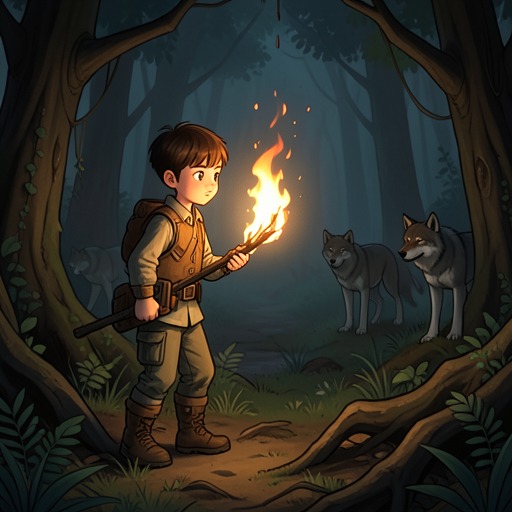
Baloo and Bagheera extend the education begun at Council Rock. Baloo teaches the Law, while Bagheera teaches Mowgli to climb for honey and move through branches. At first Mowgli clings to the trees like a sloth; later he flings himself through the branches almost as boldly as a gray ape. He attends the Council Rock meetings, discovers that a hard stare can make a wolf drop its eyes, and uses that power for amusement. He also removes thorns from the pads of his wolf companions, a small service that makes his place in the Pack practical and reciprocal rather than symbolic alone.
The adoption also creates a border between Mowgli's two possible worlds. He sometimes visits the cultivated lands at night and watches villagers in their huts, but Bagheera has shown him a concealed drop-gate trap, giving him a reason to mistrust men. Thus his wolf identity is made through habits, knowledge, care, and shared law, even as his human origin remains visible to the Pack and dangerous to Shere Khan.
The Adoption's Later Crisis
The acceptance at Council Rock does not permanently settle Mowgli's status. Years later, after Akela misses his kill and becomes the “Dead Wolf,” Shere Khan and allied wolves reopen the question of whether a human can belong among the Free People. Akela declares that Mowgli is the Pack's brother in all but blood and reminds the wolves that he was spoken for and bought into the Pack according to the Law of the Jungle. This appeal shows that the adoption remains the strongest legal defense available to him, even after the political balance of the Pack has changed.
The crisis also exposes the fragility of communal protection when leadership declines. Akela has led the Pack for twelve seasons without allowing a wolf to be trapped or maimed, but his missed kill gives the wolves a formal reason to challenge him. Shere Khan uses that moment to convert an old dispute over Mowgli into a demand for domination, declaring that the man-cub has troubled the jungle for ten seasons and should be surrendered. More than half the Pack begins to gather around the tiger, treating Mowgli's humanity as grounds for expulsion despite the earlier lawful acceptance.
The adoption's value shifts in this later scene from secure belonging to contested legitimacy. It proves that the Pack once recognized Mowgli, but it cannot by itself restrain wolves who have abandoned the honor of the Pack. The event therefore carries a double significance: it is both a genuine founding of kinship and the legal precedent against which Mowgli's later rejection is measured. His membership was never imaginary; its collapse is a political betrayal of a decision the Pack itself once made under its own law.
Narrative Significance
Mowgli's adoption establishes one of the central imaginative structures of the jungle stories: human and animal identities are not sealed compartments, and social belonging can be learned, performed, defended, and withdrawn. Mowgli is accepted by a community that recognizes his difference without requiring him to become a wolf by birth. His education makes him a hybrid figure, formed by human origin and wolf custom, by Baloo's law and Bagheera's protection, and by the material life of the jungle.
The scene also contrasts the Pack's internal law with other systems of power. The Law of the Jungle forbids most animals to kill Man because man-killing brings armed white men on elephants, guns, gongs, rockets, and torches into the jungle, causing suffering for everyone; it also treats the killing of a defenseless human as unsportsmanlike and says that man-eaters become mangy and lose their teeth. Against this practical and ethical code, Shere Khan represents appetite, grievance, and coercion. The adoption succeeds because the Pack initially acts through procedure rather than through the tiger's personal claim.
Its deepest consequence is that Mowgli's later life cannot be understood as a simple movement from wilderness to humanity. He first becomes a member of the Seeonee Wolf Pack through one of the jungle's most formal communal acts, spends his childhood learning its language and duties, and only later faces the demand that he return to the human world. The bull, Baloo's word, the full-moon inspection, and Akela's call to look well are therefore not incidental details. Together they define the terms of Mowgli's first home and make his eventual separation a loss of recognized kinship rather than the end of an accidental refuge.