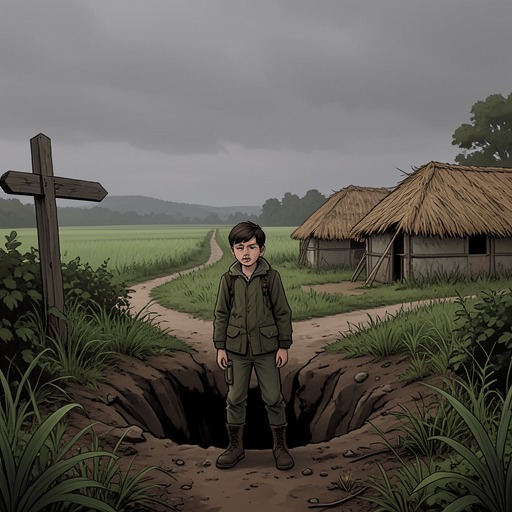
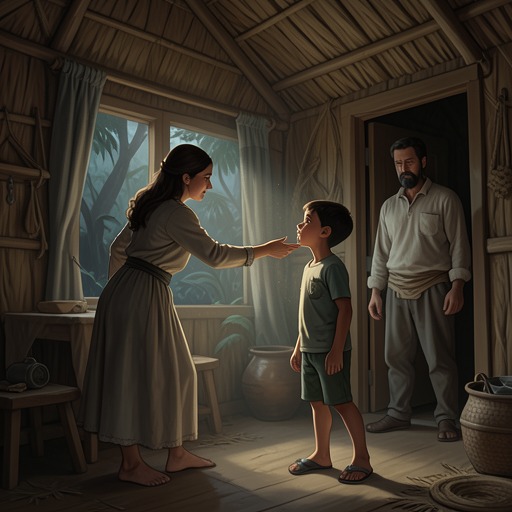
Mowgli's expulsion from the village
The Jungle BookMowgli's expulsion from the village is the decisive rupture that ends his attempted return to human society. Having completed the work of killing Shere Khan and removing the tiger's great skin, Mowgli returns with the buffalo herd expecting that the villagers will understand his victory. Instead, the village turns his unfamiliar strength and jungle knowledge into evidence of witchcraft. Driven out as both a wolf and a man, he refuses to answer superstition with slaughter, remembers Messua's kindness, and chooses the wolves and the jungle once more.
Causes and Background
The expulsion follows Mowgli's difficult passage between two societies. Before this return, Baloo had taught him the Law of the Jungle in full, not merely the hunting verse required by young wolves. Mowgli learned the Wood and Water Laws, the manners required around wild bees and water-snakes, and the Strangers' Hunting Call, which asks permission to hunt outside one's own grounds. This education gave him a precise knowledge of the jungle, but it did not teach him the human distinctions that governed the village. He did not understand caste, and when he hauled a potter's donkey from a clay pit and helped stack the pots, his conduct shocked the villagers.
The village itself was organized around storytelling as much as around practical authority. At the platform beneath the great fig tree, the head-man, watchman, barber, and Buldeo met with their huqas and exchanged tales while a cobra received its nightly platter of milk because it was sacred. Buldeo, the village hunter, carried a Tower musket and presented himself as an authority on the jungle. Mowgli knew that many of the stories were false, including Buldeo's claim that the lame tiger who had carried away Messua's son was inhabited by the ghost of the money-lender Purun Dass. Mowgli's open contempt for such explanations exposed the gulf between direct knowledge and communal superstition.
His killing of Shere Khan made that gulf more dangerous. Mowgli had worked with the buffaloes and the wolves until the great tiger's skin was drawn clear of the body. The act avenged Nathoo, Messua's son, but it also placed Mowgli in the position of someone who had accomplished what the villagers feared and could not explain. When the herd approached the settlement at twilight, Mowgli assumed the waiting crowd had gathered to honor him. The welcome instead became a collective accusation.
What Happens at the Village Gate
As Mowgli and the wolves brought the herd toward the village, lights appeared and temple conches and bells sounded. The apparent ceremony abruptly became an assault: stones flew around him while the villagers shouted that he was a sorcerer, a wolf's brat, and a jungle demon. They ordered him to leave and called on the priest to turn him back into a wolf. Buldeo was urged to shoot, and when the old Tower musket fired, the bullet struck a young buffalo rather than Mowgli. The villagers interpreted even this mistake as further sorcery, claiming that Mowgli could turn bullets aside.
Mowgli's bewilderment is central to the scene. He has just returned from a real danger and a completed act of vengeance, yet the human crowd treats him as an imaginary monster. Akela observes that the villagers are not unlike the Pack and suggests that, if bullets mean anything, they would cast Mowgli out. The comparison gives the rejection a grim symmetry: the wolf society and the human society both claim the authority to decide where Mowgli belongs, and each can expel him when his nature no longer fits its expectations.
The priest intensifies the contradiction by waving a sprig of sacred tulsi and shouting, "Wolf! Wolf's cub! Go away!" Mowgli answers that the previous rejection had been because he was a man and that this time it is because he is a wolf. The two accusations cancel each other while revealing the same fear. To the villagers, Mowgli is dangerous precisely because he crosses the boundary between human and animal without accepting the meanings that the village assigns to either category.
Messua breaks through the crowd and runs toward the herd. She calls Mowgli her son and tells him that the villagers say he is a sorcerer who can become a beast at will. Although she does not believe the charge, she warns him to go before they kill him. She also states that she knows he avenged Nathoo's death. Her testimony does not persuade the crowd; instead, the villagers threaten to stone her as well. Her intervention makes the expulsion a painful separation rather than a simple flight from enemies, because Mowgli is forced to leave the one human who has recognized both his action and his worth.
Departure and Restraint
A stone strikes Mowgli in the mouth, and he responds with a short, ugly laugh rather than an appeal for mercy. He tells Messua to run back, dismisses the accusations as one of the foolish tales told beneath the fig tree at dusk, and says that he has at least paid for her son's life. He denies being a wizard and bids her farewell. The denial is less an attempt to win the villagers than a final refusal to accept their vocabulary: he will not allow their superstition to define the act he carried out.
Mowgli then orders Akela to bring the herd into the village. The buffaloes charge through the gate like a whirlwind, scattering the crowd. The movement reverses the balance of power without becoming a massacre. Mowgli tells the villagers to keep count, since they may suspect him of having stolen one of the buffaloes, and announces that he will herd for them no more. His scorn exposes the pettiness of the human accusations, while the herd's force demonstrates that the villagers cannot safely control the situation they have created.
He also declares that the village should thank Messua because he does not enter with his wolves and hunt the people through their streets. This restraint is the moral hinge of the event. Mowgli has the means to retaliate, and the villagers have treated him as a demon, yet he distinguishes them from Messua and refuses to punish the whole community for its fear. His departure is therefore neither surrender nor forgiveness in a simple sense. It is a controlled withdrawal that preserves Messua's life and leaves the villagers responsible for the violence of their own belief.
Consequences and Aftermath
Mowgli turns away with Akela, and the narrative places his emotional release under the open stars. He feels happy at the prospect of no longer sleeping in human traps and proposes that they recover Shere Khan's skin and go away. The return to the jungle is not presented as a defeat in the ordinary sense. The village has failed to incorporate him, but the expulsion removes the daily compromises that had made him live under human suspicion.
The moon rises over the plain as Mowgli crosses it with two wolves at his heels and the bundle on his head. His steady wolf's trot carries him toward the hill of the Council Rock, where he and the wolves arrive before dawn and stop at Mother Wolf's cave. The destination restores a line of belonging that the village rejected. Yet it does not erase the human connection: Messua's kindness remains the reason Mowgli does not turn the wolves against the settlement.
Back in the village, fear continues to manufacture its own evidence. Temple bells and conches sound louder, Messua cries, and Buldeo enlarges his account until he claims that Akela stood on his hind legs and talked like a man. The villagers' final version transforms the event into another impossible tale, just as Buldeo had transformed Shere Khan into a ghost-tiger. Mowgli's actual strength, his mercy, and his departure disappear beneath the legend produced by those who witnessed them.
Narrative Significance
The event completes Mowgli's rejection by the human community while clarifying that his identity cannot be reduced to either side of the human-animal divide. In the jungle he is a man-cub who must learn rules made for beasts; in the village he is treated as an animal because he knows the jungle too well. The two societies differ in their customs, but both respond to an unsettling outsider by judging him collectively and casting him out.
The episode also reverses the usual pattern of a return. Mowgli approaches the village carrying the result of a service performed for a human family, but the community cannot recognize the service because it interprets unfamiliar knowledge through ghost stories, caste assumptions, sacred signs, and fear of sorcery. His attempted integration therefore ends not with acceptance but with a return to the world whose laws he actually understands.
At the same time, the expulsion establishes Mowgli's ethical independence. He does not remain because the villagers approve of him, nor does he destroy them because they reject him. He leaves with Shere Khan's skin still to claim, Akela beside him, and Messua's kindness preserved as a limit on revenge. The decisive consequence is not merely that Mowgli is driven from the village; it is that he chooses what kind of exile he will become, carrying the jungle's discipline and the memory of human goodness back to the wolves.