Mowgli's expulsion from the wolf pack
The Jungle BookMowgli's expulsion from the wolf pack is the turning point at which an adopted child of the Seeonee Wolves is forced to choose humanity without ceasing to belong emotionally to the jungle. The confrontation at Council Rock transforms a disputed succession into a crisis of identity, law, and loyalty: with Akela's leadership failing, Shere Khan demands Mowgli's surrender, while Mowgli answers the pack's rejection with the Red Flower, releases Akela from execution, and leaves for the human world carrying both grief and a promise of return.
A Pack in Political Crisis
Akela's fall makes the expulsion possible. After twelve seasons of leading the pack without allowing a wolf to be trapped or maimed, Akela has missed his kill, and the Law of the Jungle declares that the leader may be challenged and killed at Council Rock. The failure is not treated as an accident: Akela explains that Shere Khan's followers deliberately brought him before an untried buck in order to reveal his weakness. Yet when the moment comes, no wolf is willing to fight Akela to the death. The pack therefore possesses the formal right to execute its leader but lacks the courage to carry out the law.
Shere Khan exploits that paralysis. He walks openly among the wolves and speaks at the Council, something he would not have dared while Akela was in his prime. He dismisses the old leader as already doomed and redirects the assembly toward Mowgli, whom he claims as his rightful prey. His demand is not merely personal revenge. He insists that Mowgli is a man, a man's child, and an intolerable disturbance to the jungle's order; he also threatens to hunt in the pack's territory and deny the wolves any share of his kills. More than half the pack begins to echo the charge that Mowgli is a man and must return to his own kind.
Akela's defense reveals the pack's earlier obligations. Mowgli is, he says, the pack's brother in everything but blood, admitted and bought into it according to the Law of the Jungle. The old leader offers his own defenseless death as a way to spare the pack the shame of killing a blameless brother, and promises not to resist when his time comes. His appeal is therefore both legal and moral: the wolves have remembered the rule that excludes Mowgli while forgetting the pledge and honor that once protected him.
The Council Rock Confrontation
Bagheera recognizes that argument alone can no longer save either Mowgli or Akela. He tells Mowgli that the decision is in his hands and that the only remaining alternative is to fight. Mowgli responds with an outward calm that conceals fury and sorrow. He stands upright with the fire pot between his hands, stretches his arms, and yawns before the Council, then declares that the wolves have repeated so often that he is a man that their words have become true. He no longer calls them brothers, but dogs, and announces that he has brought the Red Flower they fear.
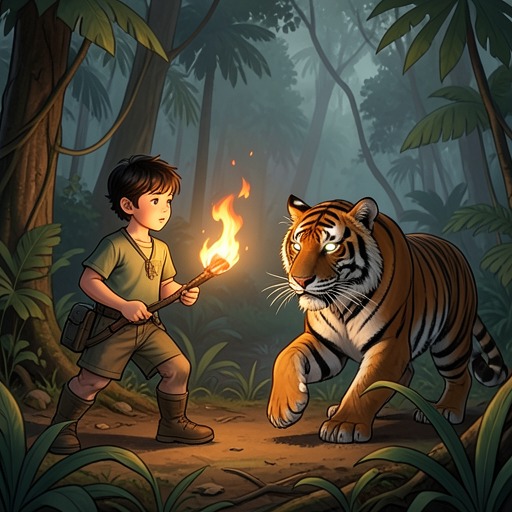
The fire pot converts Mowgli's vulnerable position into command. He throws it down, igniting dry moss, and thrusts a dead branch into the coals until it burns and crackles. The wolves recoil from the flames as he whirls the branch above their heads. The scene reverses the pack's judgment: the wolves have claimed authority to define Mowgli as an outsider, but the human fire gives him immediate power over the very bodies that condemn him. Bagheera calls him master and urges him to save Akela, who has always been his friend.
Mowgli then makes his separation explicit. He says that he will go to his own people, if they truly are his people, because the jungle is closed to him. Even while rejecting the pack's claim on him, he refuses to betray it to human beings, promising that there will be no war between them. This mercy distinguishes him from the wolves who have turned against him. His departure is not a surrender to Shere Khan's demand; it is Mowgli's own judgment, made under pressure but enforced by his own strength.
Before leaving, he exacts a debt from Shere Khan. He seizes the tiger by the tuft on his chin and orders him to rise when a man speaks, threatening to set his coat alight. He beats Shere Khan over the head with the burning branch until the tiger whimpers in fear, then drives him from the Council. Mowgli declares that when he next comes to the rock as a man, he will come wearing Shere Khan's hide. He also forbids the wolves to kill Akela, and uses the flaming branch to scatter the hostile pack. By the end of the confrontation, only Akela, Bagheera, and roughly ten wolves who supported Mowgli remain.
From Jungle Belonging to Human Society
The physical victory does not make the expulsion painless. Once the wolves have fled, Mowgli experiences an unfamiliar pain, catches his breath, sobs, and asks Bagheera whether he is dying. Bagheera explains that the tears are what men use and that they prove Mowgli is a man rather than a man's cub. This bodily discovery completes what the Council's language began. Mowgli has been called human as an accusation, but tears turn the accusation into an inward transformation: his humanity is not only a category imposed by Shere Khan or the pack; it is an emotion he can now inhabit.
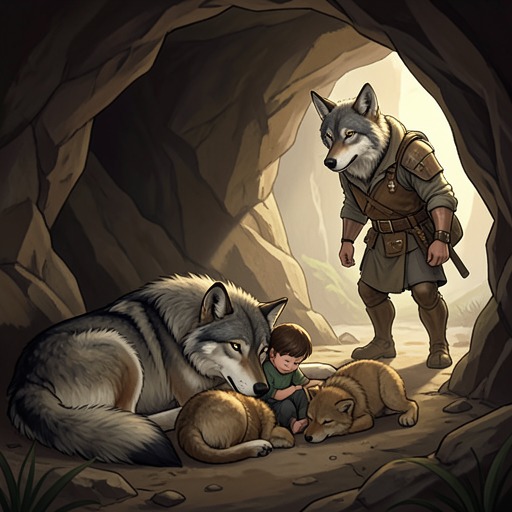
Mowgli has never cried before, and his grief therefore marks the cost of crossing the boundary. He does not leave because the jungle has become meaningless. He says that he does not wish to leave it and does not know what is happening inside him. His first act after accepting the need to go is to say farewell to Raksha, whom he calls his mother. At her cave, he cries on her coat while the four cubs howl. Raksha answers that she loved him more than her own cubs and calls him her little naked son. Their exchange preserves the reality of the relationship even as the pack's political decision denies Mowgli a place within it.
Mowgli promises that he will return, but the promised return is tied to a future act of justice. He tells Raksha that he will come back to lay Shere Khan's hide upon Council Rock and asks the jungle not to forget him. At dawn, he descends the hillside alone to meet the mysterious beings called men. The movement is a literal journey downward from the wolf territory and a threshold crossing into a society whose customs he does not yet understand.
That transition begins in the village with Messua. The villagers notice that Mowgli resembles her son, who was taken by a tiger, and a priest interprets his arrival as the restoration of what the jungle had taken. Messua accepts him into her house, which contains a lacquered bedstead, a grain chest, copper cooking pots, a Hindu image, and a real looking glass. Mowgli experiences the villagers' examination as another version of the pack's inspection, but he resolves that if he is a man, he must become one. His expulsion thus leads directly to an attempted reintegration into human life rather than to a simple abandonment of community.
Boundaries of Membership and Obedience
The event is governed by competing definitions of belonging. The wolves insist on blood when it becomes useful to exclude Mowgli, although their own earlier law had admitted him and treated him as a brother. Mowgli's response exposes that contradiction: he has learned the pack's language, companionship, and law, yet is denied protection when its leadership changes. Akela's defense shows that membership had once been a legal and ethical commitment; Shere Khan's intervention reduces it to species identity and political expedience.
The Red Flower dramatizes a second boundary, between animal autonomy and human power. Mowgli is physically naked and surrounded by wolves, but the fire pot and burning branch allow him to control the assembly. The wolves' retreat before the flames does not erase their earlier authority; instead, it reveals that the pack's authority has become dependent on fear, faction, and the public naming of an outsider. Mowgli's mastery is consequently double-edged. Fire saves Akela and prevents an immediate attack, but it also confirms that Mowgli cannot remain within the wolf world on its original terms.
The same tension between collective obedience and individual judgment recurs elsewhere in the book's treatment of animal societies. At Novastoshnah, Sea Catch fights each spring for a nursery place but observes the Rules of the Beach by refusing to pursue a beaten seal. When Kotick follows a drove to the killing grounds, he sees men slowly herd the seals so that their fur will not be damaged, then club and skin them; his companions dismiss his horror because they have not witnessed the slaughter, while Sea Catch and Matkah tell him merely to grow strong and accept the order of the beach. In the military world, Kala Nag belongs to an institution that preserves, captures, trains, and deploys elephants, while at Rawal Pindi an officer reduces obedience to a simple principle: an order is given and it is obeyed. Against these systems, Mowgli's expulsion shows both the protection and the violence of communal law: membership can shelter a vulnerable body, but it can also declare that body incompatible with the group.
Consequences and Narrative Significance
Mowgli's expulsion completes the separation phase of his larger passage between worlds. He leaves the Seeonee Wolves not as a defeated child but as a figure who has mastered the Council, saved Akela, humiliated Shere Khan, and chosen not to betray the pack. His apparent rejection therefore contains a form of moral independence. He accepts the truth of his humanity without accepting the hostile pack's interpretation of what that humanity makes him.
The immediate consequence is isolation. At first light Mowgli walks alone toward men, carrying the memory of the cave, Raksha's love, Akela's protection, and the pack's betrayal. The future is deliberately left at a threshold rather than fully integrated: he enters human society, but his promise to return to Council Rock keeps the jungle within the structure of his identity. The expulsion is thus both an ending and a deferred continuation. It closes his childhood as a wolf and prepares the later reckoning with Shere Khan that he has announced in advance.
Its deepest significance lies in the refusal of a single stable category. Mowgli is neither simply a human intruder among animals nor simply a wolf-child who can remain forever outside human society. The pack's final judgment makes his mixed belonging visible, while his tears, farewell, fire, and departure turn that contradiction into a lived passage. The event's decisive image is not the fleeing wolves alone but Mowgli descending at dawn: expelled by one community, summoned by another, and carrying the law, affection, and injury of both worlds into the life that follows.