Mowgli's return to human society
The Jungle BookMowgli's return to human society is the first sustained passage between the jungle and the village in which he must deliberately become legible to human beings. Leaving the wolf cave after the conflict at Council Rock, he crosses nearly twenty miles of rough road to a village at the edge of grazing land and jungle. There he is accepted by Messua as a possible replacement for the son taken by a tiger, but the acceptance also creates a new task: Mowgli must learn human speech and customs without surrendering the instincts and freedom that have made him a child of the jungle.
Causes and Threshold
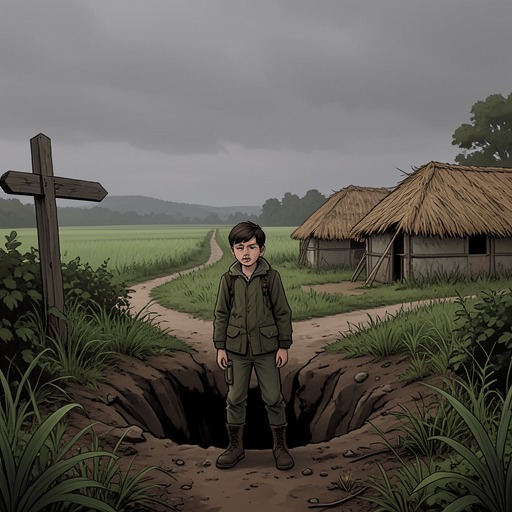
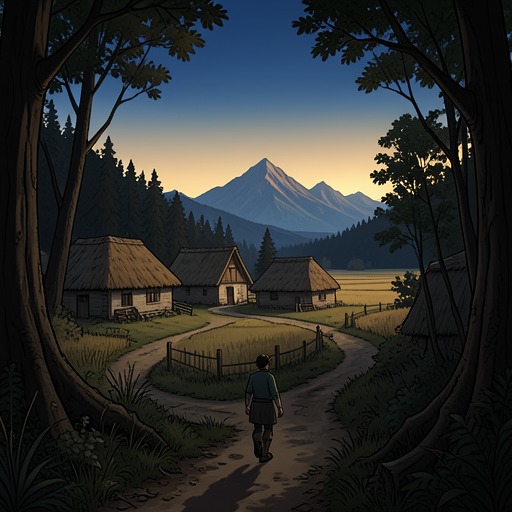
This return follows the break between Mowgli and the Seeonee Wolf Pack. The narrative stresses that he will not remain in the nearby plowed lands, because the jungle is still too close and he knows he has made at least one serious enemy at Council Rock. His steady journey down the valley therefore has both practical and symbolic force. He is escaping an immediate danger, yet he is also moving toward a world whose people he has observed from outside but never inhabited. The plain he reaches is unfamiliar: rocks and ravines divide it, cattle and buffaloes graze across it, a village stands at one end, and the jungle stops abruptly at the grazing grounds. The village gate presents a first reversal. A thorn barricade has been pushed aside at twilight, and Mowgli understands such barriers from his night wanderings as signs that human beings fear the People of the Jungle. Hungry, he sits at the entrance, rises when a man appears, opens his mouth, and points down it to request food. The gesture is perfectly clear to him, but it produces alarm rather than hospitality. The man runs back shouting for the priest, and soon at least a hundred villagers gather to stare, talk, shout, and point at the jungle-raised boy.
Recognition and Adoption
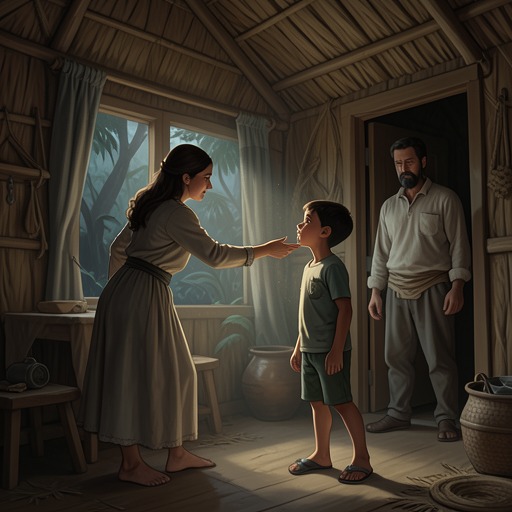
The villagers interpret Mowgli through visible evidence. The priest notices the pale scars on his arms and legs and identifies them as wolf bites, while the women call him a handsome child with eyes like red fire. Their response changes when they compare him with Messua's son, who was taken by a tiger. Messua examines Mowgli closely and recognizes the resemblance, though she also sees that he is thinner and that his feet have never worn shoes. The uncertainty is crucial: he is not simply restored as the missing Nathoo, but he is close enough to become the emotional and social answer to Nathoo's loss. The priest turns that uncertainty into a public decision. Declaring that what the jungle has taken the jungle has restored, he urges Messua to take Mowgli into her house and reminds her to honor the priest who claims to see deeply into human lives. His pronouncement gives the boy an entry into village society, but it also exposes the self-interest embedded in the scene: the priest knows Messua is married to the richest villager. Mowgli experiences the crowd's examination as another version of being inspected by the Pack, yet he recognizes the consequence of the judgment. If he is to live as a man, he must become a man. Messua's household supplies the material form of that acceptance. Inside are a red lacquered bedstead, a large decorated earthen grain chest, copper cooking pots, a Hindu god in a small alcove, and a real looking glass. Messua gives Mowgli milk and bread, places a hand on his head, and calls him Nathoo. When he does not respond to the name, she asks whether he remembers receiving new shoes; his horn-hard feet prove that his life has been wholly different from the one she imagines. Even so, she calls him her son. Adoption here begins not with certainty but with resemblance, grief, nourishment, and a willingness to accept an altered child in place of the lost one.
Learning Human Ways
The roof and door initially make the house feel dangerous to Mowgli. He has never lived beneath one, and the hut resembles a panther trap because its limits can be closed around him. He immediately tests the possibility of escape: the thatch could be torn out, and the window has no fastenings. At bedtime he refuses to sleep inside, leaves through the window, and stretches out in clean grass at the edge of the field. Messua's husband responds by allowing him his will, reasoning that a child who has never slept on a bed cannot be forced into human habits at once. Language becomes the first deliberate discipline of his new life. Mowgli understands that physical strength alone is insufficient in the village; without human speech, he is as helpless and unintelligible among men as a man would be in the jungle. He therefore resolves to learn their talk. His earlier training helps him: the imitations of jungle animals that he learned among the wolves have prepared his mouth and ear for exact reproduction. As Messua pronounces words, he repeats them almost perfectly, and before dark he has learned the names of many objects in the hut. This quick acquisition contrasts with the formal instruction he received from Baloo. In the jungle, Mowgli learned the Law of the Jungle, the Wood and Water Laws, the Master Words for different creatures, and the Strangers' Hunting Call, while Bagheera watched him recite lessons. The human village demands a different vocabulary, but not a wholly different kind of adaptation. In both societies, survival depends on knowing the rules of a community and speaking correctly within its territory. Mowgli's return is therefore not a rejection of education; it is a transfer from one social law to another.
Consequences and Significance
The episode changes Mowgli's immediate status from an exposed fugitive to a protected household member. Messua offers him food, kinship, and a place in human society, while her husband permits the unfamiliar habits that keep him from fleeing. Yet the settlement remains provisional. Mowgli can imitate words before he understands the emotional history attached to them, and Messua can welcome him without proving that he is truly Nathoo. His adoption preserves a wound rather than closing it: the mother gains a son-like presence, while Mowgli gains a mother and a house without ceasing to be the child formed by wolves. The scene also establishes the central tension of Mowgli's later life. Human society appears ordered through gates, houses, priestly authority, names, shoes, beds, and spoken language; the jungle has formed him through movement, bodily knowledge, animal speech, and the ability to leave any enclosure. He enters the village because he needs safety and because the wolf world has become dangerous, but he does not enter as a blank human child. His scars, hardened feet, quick imitation, and instinctive testing of exits make the jungle visible inside the household. As a narrative threshold, the event reverses the usual direction of civilization stories. Mowgli does not pass from ignorance into a superior human world. He arrives already educated by Baloo, protected by Bagheera and the wolf family, and capable of reading danger in the landscape. What he lacks is not intelligence but membership. The village can feed and name him, yet it must also learn to accommodate a person whose first society was the jungle. His return thus begins an experiment in divided belonging: adoption gives him a human home, while his body and memory continue to speak for the world he has left.