Nag
The Jungle BookNag is the adult black cobra whose presence turns the garden and bungalow into contested territory. Five feet long from tongue to tail, he is both a predator of smaller creatures and the principal male force in the cobra pair that seeks to reclaim the garden. His death marks the first decisive victory in Rikki-tikki-tavi’s campaign against the snakes, but it does not end the danger, because Nagaina remains and continues the struggle.
Identity and Appearance
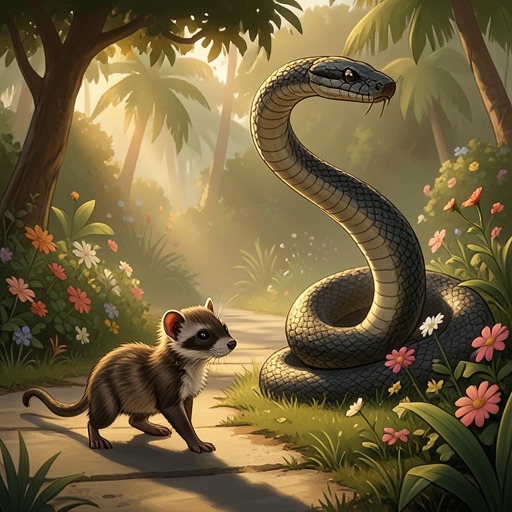
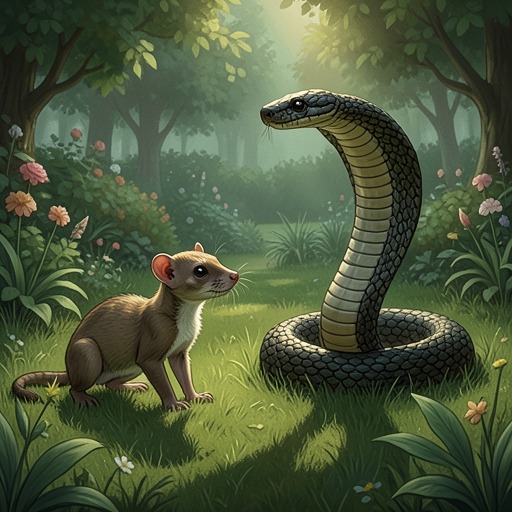
Nag first appears as a frightening physical presence beneath Darzee’s thornbush. He rises inch by inch from the thick grass, lifting his hood and balancing a third of his body above the ground. The spectacle-mark on the back of his hood resembles the eye portion of a hook-and-eye fastening, and his eyes retain the fixed, unreadable expression associated with snakes. The description emphasizes both scale and controlled movement: Nag is not merely a snake encountered by chance, but a fully grown cobra whose body, hood, and stillness make him an immediate threat.
His authority is also verbal. When Rikki-tikki-tavi asks who he is, Nag identifies himself as the great cobra and invokes the mark that, according to his account, the god Brahm placed upon cobra-kind. He uses that inherited sign to demand fear and recognition. The appeal fails to secure obedience, however, because Rikki-tikki-tavi’s upbringing has prepared him for exactly this adversary: his mother fed him dead cobras, and he understands that a grown mongoose is expected to fight and eat snakes. Nag recognizes the same danger. Beneath his cold composure, he is afraid of the mongoose.
Predator and Strategist
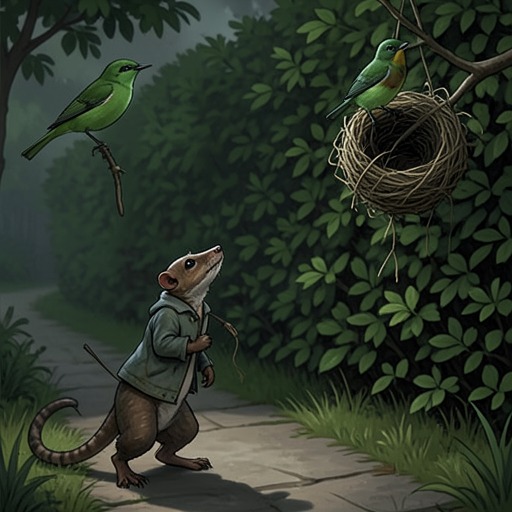
Nag’s first exchange with Rikki-tikki-tavi reveals a predator capable of argument as well as intimidation. When challenged for eating Darzee’s fledglings, he answers by comparing his own behavior with the mongoose’s diet of eggs. The comparison is a piece of moral equivalence: Nag turns predation into a general rule so that his own attack will appear no worse than the habits of his opponent. Yet the scene also shows that he is not confident. While speaking, he watches the grass behind Rikki-tikki-tavi for the smallest movement and lowers his head in an effort to draw the mongoose off guard.
Nag’s calculation becomes clearer when he confers with Nagaina. He knows that a mongoose in the garden means death sooner or later for him and his family, and he therefore treats the human occupants of the bungalow as part of the problem. Nagaina proposes that he enter the house and kill the large man, his wife, and, if possible, the child. Nag initially questions whether killing the people will accomplish anything, but he accepts her reasoning that an empty bungalow would leave the garden to the cobras and drive Rikki-tikki-tavi away. His objective is thus broader than personal survival: he wants to remove the human household, eliminate the mongoose’s refuge, and restore cobra control over the garden.
The Bathroom Ambush
The plot against the household leads Nag into the bungalow’s bathroom. Rikki-tikki-tavi hears the faint scratching of scales and slips toward the bathroom sluice, where a brick has been removed from the smooth plaster wall to let bath water out. From there he overhears Nag and Nagaina whispering in the moonlight. Nagaina reminds her husband that the big man killed Karait and warns him to bite first when the man enters without his stick. Nag agrees to wait in the cool bathroom until daylight, when the family will be more vulnerable.
The plan gives Nag a tactical advantage, but it also places him within reach of Rikki-tikki-tavi. The mongoose is enraged by the threat to Teddy, Teddy’s mother, and the big man, yet he is frightened by the cobra’s size. He understands that an attack on the open floor would favor Nag and therefore waits for a more precise opportunity. When Nag bends to drink from the large water jar, Rikki-tikki-tavi decides that the only viable target is the head above the hood and that he must not let go once he has bitten.
Rikki-tikki-tavi’s attack reverses the expected balance of power. He jumps onto Nag’s head and braces his back against the curve of the red earthenware jar, gaining a momentary purchase. Nag then thrashes him across the bathroom like a rat shaken by a dog, overturning the tin dipper, soap dish, and flesh brush and striking the tin side of the bath. Rikki-tikki-tavi holds tighter despite the violence, determined to keep his teeth locked even if he is beaten to death. The struggle ends when the awakened big man fires both barrels of a shotgun into Nag just behind the hood. The blast knocks Rikki-tikki-tavi senseless and singes his fur, but it kills the cobra.
Death and Immediate Consequences
Nag’s death is confirmed when his body is thrown onto the rubbish heap. Darzee turns the event into a song, repeating that the valiant Rikki-tikki-tavi caught Nag by the head and held fast while the big man brought the gun. The song celebrates the immediate result: Nag can no longer eat Darzee’s babies. It also preserves the unusual division of labor in the victory. Rikki-tikki-tavi makes the dangerous seizure; the human weapon supplies the force that ends the cobra’s life.
The victory does not produce security. Rikki-tikki-tavi is angry that Darzee sings too soon, because Nagaina is still alive and has already come to the bathroom sluice calling for Nag. Nag’s removal therefore changes the conflict rather than resolving it. The pair’s plan to dominate the garden is broken, but the surviving female cobra inherits the active threat, while Rikki-tikki-tavi must continue protecting the household and searching for the remaining danger.
Narrative and Thematic Role
Nag is presented as an animal with perception, language, family interests, and political judgment rather than as a mere obstacle. He remembers the danger posed by mongooses, reasons about the relation between the bungalow and the garden, coordinates with Nagaina, and adapts his hunting behavior to human routines. At the same time, the narrative places his intelligence within a struggle over territory and survival: the garden is not simply a human setting but a shared environment in which birds, snakes, mongoose, and people pursue incompatible claims.
His defeat exposes the limits of predatory confidence. Nag invokes divine authority, physical size, and the inherited habits of cobra-kind, yet he is undone by the very strategy that seems most prudent: hiding in the bathroom to attack the family at dawn. The ambush brings him into a confined space where Rikki-tikki-tavi can reach his head and where the big man’s shotgun can intervene. Nag therefore functions as both shadow and warning. He is the lethal embodiment of the garden’s danger, but his calculated violence also provokes the alliance between Rikki-tikki-tavi and the human household that destroys him.