Nagaina
The Jungle BookNagaina is the female cobra and mate of Nag, defined by a combination of calculated territorial ambition, maternal urgency, and lethal persistence. She is not merely a second snake in the garden: she understands how the presence of the bungalow’s human occupants has altered the balance of power, recognizes Rikki-tikki-tavi as the chief obstacle to her rule, and turns the survival of her eggs into the decisive stake of the conflict. Her defeat removes both the immediate threat to the household and the next generation of cobras that might have renewed it.
Identity and Territorial Aim
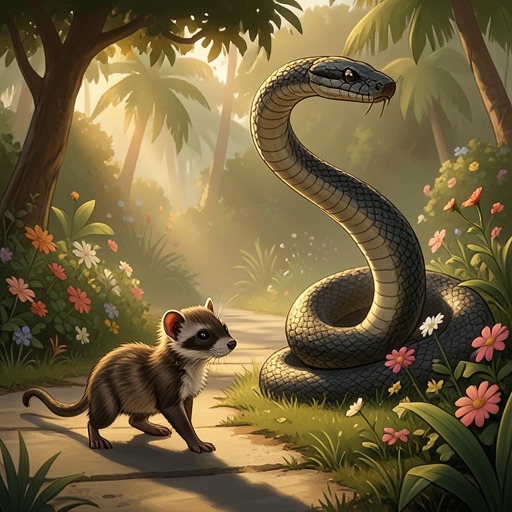
Nagaina’s first appearance establishes her as an attacker who relies on timing and concealment. While Rikki-tikki-tavi is speaking with Darzee, she creeps up behind him in an attempt to kill him. Darzee’s warning allows Rikki-tikki-tavi to leap over her striking head, but his brief bite only tears and angers her; he is not yet experienced enough to break her back before escaping the cobra’s return stroke. The encounter reveals both her danger and the limits of Rikki-tikki-tavi’s early confidence: even when she misses, she remains a threat that cannot safely be pursued alongside Nag.
Nagaina’s larger objective becomes explicit when she and Nag whisper outside the bathroom sluice in the moonlight. She argues that the human family must be killed because the bungalow has drawn a mongoose into the garden. In her reasoning, an empty bungalow would restore the old order: she and Nag would be “king and queen of the garden,” while the hatching of their eggs would give their offspring the room and quiet they require. Her violence is therefore presented as a struggle for habitat and succession, not as an isolated act of malice. The people are obstacles to cobra sovereignty, and Rikki-tikki-tavi is the guardian who prevents that sovereignty from being re-established.
Widowhood and Escalation
Nagaina’s plan changes after Rikki-tikki-tavi kills Nag. She becomes a widow, but widowhood does not weaken her purpose; it concentrates it. She declares that although Nag lies on the rubbish heap, Teddy will lie still before night. The threat joins revenge to strategy. By targeting the child, she seeks both to punish the household and to force Rikki-tikki-tavi into a desperate defense in which he cannot simply protect himself from a distance.
Her pursuit of Rikki-tikki-tavi also shows a deliberate use of intimidation. She tells him that escape is useless and orders him to look at her, exploiting the paralysis that a snake’s gaze can induce in a bird. Rikki-tikki-tavi refuses the trap of staring and remains focused on movement and distance. The contrast matters: Nagaina tries to control the encounter through fear and hypnotic attention, whereas Rikki-tikki-tavi survives by refusing the form of attention she demands.
The Eggs and the Final Pursuit
The most concrete expression of Nagaina’s maternal and territorial stakes is the clutch hidden in the melon bed. Rikki-tikki-tavi discovers twenty-five eggs, each about the size of a bantam’s egg and covered by whitish skin rather than a shell. The young cobras are already visible inside, and each could kill a man or a mongoose once hatched. By crushing the eggs one by one, Rikki-tikki-tavi attacks the future that Nagaina had invoked when she argued that her children needed space and quiet. The garden’s conflict thus shifts from defending the present household to preventing the return of the danger through reproduction.
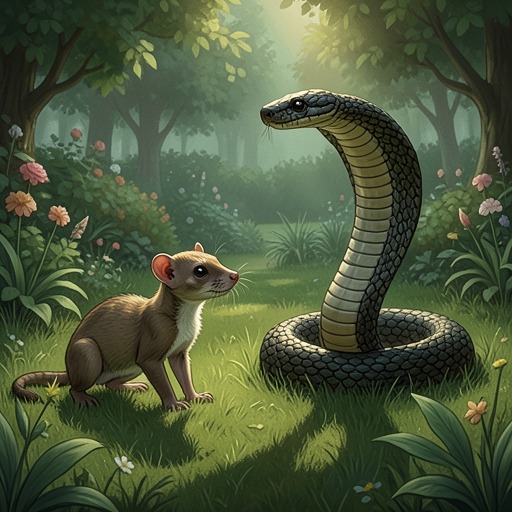
Nagaina realizes that the last egg can be used to control Rikki-tikki-tavi. She abandons her immediate chance to kill Teddy and demands the egg, promising to leave if it is returned. Rikki-tikki-tavi rejects the bargain and tells her that she will join Nag on the rubbish heap. Their confrontation on the veranda becomes a contest of timing and endurance. Nagaina repeatedly strikes, each blow landing against the matting as Rikki-tikki-tavi jumps upward and backward, then circles to get behind her. She turns with him, keeping her head aimed at his, while the movement of her tail makes a sound like dry leaves blown along by the wind.
The struggle briefly turns in Nagaina’s favor when Rikki-tikki-tavi forgets the egg. She seizes it, races down the path, and heads for the long grass and the thorn-bush. Darzee’s singing does not stop her, but Darzee’s wife flaps around her head and causes the instant of delay that lets Rikki-tikki-tavi catch up. When Nagaina plunges into the rat-hole where she and Nag once lived, Rikki-tikki-tavi clamps his teeth onto her tail and follows her underground, despite the danger that the darkness may open into a wider space where she can turn and strike.
Death and Aftermath
The underground pursuit produces a final reversal in the story’s visible evidence. The grass stops moving, and Darzee assumes that Nagaina has killed Rikki-tikki-tavi; he begins composing a death song for him. Then the grass quivers again, and Rikki-tikki-tavi emerges from the hole covered in dirt, licking his whiskers. He announces that the widow will never come out again, confirming Nagaina’s death without describing the hidden combat itself. The narrative withholds the exact killing blow but makes the outcome unmistakable: the cobra’s last advantage, the darkness of her own refuge, has become the setting of her destruction.
Nagaina’s death completes the removal of the cobra threat. Rikki-tikki-tavi sleeps in the grass until late afternoon because the pursuit has exhausted him, then returns to the house and asks Darzee to tell the garden that Nagaina is dead. Her defeat also closes the reproductive danger represented by the eggs. Nag is already dead, the eggs have been destroyed except for the final one carried into the hole, and Nagaina herself does not return; the household and garden are freed from the linked threats of adult cobras and their brood.
Narrative Significance
Nagaina functions as the conflict’s final antagonist because she combines the two motives that have driven the snakes from the beginning: possession of the garden and destruction of the mongoose who prevents it. Her words about being “king and queen of the garden” give the struggle a political shape, while the twenty-five eggs give it a biological future. Rikki-tikki-tavi defeats not only an individual predator but an attempted transfer of the garden back to cobra rule.
Her characterization also gives the ending its strongest value reversal. At first, Nagaina’s hidden approach catches Rikki-tikki-tavi inexperienced and frightened; later, her size, speed, and knowledge of the hole make her appear nearly unassailable. Yet the very instruments of her power—surprise, the egg, the rat-hole, and the terror of the cobra’s strike—are progressively turned against her. The egg draws her into pursuit, the delay at the garden brings Rikki-tikki-tavi to her tail, and the hole becomes a one-way passage. Her final absence is therefore more than a death: it is the narrative proof that the garden’s future no longer belongs to Nagaina and the brood she sought to protect.