Novastoshnah
The Jungle BookNovastoshnah, or North East Point, is the great seal rookery on Saint Paul Island in the Bering Sea and the principal setting of Kotick’s early life. It is at once a place of abundance, family, seasonal return, and communal order, and a place where human commercial violence reaches directly into the life of the seal people. The location’s decisive significance lies in that contradiction: the beach is the finest accommodation for seals in the world, yet its very suitability makes it a target for the killing grounds, driving Kotick to seek a safer home for his kind.
Geographic Setting and Seasonal Life
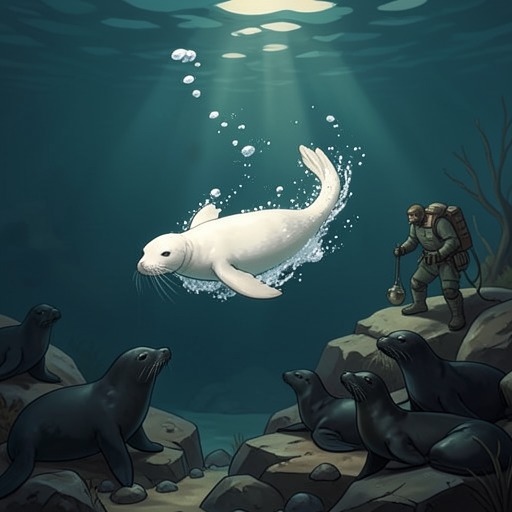
Novastoshnah lies far out in the Bering Sea, away from ordinary human traffic. The narrator identifies it as a place visited only on business, with the seals as its regular inhabitants and seasonal users. In the summer months, hundreds of thousands of seals arrive from the cold gray sea, transforming the coast into a crowded breeding ground whose scale exceeds ordinary human measure.
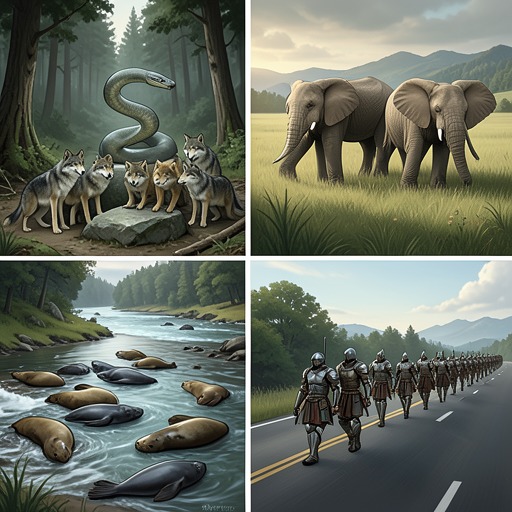
The rookery is not merely a backdrop but a living seasonal system. Seals fill every stretch of ground visible through the fog: old males, mothers, newborns, and young holluschickie move between the beach and the water in dense groups. The air is marked by whistling, bellowing, roaring, and blowing, while fog commonly covers the beach and occasionally gives way to brief pearly, rainbow-colored sunlight. The coast’s noise and congestion express both its fertility and its vulnerability, because a population concentrated so densely can be driven and controlled.
Sea Catch’s annual return shows how the place organizes seal life. Each spring he swims toward Novastoshnah from wherever he has wintered, moving with great speed toward the shore, then spending a month fighting other males for a position close to the sea. His aim is not conquest for its own sake but possession of room for a nursery. Even in these violent contests, the Rules of the Beach limit conduct: Sea Catch may fight for space, but he does not pursue a defeated seal. Novastoshnah therefore sustains a recognizable social order in which conflict is connected to family protection and bounded by communal rules.
The Rookery and the Seal Community
The beach is the birthplace of Kotick, the son of Sea Catch and Matkah. He is born amid the immense seasonal confusion, physically recognizable as a tiny seal but distinguished by a pale coat that makes his mother examine him closely. His unusual whiteness immediately marks him as exceptional within the community. Sea Catch initially rejects the possibility that a white seal could exist, while the difference later gives Kotick a visibility that is both protective and dangerous.
Novastoshnah’s social world is organized around nurseries, breeding places, and the movement of seals between land and sea. Sea Catch’s scars, size, and readiness to fight show the harshness of life on the crowded rocks, but his restraint under the Rules of the Beach also distinguishes the seal community’s violence from the systematic violence imposed by humans. The rookery is therefore a political space as much as a biological one: access to the shore determines safety, reproduction, and family continuity.
Kotick’s identity as a white seal intensifies his separation from the ordinary expectations of the rookery. Other seals understand human driving as an established part of the day’s work, and they advise him to mature, become large enough to fight for himself, and secure a nursery of his own. Because they have not witnessed what Kotick sees, they cannot share the force of his alarm. Novastoshnah becomes the place where communal normality and individual testimony diverge.
Human Access and the Killing Grounds
The rookery’s proximity to human settlement makes its abundance exploitable. Kerick Booterin and his son Patalamon come from a village less than half a mile from the nurseries and decide which seals will be driven to the killing pens. The seals are handled like sheep, and their skins are destined to become seal-skin jackets. The language of routine business conceals the physical brutality of the process, while the geography makes clear that the slaughter is not a distant threat: it begins within sight and sound of the breeding beach.
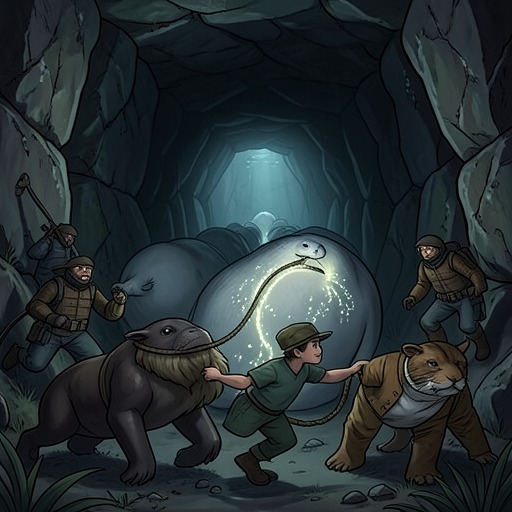
Kotick first encounters the men at Novastoshnah after dancing with the yearling seals. The men’s surprise at his coat turns his natural difference into an omen; Kerick treats him as a possible ghost rather than simply as an animal. Yet the supernatural explanation does not prevent the practical machinery of exploitation. The drive proceeds slowly so that the seals do not become overheated and suffer damage when skinned. At the Salt House, men armed with iron-bound clubs separate some animals and kill the rest with blows to the head.
The short distance between the rookery and the killing grounds creates a terrible spatial continuity. The drive covers only half a mile but takes an hour, and Kotick hears the roar of the nurseries behind him as loudly as a train in a tunnel. The familiar beach is therefore not separated from industrial violence by any meaningful boundary; the route from nursery to slaughter is a controlled extension of the rookery itself. When Kotick sees the skins ripped from his companions, Novastoshnah is permanently changed in his perception from home into a place that cannot guarantee safety.
Kotick’s Departure and Narrative Significance
Kotick returns to Novastoshnah expecting sympathy, but the other seals defend the established order. They tell him that men have always driven the holluschickie and that anyone unwilling to see ugly things should not have gone to the killing grounds. Their response reveals the limits of experience within the community: none of them has witnessed the slaughter, and Kotick’s white coat further separates him from the ordinary seal population. His parents urge endurance rather than resistance, advising him to grow large, fight for a nursery, and wait several years.
The rookery thus becomes the starting point of Kotick’s quest for an alternative. With no support for changing conditions at Novastoshnah, he leaves the beach in autumn and searches across the Pacific for Sea Cow and for a quiet island whose firm beaches will place seals beyond human reach. His search begins as a direct response to what the rookery has revealed: a place can be biologically perfect and socially inherited while still being structurally unsafe.
Novastoshnah also anchors the story’s wider contrast between animal self-government and human classification. The seals return by instinct, establish nurseries through contests governed by rules, care for their young, and preserve communal habits, whereas the men reduce them to a managed supply of skins. The beach’s immense population makes the seals seem powerful, yet its concentration enables their treatment as a resource. Through Novastoshnah, the narrative turns landscape into an ethical instrument: the same fogbound shore that shelters birth and seasonal community also exposes the cost of leaving access and authority in human hands.