Oodeypore
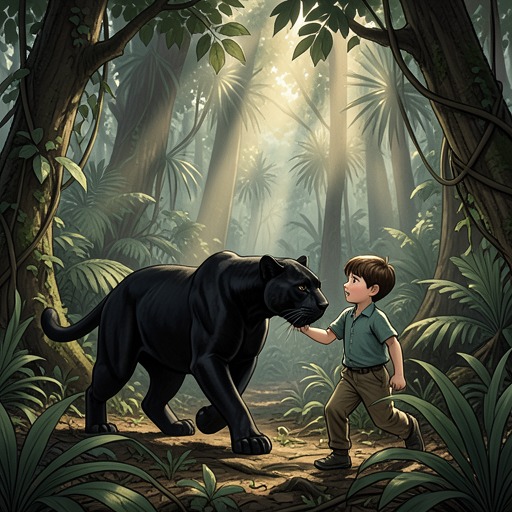
The Jungle BookOodeypore is a remembered human location whose decisive significance lies in Bagheera’s history. It is the site of the king’s palace where the panther was born among men, where his mother died, and where he was kept behind bars before breaking free. Through that compressed history, Oodeypore becomes more than a place-name: it is the origin of Bagheera’s knowledge of human life and the hidden source of his bond with Mowgli.
Royal Palace and Captivity
Oodeypore appears in Bagheera’s account of his past, not as a landscape explored by the present action but as the setting of a formative confinement. He tells Mowgli that he was born among men and that his mother died in the cages of the king’s palace at Oodeypore. The palace therefore joins royal magnificence to imprisonment: its authority is represented by cages, and its human order is first encountered by Bagheera as a system that turns a living creature into a possession.
Bagheera recalls that men fed him behind bars from an iron pan. The concrete detail makes captivity a daily arrangement rather than a single moment of violence. His identity as a panther was not erased, however. One night he recognized himself as Bagheera, no longer willing to be a man’s plaything, and broke the lock with one blow of his paw. Oodeypore thus marks the threshold between an imposed human identity and the self-determined life he claimed in the jungle.
A Source of Knowledge
Bagheera’s escape from Oodeypore does not merely remove him from human society; it leaves him carrying knowledge that the other Jungle People do not possess. Because he had learned the ways of men, he became, in his own judgment, more terrible in the jungle than Shere Khan. His strength is therefore both physical and cultural. The palace cages teach him what human power looks like from inside, while the jungle gives him the freedom and setting in which to turn that knowledge into survival.
This background explains why Bagheera can move between worlds without fully belonging to either. He is a jungle panther shaped by a human captivity, and his authority over Mowgli depends partly on that double experience. Oodeypore remains absent from the visible jungle plot, yet its memory is active whenever Bagheera interprets the relation between the Jungle People and men.
Connection with Mowgli
Bagheera’s disclosure of Oodeypore is made while he is persuading Mowgli to understand a future he does not yet accept. He compares his own return to the jungle with the man-cub’s eventual return to men: just as Bagheera once left human captivity for the forest, Mowgli must ultimately go back to the human beings who are his brothers. The comparison gives the warning emotional force. It is not an abstract rule about species; it is advice spoken by someone who has crossed the same boundary in the opposite direction.
The conversation also reveals why Bagheera paid the price for Mowgli at the Council when Mowgli was still a naked cub. Bagheera’s human origin and Mowgli’s human nature create a private recognition between them, even though Mowgli has been raised within the Seeonee Wolf Pack. Oodeypore is consequently tied to the protective relationship between the two figures: the place where Bagheera was confined helps explain why he protects a child whose belonging is likewise divided.
Spatial Contrast and Narrative Meaning
Across the wider book, human and animal spaces repeatedly define identity through access and exclusion. The wolf cave protects Mowgli when Shere Khan demands that the man’s cub be surrendered; the Lost City exposes the Bandar-log as creatures who imitate human arrangements without understanding their purpose; the village gate tests Mowgli’s unreadable status; and the human bathrooms become a battleground between Rikki-tikki-tavi and the cobras. Oodeypore belongs to the same spatial pattern, but from the opposite angle: it is a human place remembered as the site where an animal was excluded from freedom.
Its significance is therefore concentrated rather than expansive. The name evokes a palace, cages, an iron feeding pan, and the broken lock through which Bagheera entered his true life. It establishes that the border between jungle and human society is not simply geographical. It can be a cage, a village gate, a family claim, or a remembered obligation. For Bagheera, Oodeypore is the place where captivity produced knowledge; for Mowgli, that knowledge becomes a warning that no adopted home can permanently cancel the question of origin.