Pudmini
The Jungle BookPudmini is Petersen Sahib’s clever she-elephant and a decisive participant in the revelation of the elephants’ hidden night life. As a trained animal belonging to the permanent Keddah force, she appears to stand within the human system of ropes, chains, camps, and elephant drives; yet her escape from that system allows her to join the wild gathering in the Garo hills. Her presence there helps confirm Little Toomai’s extraordinary claim and contributes to his transformation from a camp child into Toomai of the Elephants.
Identity and Position
Pudmini is introduced as Petersen Sahib’s clever she-elephant, ridden by the experienced elephant officer when he arrives at the hill camp as the season is ending. She belongs to the permanent force associated with Petersen Sahib, among the elephants used by the catchers, hunters, beaters, drivers, and trackers of the Keddah. Her status distinguishes her from the newly caught elephants being prepared for the march to the plains: she is already trained, trusted, and closely associated with the officer who directs the camp.
Her intelligence is also made visible through the human habit of listening to elephants. Petersen Sahib has learned to attend to the silent signs of the animals he works with, and Pudmini is treated as a capable working partner rather than as an interchangeable beast of burden. The camp’s organization nevertheless depends on restraint. Elephants are chained by their hind legs to large picket stumps, and extra ropes are fitted to those newly taken from the jungle. Pudmini’s later action gains force because it breaks through this carefully maintained arrangement.
Escape and the Night Gathering
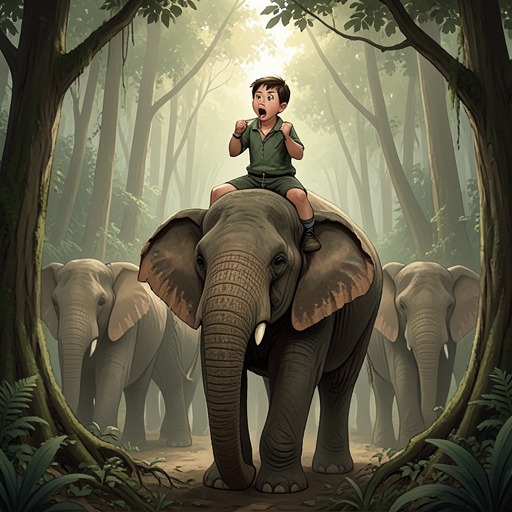
During the night when Little Toomai follows Kala Nag into the forest, Pudmini appears among the elephants assembling in the darkness. The boy first hears the chinking of a leg iron and then sees her come up the hillside, grunting and snuffling. She has broken her pickets and come directly from Petersen Sahib’s camp. A second unfamiliar elephant, marked by deep rope galls across its back and breast, has also escaped from a hill camp. The gathering therefore includes both wild elephants and trained animals who have crossed the boundary imposed by human custody.
Pudmini’s presence is not incidental. When the elephants begin to move together, Kala Nag enters the crowd, and the animals communicate, push, and gather around one another in their own manner. The night becomes a collective space inaccessible to ordinary human knowledge. They trumpet, stamp, and surge across the clearing for what seems to Little Toomai like two hours. Their synchronized feet crush grass and cane into fibers and then hard earth, enlarging the clearing into a dance-room. At dawn, the elephants vanish, leaving only Kala Nag, Pudmini, and the rope-scarred elephant behind.
The fact that Pudmini remains is especially significant. Her survival at the site gives the human observers a material trace connecting the camp with the secret assembly. When Petersen Sahib and Machua Appa later follow the tracks, they find evidence that the event was real: seventy elephant tracks cross the river, and Pudmini’s leg iron has cut the bark of a tree. Her broken restraint is thus converted into testimony. The mark she leaves behind helps establish that Little Toomai did not invent what he saw.
Relationship with Little Toomai and Kala Nag
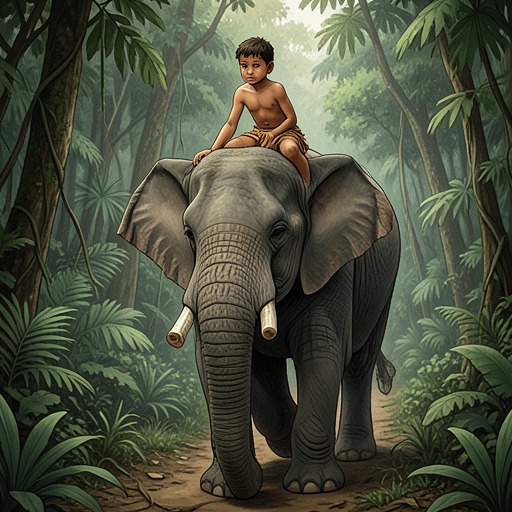
Pudmini is part of the scene through which Little Toomai’s unusual relationship with elephants becomes legible. The boy is carried by Kala Nag, his familiar elephant companion, while Pudmini moves freely among the larger gathering. Little Toomai knows that the wild elephants will not reach up to pull him from the neck of a tame elephant, and he remains on Kala Nag as the animals surround them. Pudmini’s presence places him in a world where the trained and the wild are temporarily joined, making the child a witness to an animal society that human handlers cannot command.
At dawn, Little Toomai sees Pudmini again beside Kala Nag. His exhausted request is that they remain near her and return to Petersen Sahib’s camp, because he is too worn out to continue alone. The detail is both practical and revealing: Pudmini serves as a familiar point of safety after the overwhelming night, while Kala Nag is the animal who carried the child through the dance. Together they form the visible remnants of the secret assembly and the route by which Little Toomai returns to human company.
Proof, Recognition, and Salute
Pudmini’s role becomes public when Petersen Sahib and Machua Appa investigate the clearing. Machua Appa identifies the mark made by her leg iron and confirms that she had been present. The evidence supports Little Toomai’s account even though the adults cannot explain the purpose or meaning of the elephants’ gathering. Their puzzlement emphasizes the limits of human expertise: Machua Appa has followed elephants for forty-five years, yet he has never known a human child to witness what Little Toomai has seen.
At the ensuing feast, Machua Appa names the boy Toomai of the Elephants. In his proclamation he addresses Pudmini and Kala Nag as elephants who saw Little Toomai at the dance, and he calls on them to honor him. The entire line of elephants raises its trunks in the Salaamut of the Keddah, a salute ordinarily associated with the highest human authority. Pudmini therefore participates in a reversal of the camp’s hierarchy. The trained elephants, usually chained and directed by men, become the witnesses whose hidden world grants the child his new name and status.
Pudmini is not given an independent speech or a separate quest, but the narrative assigns her a clear agency through movement. She breaks her pickets, leaves the camp, enters the forest gathering, and returns with physical evidence stamped into bark and earth. Her actions show that domestication has not erased the elephant’s connection to the larger elephant community. She is at once a working animal within a human institution and a participant in an animal order that briefly escapes human supervision.