Rawalpindi review
The Jungle BookThe Rawalpindi review is both a military exhibition and a demonstration of organized obedience. Held at Rawal Pindi before the Viceroy of India and the Amir of Afghanistan, it gathers an enormous camp of soldiers, cavalry, artillery, elephants, horses, bullocks, mules, and camels into one choreographed public image. The review’s spectacle is impressive precisely because it converts thousands of separate bodies into a single moving instrument, then explains that apparent unity through a chain of command extending from the imperial representative to the animal at the lowest operational level.
Setting and Imperial Occasion
The review takes place after a month of heavy rain at Rawal Pindi, where thirty thousand men and thousands of camels, elephants, horses, bullocks, and mules have assembled. The Viceroy is receiving the Amir of Afghanistan, whose bodyguard consists of eight hundred men and horses from Central Asia, many of whom have never encountered a military camp or a locomotive. The weather and the size of the gathering make the camp unstable: the Amir’s horses repeatedly break their heel ropes and stampede through the mud, while camels escape, run among the tents, and fall over the ropes. Even before the formal parade begins, the imperial camp is shown as a vast logistical system whose animals can disrupt human plans as readily as they sustain them.
The narrator experiences that instability directly when a camel blunders into a tent during the night. The tent collapses as its pole snaps, and the animal’s noise and movement turn the structure into something that appears to dance through the storm. The incident contrasts with the controlled choreography of the following day. The same animal world that produces confusion in the unregulated darkness will soon be displayed as disciplined strength on the parade ground.
The Parade of Men and Animals
The formal parade is held in the afternoon, with the narrator and Vixen positioned near the Viceroy and the Amir. Infantry regiments pass in ordered waves, their legs moving together and their guns aligned. The cavalry follows to the tune of “Bonnie Dundee”; the troop-horse of the second squadron sets the pace, carrying his head in and moving with the smoothness of waltz music. His polished appearance and exact movement make him a living component of the formation rather than a merely decorative animal.
The artillery makes the interdependence of military power and animal labor even more explicit. Two Tails and two other elephants are harnessed to a forty-pounder siege gun, followed by twenty yoke of oxen. The seventh pair has a new yoke and looks stiff and tired, a small but telling sign that the parade’s grandeur rests on exertion, equipment, and bodily strain. The screw guns come last, with Billy the mule carrying himself as though he commanded the troops; his harness is oiled and polished, yet he refuses to acknowledge the narrator’s cheer. The animals appear as individuals with distinct bearing, but the parade assigns each one a precise place in an immense mechanism.
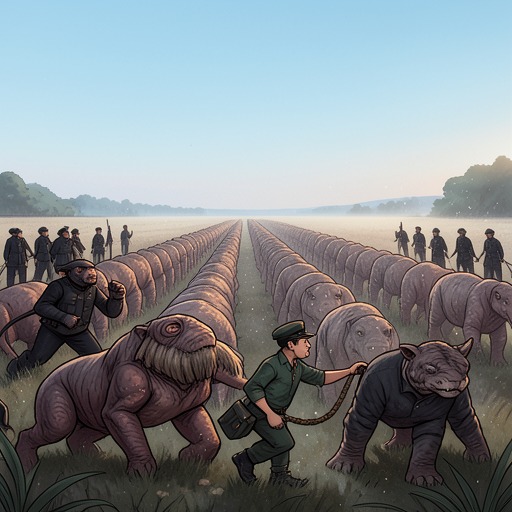
Rain returns and briefly obscures the formation. When visibility improves, the troops have spread into a line three-quarters of a mile long, a solid wall of men, horses, and guns. Its advance makes the ground shake like a steamer’s deck under full power. The movement is frightening even to spectators who know that it is only a review, because disciplined repetition creates the sensory force of an actual attack without requiring combat. The review therefore stages war as controlled potential: violence is not enacted, but its scale and obedience are made physically perceptible.
The Amir’s Response and the Climax
The Amir has shown no visible astonishment during the earlier stages of the ceremony. As the long line advances, however, his eyes grow larger, and he lifts the reins on his horse’s neck while looking behind him. For a moment he seems ready to draw his sword and cut his way out through the English men and women in the carriages. His reaction marks the point at which spectacle becomes politically effective. The formation is not simply observed as pageantry; it is experienced as an advancing power capable of overwhelming the observer.
The advance stops suddenly before the Viceroy and the Amir. The ground becomes still, the entire line salutes, and thirty bands play together. The abrupt transition from movement to stillness completes the ritual: force is demonstrated, brought under control, and then presented as submission to command. The ceremony ends with the regiments returning to their camps in the rain, while an infantry band plays a song about animals entering the Ark to escape the weather. The song’s comic allusion softens the spectacle without undoing its scale.
The Command Structure Revealed
After the review, an old, long-haired Central Asian chief asks how the astonishing performance was accomplished. A native officer answers that an order was given and obeyed. When the chief asks whether the beasts are as wise as the men, the officer explains that mule, horse, elephant, and bullock obey their drivers; drivers obey sergeants; sergeants obey lieutenants; lieutenants obey captains; captains obey majors; majors obey colonels; colonels obey the brigadier; the brigadier obeys the general; and the general obeys the Viceroy, who serves the Empress.
This explanation makes the review’s political meaning explicit. The parade does not depend on every participant understanding the whole structure. Its effectiveness comes from successive acts of obedience, each local link transmitting an order received from above. Animal discipline is placed within the same chain as human military discipline, so the working animal becomes part of imperial governance rather than an external accessory to it. The chief’s wish that Afghanistan possessed the same obedience reveals the contrast between centralized command and a society described as following individual will; the officer’s reply further connects obedience to imperial superiority.
Significance and Narrative Perspective
The Rawalpindi review gives visible form to an empire’s claim that order can master immense diversity. Men from different regiments, animals of different species, artillery, cavalry, transport beasts, weather, mud, and foreign observers are drawn into one temporary pattern. Yet the narrative also preserves the physical costs and unruly possibilities hidden beneath that pattern: exhausted bullocks, escaped camels, stampeding horses, and animals whose labor makes the human display possible.
The event is narrated by a human observer who watches both the camp’s disorder and the parade’s precision, while Vixen shares the position from which the ceremony is viewed. The surrounding animal stories complicate the review’s official lesson. Sea Catch and the seals expose animals treated as commodities; Kotick’s experience of the killing grounds turns animal witnessing into moral accusation; Kala Nag’s long service records a body shaped by war, transport, timber work, and elephant capture; and Billy’s account presents specialized animal skill from the worker’s own perspective. Against those episodes, the review’s final hierarchy is not merely a neutral description of efficiency. It is an imperial ideal in which animals and people become legible through assigned functions, even as the narrative continues to show their memories, fatigue, fear, judgment, and resistance to being reduced to instruments.