Red Flower
The Jungle BookRed Flower is the animals’ euphemistic name for fire, and in Mowgli’s story it is far more than a source of warmth or light. It is the emblem of human power: mysterious to the Jungle People, dreaded by every beast, and ultimately placed in Mowgli’s hands when the wolf pack’s protection collapses. His possession and use of Red Flower transform him from a threatened member of the pack into the figure who can command the Council Rock, spare Akela, and drive Shere Khan away.
Name, Nature, and Taboo
Red Flower is fire, but the Jungle People refuse to call it by its ordinary name. The narrative explains that every beast lives in deadly fear of it and invents many descriptions instead. The euphemism therefore expresses both ignorance and cultural taboo: fire is familiar to humans, yet it lies outside the ordinary powers of the animals and marks the boundary between their world and human society.
The danger associated with fire is also practical rather than merely symbolic. The Law of the Jungle forbids most beasts to kill Man because man-killing eventually brings armed white men on elephants, guns, gongs, rockets, and torches into the forest, causing suffering throughout the jungle. Fire belongs to this larger human power. It is not simply an object that animals dislike; it is part of the destructive force that makes human intrusion overwhelming. The animals’ fear is therefore connected to their knowledge that humans can alter the balance of the jungle by means unavailable to them.
Bagheera’s Counsel
Bagheera introduces Red Flower to Mowgli at the moment when the wolf pack’s political order is beginning to fail. He warns that Akela will soon miss another kill and that, when this happens, the pack will turn against both its aging leader and Mowgli. Bagheera’s advice is precise: Mowgli must go to the men’s huts, obtain some Red Flower, and keep it for a time of need. The fire is presented as a stronger protection than even Bagheera, Baloo, or the wolves who still love Mowgli.
Mowgli already knows that humans cultivate Red Flower outside their huts at twilight, so he accepts the task without hesitation. Bagheera further tells him that it grows in small pots, giving the boy a concrete means of acquiring and carrying it. The advice depends on Mowgli’s divided identity: the wolves fear fire, while the human child can recognize it as something usable. Bagheera calls this understanding a sign of the man-cub in him.
Taking and Learning to Tend the Fire
Mowgli reaches the croplands and hides beside a hut, where he watches a husbandman’s wife feed the hearth with black lumps. At dawn he sees the man’s child fill a wicker pot, plastered inside with earth, with red-hot charcoal and carry it beneath his blanket while going to tend the cattle. Mowgli’s response is characteristically practical. Since a human child can handle the object, he concludes that there is nothing to fear, takes the pot from the boy, and disappears into the mist while the child cries out.
He does not merely steal the fire and leave it unattended. Remembering how the woman fed the hearth, Mowgli blows into the pot and adds twigs and dry bark when the fire begins to die. He learns that Red Flower must be nourished, just as a living thing must be sustained. He then tests dry branches in the coals until he finds one that will burn effectively. This sequence changes fire from an abstract terror into a controlled tool, and it shows Mowgli acquiring human knowledge through observation, imitation, and experiment.
Mowgli carries the fire-pot back while the wolves are searching for him. When he meets Bagheera, he holds it up as proof that he is ready. Bagheera explains that a dry branch placed in the glowing material will blossom with flame, but Mowgli answers that he is not afraid. He vaguely remembers having once lain beside Red Flower before he became a wolf, when it was warm and pleasant. The memory gives the object a second meaning: fire is not only the source of human danger but also a trace of Mowgli’s earliest, half-lost connection with his own kind.
The Council Rock and the Reversal of Power
Mowgli spends the day tending the fire-pot and dipping branches into it, preparing himself for the confrontation at the Council Rock. When Tabaqui tells him that the council wants him, Mowgli laughs rather than showing fear. He arrives with the pot between his knees while Akela lies beside his rock, signaling that the pack’s leadership is open and that the old leader has been reduced to the status of the “Dead Wolf.” Shere Khan and his followers openly exploit Akela’s weakness and demand that Mowgli be surrendered because he is human.
As the wolves gather around Shere Khan, Mowgli stands upright with the fire-pot in his hands. He declares that their repeated insistence that he is a man has made him recognize the truth, and he rejects the claim that they are his brothers. He then reveals that he has brought the Red Flower that they fear. The gesture is political before it becomes violent: Mowgli changes the terms of the council by introducing an object that makes the wolves’ collective courage collapse.
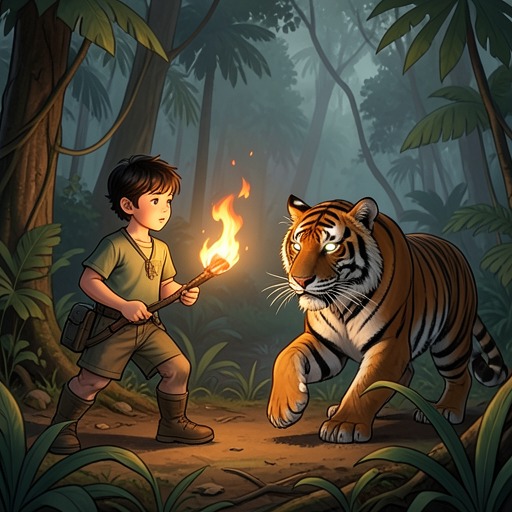
He throws the fire-pot to the ground, and the coals ignite dried moss. The council draws back from the sudden flames. Mowgli thrusts a dead branch into the fire until it crackles, then whirls the burning branch above his head while the wolves cower. The Red Flower reverses the hierarchy at once. The pack had attempted to judge Mowgli; now Mowgli possesses the power before which the judges retreat. Bagheera recognizes the reversal and tells him to save Akela from death, because Akela has always been his friend.
Weapon Against Shere Khan and Symbol of Separation
Mowgli uses the burning branch directly against Shere Khan. He takes the tiger by the tuft on his chin and orders him to rise, threatening to set his coat ablaze. Shere Khan flattens his ears and shuts his eyes as the branch approaches. Mowgli then beats him over the head with the fire, and the tiger whimpers and whines in terror. The scene strips Shere Khan of the dominance he had claimed through threats and appetite: the cattle-killer who wanted Mowgli handed over is reduced to an animal unable to resist the human weapon.
Mowgli announces that he will return to the Council Rock as a man, wearing Shere Khan’s hide on his head. He also frees Akela by declaring that the wolves will not kill him because that is not Mowgli’s will. With the burning branch still blazing, Mowgli strikes around the circle and drives the wolves away, while only Akela, Bagheera, and a small group that supported him remain. Red Flower has therefore accomplished three linked acts: it protects Mowgli, preserves Akela’s life, and expels the hostile majority.
Yet fire cannot prevent the emotional cost of the victory. Once the wolves have fled, Mowgli begins to sob and does not understand the pain within him. The Red Flower has made his authority undeniable, but it has also forced him to acknowledge that the jungle is closed to him and that he must go to his own people, if they will accept him. The object that saves him from physical violence thus marks his separation from the wolf community. It is both the instrument of his triumph and the visible sign that his human identity can no longer be denied.
Cultural and Narrative Significance
Red Flower condenses the book’s contrast between animal law and human power. The wolves possess a detailed code governing pack membership, the presentation of cubs, leadership, hunting, and punishment, yet their law cannot protect Mowgli when fear and faction overwhelm loyalty. Fire exposes the limit of that order. It does not refute the Law of the Jungle in theory; instead, it demonstrates that the wolves’ political practice is vulnerable to a force outside their legal and physical system.
The expression also belongs to a wider pattern in the book in which animals explain the world through names, songs, and inherited rules. Baloo teaches Mowgli the Law of the Jungle, the Wood and Water Laws, and the Strangers’ Hunting Call; other animal communities preserve their knowledge through lullabies, chants, and remembered customs. Against these verbal systems, Red Flower is a material sign whose meaning is immediately bodily. Its flame makes the wolves recoil before any argument can persuade them. It is therefore a cultural boundary, a survival technology, and a device of political speech enacted through action rather than words.
For Mowgli, mastery of Red Flower completes a crucial movement from dependence to agency. Bagheera identifies the threat and supplies the plan, but Mowgli obtains the fire, learns to maintain it, chooses the branch, and decides how far to use it. He does not surrender the object to an adult protector. He carries it into the council himself and makes it answer to his judgment. In that sense, Red Flower is the physical form of Mowgli’s emerging self-knowledge: he is not simply a wolf who has learned a human trick, nor simply a human child temporarily sheltered by wolves, but a figure capable of moving between both worlds while belonging completely to neither.