Rikki-Tikki-Tavi kills Nagaina
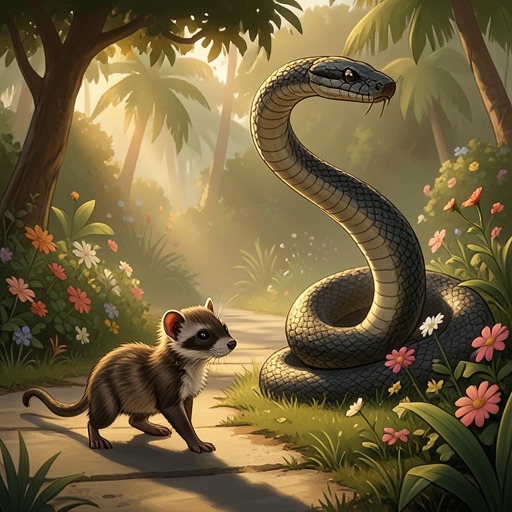
The Jungle BookRikki-Tikki-Tavi kills Nagaina in the decisive final encounter of the cobra conflict. The action begins when Nagaina uses Teddy as a motionless target on the veranda, turns the last surviving egg into a point of leverage, and escapes toward her underground refuge. Rikki-Tikki-Tavi follows her into the rat-hole, accepts the danger that few mongooses would face, and emerges alone to announce that the widow will never return. The value at stake shifts from imminent danger for Teddy and his parents to the garden’s restored safety.
Causes and Immediate Stakes
The confrontation follows Rikki-Tikki-Tavi’s discovery of Nagaina’s twenty-five eggs in the melon patch. He has already crushed most of them because each young cobra could kill a man or a mongoose; when Darzee’s wife warns that Nagaina has entered the veranda to kill, only three eggs remain, and Rikki-Tikki-Tavi carries the last one with him. The egg is not merely a remnant of the brood but the one object capable of interrupting Nagaina’s attack and drawing her away from her human victims.
Nagaina is coiled beside Teddy’s chair, within striking distance of his bare leg, while Teddy, his mother, and his father sit rigid and white-faced. Her threat is deliberately double-sided: movement may provoke a strike, but stillness offers no safety either. She reminds Teddy that his father killed Nag and presents the family’s helplessness as the final advantage of the cobra pair. Rikki-Tikki-Tavi therefore enters a scene in which the immediate objective is not simply to defeat Nagaina but to prevent her from choosing the moment of Teddy’s death.
The Veranda Duel
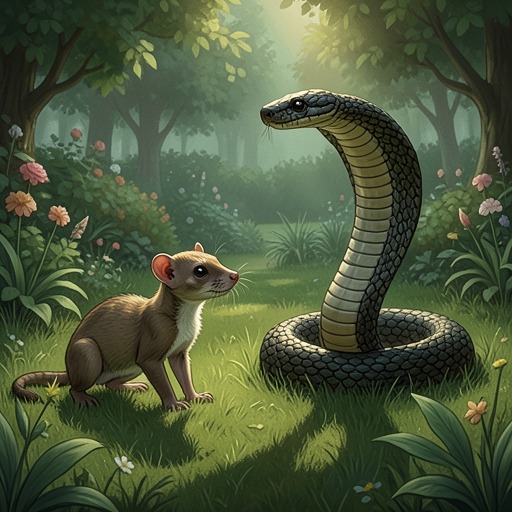
Rikki-Tikki-Tavi challenges Nagaina directly, ordering her to turn and fight, but she initially keeps her attention on the family and claims that she will settle her account with him later. He counters by directing her attention to the eggs in the melon bed. When she sees the final egg on the veranda, he places his paws on either side of it and taunts her with the destruction of the rest of the brood, making the last egg the center of their contest.
Nagaina spins around for the egg, and that moment allows Teddy’s father to seize Teddy by the shoulder and pull him across the small table, safely beyond Nagaina’s reach. The rescue is achieved through coordinated action: Rikki-Tikki-Tavi creates the opening by controlling Nagaina’s attention, while Teddy’s father converts the opening into physical safety. Rikki-Tikki-Tavi then declares that he was the one who caught Nag by the hood in the bathroom and killed him before the big man shot him. The revelation turns the encounter into an explicit reckoning between the mongoose and the surviving cobra.
Nagaina offers to leave forever in exchange for the egg, lowering her hood as she bargains. Rikki-Tikki-Tavi rejects the promise and insists that she will go to the rubbish heap with Nag. He keeps the fight active while Teddy’s father goes for his gun, refusing to let Nagaina regain control of the situation. The duel becomes a contest of reach and timing: Rikki-Tikki-Tavi bounds around her just outside the range of her stroke, while she repeatedly strikes at him and crashes her head against the veranda matting.
Pursuit into the Rat-Hole
The fight nearly fails because Rikki-Tikki-Tavi forgets the egg. Nagaina creeps toward it while he pauses to draw breath, seizes it in her mouth, and races down the path. She heads for the long grass and the thorn-bush, aiming for the rat-hole where she and Nag had lived. Rikki-Tikki-Tavi understands that catching her is essential, because allowing her to escape with the egg would permit the danger to begin again through the surviving brood.
Darzee’s wife helps by flying at Nagaina’s head and delaying her for an instant; Darzee himself is still singing a premature song of triumph. The delay is enough. As Nagaina plunges into the hole, Rikki-Tikki-Tavi catches her tail in his teeth and follows her underground. The decision is exceptionally dangerous because the darkness may open into a wider space where Nagaina can turn and strike. He holds on savagely and braces his feet against the hot, moist earth as brakes on the slope, converting his small body into an anchor against the fleeing cobra.
Death and Aftermath
The grass at the mouth of the hole stops moving, and Darzee assumes that Rikki-Tikki-Tavi is dead, beginning a death song for him. The apparent reversal intensifies the danger: from outside, the underground struggle cannot be seen, and the cobra’s familiar refuge appears to have swallowed the mongoose. Then the grass quivers again, and Rikki-Tikki-Tavi drags himself out leg by leg, covered with dirt and licking his whiskers. He reports that the widow will never come out again, confirming Nagaina’s death without describing the unseen final blow.
Rikki-Tikki-Tavi sleeps in the grass until late afternoon because the fight has exhausted him. On waking, he plans to return to the house and have Darzee tell the Coppersmith so that the garden will learn that Nagaina is dead. The immediate consequence is therefore both practical and communal: Teddy is safe, the last cobra has been removed, and the news is carried outward through the garden’s network of creatures.
Narrative and Thematic Significance
The action completes a pursuit-and-rescue sequence whose central reversal is the transformation of Nagaina’s apparent control into vulnerability. She begins with Teddy immobilized beside her, but the last egg makes her desire legible and manipulable. Her maternal claim to the brood becomes the means by which Rikki-Tikki-Tavi draws her away from the family, while the escape that seems to restore her advantage instead leads her into the confined darkness of her own refuge.
The episode also gives animal characters political and ethical agency. Rikki-Tikki-Tavi judges the cobra threat, destroys the eggs, protects the human household, and makes a deliberate decision to enter the rat-hole despite the risk. Darzee’s wife acts decisively at the critical moment, whereas Darzee’s celebratory song repeatedly mistakes appearance for outcome. The contrast between premature public confidence and the mongoose’s stubborn physical action keeps the scene focused on verified consequence rather than ceremony.
The ending restores order, but it does not make victory effortless or bloodless. The veranda has held Teddy’s life in suspension; the path and thorn-bush carry the conflict away from the house; and the rat-hole becomes the final arena where safety can be secured only by pursuing danger to its source. Rikki-Tikki-Tavi’s emergence, dirt-covered and exhausted, joins triumph to cost. His announcement that Nagaina will never return is the garden’s definitive change in condition: the recurring threat represented by Nag and Nagaina has ended.