Rikki-tikki-tavi
The Jungle BookRikki-tikki-tavi is the mongoose at the center of the great conflict in the bath-rooms and garden of the bungalow at Segowlee cantonment. Although Darzee assists him and Chuchundra offers advice, the narrative assigns the actual fighting to Rikki-tikki: he is the small defender whose speed, teeth, and refusal to remain frightened overcome the snakes that threaten both the human household and the garden’s other inhabitants.
Identity and Introduction
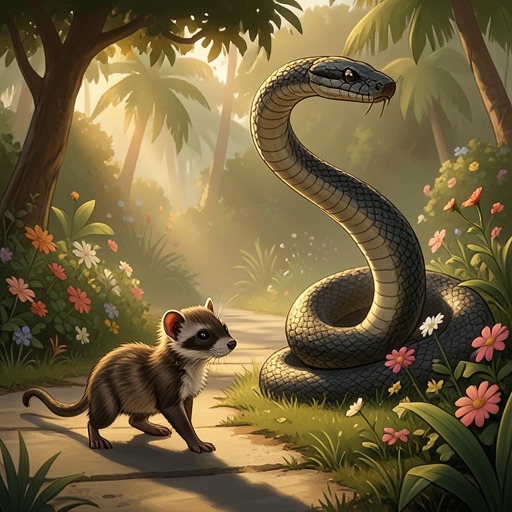
Rikki-tikki is described as a mongoose resembling a little cat in his fur and tail but a weasel in his head and habits. His eyes and the end of his restless nose are pink, he can scratch himself with any leg, and he can raise his tail until it resembles a bottle brush. His repeated war cry, "Rikk-tikk-tikki-tikki-tchk!", gives his movement an audible signature: he is introduced not as a silent or contemplative protector but as a creature whose energy announces itself through scuttling, springing, and battle.
His arrival in the human garden is itself a violent interruption. A high summer flood washes him from the burrow where he lives with his father and mother and carries him, kicking and clucking, down a roadside ditch. He clings to a floating wisp of grass until he loses consciousness, then revives on a hot garden path, thoroughly draggled, while Teddy mistakes him for a dead mongoose. Teddy’s mother brings him inside to dry him, and this act of rescue creates the household connection that Rikki-tikki will later defend.
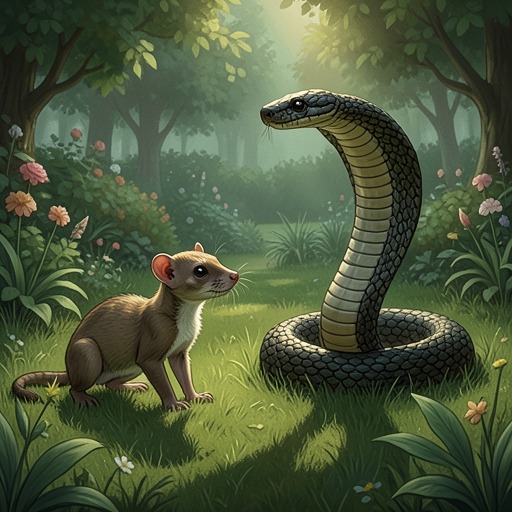
The family’s care does not make him tame in the ordinary sense. It gives him a place from which his natural vocation can operate. His mother had fed him on dead snakes, and he knows that the business of a grown mongoose is to fight and eat snakes. When he first confronts Nag, he is briefly afraid because he has never met a live cobra, but the fear cannot hold him. The scene establishes a governing contrast: Nag possesses size, venom, hood, and an inherited sacred mark, while Rikki-tikki possesses the trained instinct to close distance and strike.
Life and Plot Trajectory
Rikki-tikki’s first decisive fight is against Karait, the dusty brown snakeling that lies on the dusty earth and is so small that people overlook him. Karait’s bite is as dangerous as a cobra’s, and his small size makes him especially difficult to fight because he can turn quickly. When Teddy approaches, Karait warns that he is Death, but Rikki-tikki responds by dancing toward him with the rocking, swaying gait inherited from his family.
The encounter is dangerous precisely because Rikki-tikki must attack at close range. Karait strikes, Rikki-tikki jumps sideways, and the snake’s head follows his heels. Rikki-tikki eventually springs onto Karait’s back, drops his head between his forelegs, and bites as high up the back as he can reach. The bite paralyzes Karait. He is about to eat the snake from the tail, following his family’s custom, but restrains himself because a full meal would make him slow. Keeping himself thin preserves the strength and quickness required for the larger campaign still ahead.
The household interprets the victory as a rescue. Teddy calls to the house that their mongoose is killing a snake; Teddy’s mother screams, and his father runs out with a stick. By the time the father arrives, Karait has lunged too far and Rikki-tikki has completed the attack. Teddy’s mother hugs him and says that he has saved Teddy from death, while Teddy’s father calls him a providence. Rikki-tikki does not understand the fuss and is more amused than solemn, but the family’s gratitude marks a change in his status: the rescued animal has become the household’s active protector.
That evening, even while he enjoys food, pats, and Teddy’s shoulder, Rikki-tikki cannot settle into domestic comfort. His eyes redden from time to time, and he breaks into his war cry because Nag and Nagaina remain alive. The tenderness of the household and the pressure of the garden’s danger therefore coexist. Affection is not an alternative to his duty; it makes the danger more immediate and gives his fighting a concrete object.
Nag’s attack on the bungalow turns the conflict from garden danger into direct household warfare. Nag enters the bath-room and waits near the water jar, while Rikki-tikki reasons that the decisive target is the head above the hood and that, once he reaches it, he must not let go. He bites the head under the curve of the jar and braces his back against the red earthenware to gain one second of purchase. Nag batters him across the floor, upsetting the tin dipper, soap dish, and flesh brush and striking the tin side of the bath, but Rikki-tikki keeps his jaws closed.
The fight reaches its apparent limit when the big man wakes and fires both barrels of a shotgun into Nag just behind the hood. The blast knocks Rikki-tikki senseless and singes his fur, yet his grip has held. When he regains awareness, the big man identifies him as the mongoose who has saved their lives. Rikki-tikki is badly shaken and spends much of the night testing his body, but Nag is dead. His victory has depended on a combination of personal attack and human intervention: he creates the opening, endures the danger, and remains attached long enough for the household’s weapon to finish the cobra.
The final pursuit carries Rikki-tikki into Nagaina’s underground refuge. Darzee believes that he has died and begins composing a death song while the grass at the mouth of the hole stops waving. The expectation of Rikki-tikki’s death is reversed when he emerges covered with dirt, dragging himself out leg by leg and licking his whiskers. He announces that the widow will never come out again. He then sleeps in the grass until late afternoon, the rest following the exertion of the underground fight rather than diminishing its scale.
Relationships and Conflict
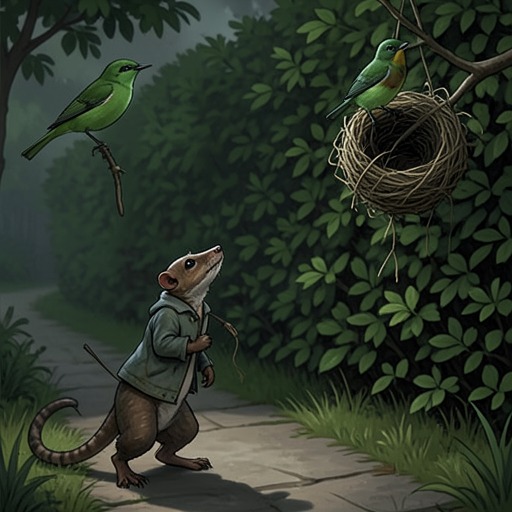
Rikki-tikki’s most important conflict is with Nag and Nagaina, whose presence makes the garden unsafe. Nag recognizes that mongooses in the garden mean death sooner or later for him and his family, and he is afraid even while trying to manipulate Rikki-tikki. The cobra’s hood, spectacle-mark, and invocation of the mark placed upon cobras by the god Brahm attempt to turn physical superiority into authority. Rikki-tikki answers that marks do not justify eating fledglings from a nest. His challenge reduces the confrontation to conduct and consequence: the cobra’s inherited prestige cannot excuse predation.
His relationship with the human family is formed through mutual rescue. Teddy’s mother saves him from the flood’s aftermath, and Rikki-tikki later saves Teddy from Karait and the household from Nag. Teddy’s father supplies the stick in the first encounter and the shotgun in the bath-room, but Rikki-tikki remains the necessary agent who detects, engages, and holds the snakes. Teddy, meanwhile, becomes both the child under threat and the figure who publicly recognizes the mongoose’s courage.
Darzee is Rikki-tikki’s active ally and celebrant. He helps in the war, watches the entrances to danger, and sings a death song when he believes Rikki-tikki has been killed. His song makes the mongoose’s apparent death part of the garden’s shared emotional life, while Rikki-tikki’s emergence turns mourning into astonishment. Chuchundra, who never comes into the middle of the floor and instead creeps around the wall, contributes advice rather than combat. Their different forms of assistance emphasize that Rikki-tikki’s role is not solitary in a literal sense, even though the decisive physical fighting belongs to him.
Change, Ending, and Significance
Rikki-tikki changes from a flood-stranded animal into an established guardian. At first he is found helpless on a garden path, mistaken for dead and dependent on the household’s decision to take him in. By the end, he is sufficiently confident to tell the garden that all the cobras are dead, and sufficiently disciplined not to become vain. His pride is justified, but it does not replace vigilance.
The ending defines his victory as a continuing responsibility rather than a single heroic climax. Rikki-tikki keeps the garden as a mongoose should, using tooth, jump, spring, and bite until no cobra dares show its head inside the walls. The repeated forms of movement that characterized him from the beginning become the terms of permanent security. He does not merely defeat one enemy; he establishes a new condition in which the threat no longer enters.
His character combines instinct with judgment. He fights because mongoose nature demands it, but he also chooses not to eat Karait when doing so would slow him, distinguishes the head as the crucial point of attack, and refuses to release Nag despite overwhelming physical punishment. Courage here is not the absence of fear or pain. It is the ability to convert fear, speed, inherited knowledge, and bodily endurance into protective action.
Rikki-tikki’s narrative significance lies in the way a small animal acquires heroic scale without ceasing to be an animal. He does not seek human praise, cannot understand the household’s fuss, and treats the final safety of the garden as the proper execution of his nature. The story’s lasting image is therefore not of a conqueror claiming power, but of a tireless guardian returning to ordinary vigilance after extraordinary violence.