Rikki-tikki-tavi and Nagaina
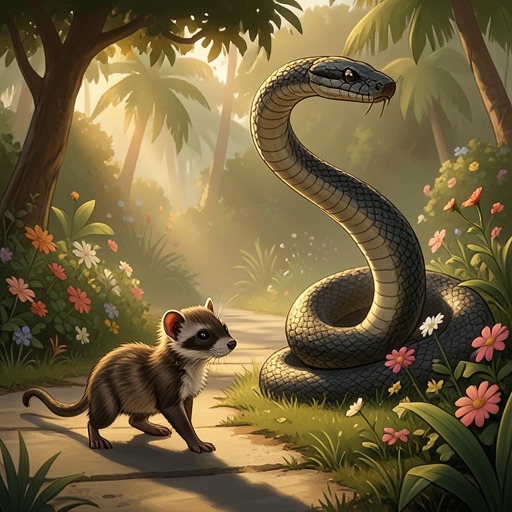
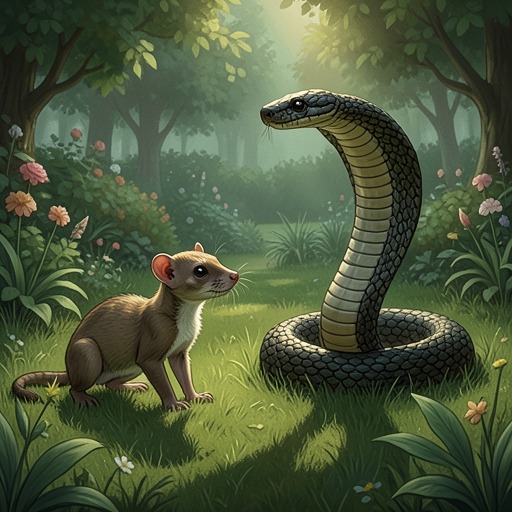
The Jungle BookRikki-tikki-tavi and Nagaina are mortal enemies whose conflict determines whether the garden will remain a refuge for the human family or return to cobra rule. Their struggle is not a single contest but a tightening sequence of attacks, threats, discoveries, and pursuits: Nagaina tries to eliminate the mongoose and the people who shelter him, while Rikki-tikki-tavi answers by defending the household, destroying her unborn brood, and finally following her into the rat-hole from which she and Nag had ruled the garden.
Origins of the Enmity
The hostility begins as a contest over territory and survival. Nagaina is Nag’s wife and his partner in governing the garden through fear. When she catches Rikki-tikki-tavi speaking with Darzee, she attempts to strike him from behind. Rikki-tikki-tavi leaps into the air as her head flashes beneath him, then lands across her back and bites her before escaping the cobra’s return stroke. The bite is not held long enough to break her back, leaving Nagaina wounded, enraged, and alive. The failed attack establishes the relationship’s defining pattern: each opponent is close enough to kill the other, but a missed opportunity turns immediate victory into a more dangerous future confrontation.
Nagaina’s purpose is made explicit when she and Nag whisper outside the bathroom sluice. She argues that once the bungalow is emptied of people, the garden will belong to them again, as it had before the people arrived and before any mongoose lived there. She also links the planned murders to her eggs in the melon bed, which may hatch the next day and require room and quiet. Her violence is therefore strategic as well as retaliatory: the human family is an obstacle to cobra dominion, and Rikki-tikki-tavi is the protector who must be removed before the garden can be reclaimed.
The Conflict Over the Household
Nagaina’s plan places the family directly inside the feud. She tells Nag to enter quietly and bite first the big man who killed Karait, then proposes that the two cobras hunt Rikki-tikki-tavi together. Nag expands the plan to include the man, his wife, and the child if possible, believing that an emptied bungalow will cause the mongoose to leave. Rikki-tikki-tavi overhears the conspiracy and responds with rage, but the sight of Nag’s five-foot body also frightens him. The conflict thus moves beyond a private animal rivalry: the cobra couple seek to make the family’s presence itself impossible, while the mongoose must defend people who are vulnerable precisely because they cannot fight the snakes on equal terms.
Nag’s death changes the balance without ending the danger. After Rikki-tikki-tavi kills him, Rikki-tikki-tavi recognizes that Nagaina remains and may be more dangerous than several Nags. He also knows that the eggs may hatch at any moment. Nagaina consequently becomes the sole active cobra enemy, carrying both the desire for revenge and the biological future of the threat. The death of her husband does not make her withdraw; it concentrates the conflict around her and gives the final pursuit its urgency.
Eggs, Threats, and Reversal
Nagaina’s most decisive advantage is her hidden brood. Rikki-tikki-tavi finds twenty-five eggs in the warm litter above the melons, each about the size of a bantam’s egg and covered with whitish skin rather than a shell. He can see the baby cobras curled inside and understands that each could kill a man or a mongoose as soon as it hatched. He therefore bites off the tops, crushes the young cobras, and repeatedly turns the litter to make sure none is missed. The eggs transform the feud from revenge between two surviving enemies into a race against multiplication: Nagaina’s victory would have produced a new generation of lethal cobras, whereas Rikki-tikki-tavi’s destruction of the eggs limits the danger to the adults.
Nagaina nevertheless retains one egg, and she uses it to lure Rikki-tikki-tavi into a confrontation at the veranda. She coils beside Teddy’s chair within striking distance of Teddy’s bare leg while Teddy, his mother, and his father sit motionless with white faces. She threatens the child and the adults at once, making movement itself dangerous: if they move, she will strike, and if they remain still, she claims she will strike anyway. The scene gives Nagaina temporary control over the family’s bodies and turns the veranda into a space of suspended violence.
Rikki-tikki-tavi breaks that control by drawing Nagaina away from Teddy and seizing the remaining egg. Nagaina lowers her hood and offers to leave if he gives it back, but Rikki-tikki-tavi refuses the bargain and challenges her to fight, knowing that the egg is the last chance for her brood. The value at stake shifts from the family’s immediate survival to the removal of the future threat as well. Nagaina’s threat has forced Rikki-tikki-tavi into the open, but the egg gives him a counterclaim: he can deny her both revenge and continuation.
The Final Pursuit
The last combat is a contest of movement and endurance. Rikki-tikki-tavi bounds around Nagaina just outside the reach of her strikes, while she repeatedly flings herself at him, her head striking the veranda matting before she recoils and gathers herself like a watch spring. He circles to get behind her, and she spins to keep her head facing him. Yet the intensity of the duel produces a moment of danger: Rikki-tikki-tavi forgets the egg, and Nagaina manages to seize it and flee toward the thorn-bush.
The pursuit becomes a race through the garden. Darzee continues singing his triumph, but Darzee’s wife acts more effectively, flapping around Nagaina’s head and delaying her for an instant. That small interruption allows Rikki-tikki-tavi to catch up. When Nagaina plunges into the rat-hole where she and Nag once lived, Rikki-tikki-tavi clamps his teeth onto her tail and follows her underground, despite the extreme danger. In the darkness he cannot know when the tunnel may widen enough for Nagaina to turn and strike. He braces his feet against the hot, moist earth and holds on, converting his smaller body into an anchor against the cobra’s escape.
The grass at the hole’s mouth stops moving, and Darzee assumes that Nagaina has killed him. A death song begins, but the apparent ending is reversed when Rikki-tikki-tavi drags himself out covered in dirt, licking his whiskers. He declares that the widow will never come out again. The victory is therefore confirmed not by a witnessed underground blow but by the cobra’s permanent absence and by Rikki-tikki-tavi’s return from the place where he was expected to die.
Consequences and Significance
Nagaina’s death ends the cobra reign over the garden. Rikki-tikki-tavi asks Darzee to tell the Coppersmith, the garden’s news-carrier, and the announcement spreads in rhythmic calls that Nag is dead and Nagaina is dead. Birds sing and frogs croak because the cobras had eaten both small birds and frogs. The public response makes the relationship’s conclusion communal: what began as a hidden contest between predator and defender becomes news that restores the garden’s wider life.
The family’s reaction confirms the human cost that Rikki-tikki-tavi has prevented. Teddy’s mother, still pale from the ordeal, and Teddy’s father come out and nearly cry over him; she tells her husband that he saved all their lives, including Teddy’s. Rikki-tikki-tavi then eats everything given to him and sleeps on Teddy’s shoulder. The final image reverses the fear governing the veranda: the child who had been held within Nagaina’s striking distance now carries the mongoose in a position of trust and safety. Their enmity ends not in reconciliation but in the destruction of Nagaina and the restoration of the household’s security.