Seal
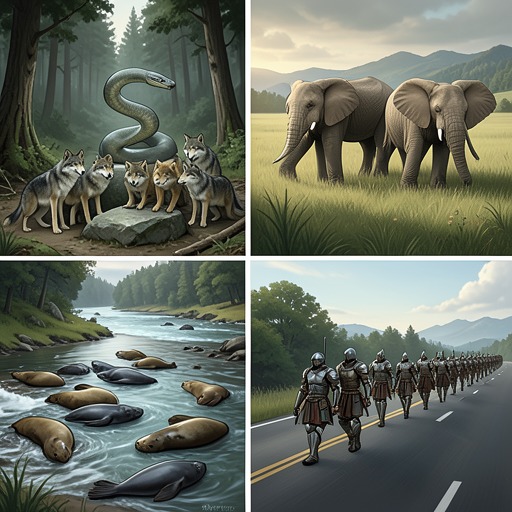
The Jungle BookThe Seal is presented not as a decorative background animal but as a socially organized people with territories, customs, family life, songs, rivalries, memory, and political resistance. At Novastoshnah, immense seasonal gatherings bring hundreds of thousands of seals together, while the experience of the killing grounds forces Kotick and eventually an entire community to question whether inherited habits can preserve them.## Society and Seasonal Life At Novastoshnah, or North East Point on Saint Paul Island in the Bering Sea, seals arrive in the summer by the hundreds of thousands because the beach offers exceptional nursery ground. The scale of this migration makes the rookery a society rather than a mere crowd. Adult males compete for reservations on the rocks nearest the sea, while females arrive later, in late May or early June, after the worst fighting has diminished. Young two-, three-, and four-year-old seals who have not begun housekeeping form the bachelor population known as the holluschickie; at Novastoshnah alone, their number may reach two or three hundred thousand.
The spring settlement is governed by violence but not by unlimited violence. Sea Catch, a fifteen-year-old gray fur seal nearly seven hundred pounds in weight and more than four feet high when raised on his flippers, fights repeatedly for space. His body bears the scars of savage contests, and he attacks by fixing his long teeth in an opponent's neck. Yet he does not pursue a beaten rival, because the Rules of the Beach forbid that excess. His aim is room for a nursery, not destruction for its own sake. The crowded beach therefore resembles a harsh political order in which territory, reproduction, and restraint are inseparable.
The rookery is also a world of sound and collective movement. From Hutchinson's Hill, an observer can see three and a half miles covered with fighting seals, while the surf is dotted with animals hurrying ashore. They fight in the breakers, on the sand, and across the smooth basalt rocks of the nurseries; the bachelors play inland among the dunes, stripping away the green growth. The narration compares their quarrelsome lack of accommodation to that of men, but the comparison also gives the seals their own social logic: they possess customs and institutions before human observers impose a system upon them.## Family, Song, and the White Seal Sea Catch's household introduces the seal as a creature of kinship as well as contest. After his forty-fifth fight of one spring, he receives Matkah, his gentle-eyed wife, and claims a nursery reservation for their family. Matkah later announces that their baby will be white, a condition Sea Catch initially rejects as impossible. Her certainty, followed by the birth of Kotick, establishes the white seal as an exception within the species and as a visible mark that separates one individual from the ordinary social body.
Matkah's response to motherhood is expressed through the Seal Lullaby, which warns the young seal not to swim until six weeks old. The song is both a practical instruction and a cultural inheritance: the mother seals sing it to their babies, turning survival knowledge into communal memory. Elsewhere the seals sing Lukannon, the sad national song of the Saint Paul seals while they return to their beaches. Through these songs, the species possesses a history and emotional vocabulary of its own, not merely reactions supplied by a human narrator.
Kotick's whiteness makes him conspicuous, but his decisive difference comes from what he sees. He follows a drove toward the killing grounds and witnesses men separating the animals, cooling them so their fur will not be damaged, and clubbing them with iron-bound weapons. The journey of only half a mile takes an hour because the men deliberately regulate the seals' pace; after the slaughter, Kotick no longer recognizes his friends, whose skins have been ripped away and piled on the ground. He escapes to the sea horrified, carrying knowledge that the other seals lack.
When Kotick returns, the community refuses his interpretation of its life. The seals say that men have always driven the holluschickie and that anyone unwilling to see ugly things should not visit the killing grounds. Sea Catch advises his son to grow large, establish a nursery, and wait five years until he can fight for himself; Matkah likewise tells him that he cannot stop the killing. The response reveals a central conflict within seal society: inherited custom offers continuity, but it also normalizes a danger that Kotick has personally witnessed.## Kotick's Search for Safety Kotick's response to the community's resignation is a quest for another social space. He leaves the beach in autumn and travels alone, determined to find Sea Cow and a firm, quiet island where men cannot reach the seals. His search carries him across the North and South Pacific; he can swim as much as three hundred miles in a day and a night. He narrowly escapes several kinds of shark and encounters the varied inhabitants of the open sea, yet finds neither Sea Cow nor a suitable island on his first attempts.
The search changes the meaning of the white seal's difference. At first whiteness makes Kotick an object of curiosity and isolation. After the killing, however, it becomes associated with unusual perception and responsibility. The other seals have not seen what he has seen, so their refusal to sympathize is not simply cruelty; it is the consequence of a divided knowledge. Kotick's journey turns that private witness into a public purpose, asking the group to exchange familiar beaches for an unknown refuge.
Eventually Kotick finds the Sea Cow's tunnel and a protected rookery beyond it. He returns to persuade the seals, but persuasion alone cannot overcome their distrust. At the decisive confrontation, he fights for his claim and is wounded until he is red from head to tail. The injuries demonstrate that his authority is not granted by his exceptional color or by a speech alone; it is earned through bodily risk on behalf of the community. When thousands of tired voices agree to follow him, the white seal becomes a leader whose difference has been converted into collective action.## Migration and Collective Change A week after the decision, Kotick leads nearly ten thousand holluschickie and old seals north to the Sea Cow's tunnel. The seals who remain at Novastoshnah call them idiots, showing that social change begins as a breach with the established majority. The new colony is not created through a sudden conversion of every seal. Instead, its existence becomes known through reports exchanged when the groups meet off the Pacific fishing banks.
More seals leave year after year, slowly abandoning Novastoshnah, Lukannon, and other nurseries for the quiet, sheltered beaches. The narrative emphasizes that the seals are not very clever and need a long time to turn a new possibility over in their minds; their eventual migration is therefore collective change in its most material form. A new idea becomes persuasive because it is embodied in a place where the danger has been removed.
Kotick remains at the refuge through the summer, growing larger, fatter, and stronger while the holluschickie play around him in waters where no man comes. The ending gives safety a physical geography. Freedom is not an abstract moral reward but a beach, a tunnel, and a sea beyond human access. The seals preserve their social life—nurseries, bachelors, families, play, and seasonal movement—while escaping the human economy that had made their bodies into commodities.## Narrative Significance The Seal story combines an animal fable with a narrative of witness. Its seals speak, organize, remember, sing, and make decisions, so they occupy the position of subjects rather than scenery. Human beings enter the account primarily as agents of capture and killing, while the seals' own institutions—the Rules of the Beach, the nursery reservations, the songs, and the migration—supply the story's moral and political framework.
The species also provides a contrast with other animal societies in the book. Jungle animals are governed by the Law of the Jungle, while seals follow the Rules of the Beach; both systems show that nonhuman communities possess norms regulating access, conflict, and survival. Yet the seal narrative is especially concerned with the failure of custom when an external power exploits it. Sea Catch's advice to wait and become strong protects one individual, not the species. Kotick's achievement lies in recognizing that survival requires changing the group's space, not merely hardening one animal within the old order.
The seal therefore represents both continuity and transformation. Its seasonal gatherings, parental songs, and territorial contests preserve an ancient communal pattern, while Kotick's discovery forces that pattern to migrate. The final image of seals living where no man comes completes the movement from exposed abundance to chosen refuge: the community survives not by defeating every human hunter, but by finding a world in which the hunters cannot reach it.