Seeonee Wolf Pack
The Jungle BookThe Seeonee Wolf Pack is the principal wolf society of Mowgli's childhood and the institution that turns his impossible status as a human child into a recognized place within the jungle. Governed by the Law of the Jungle, it is presented both as a disciplined community with procedures for admission and protection and as a political body vulnerable to fear, faction, and predatory influence. Its acceptance of Mowgli gives him a family and a language; its later betrayal makes his departure for human society inevitable.
Nature and Organization
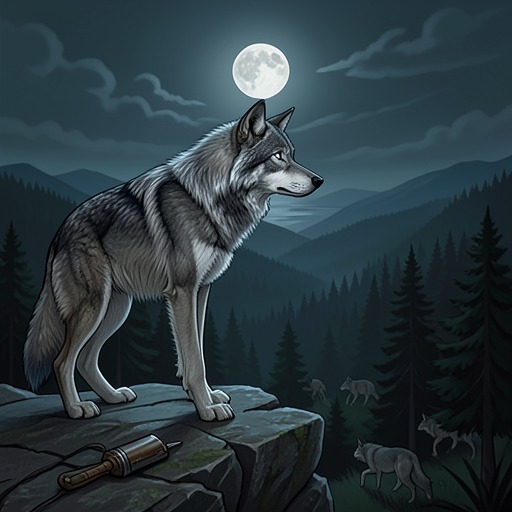
The Pack is led by Akela, the great gray Lone Wolf, whose authority rests on strength, cunning, experience, and the trust of the wolves. At the Pack Meeting, more than forty wolves gather beneath the full moon at Council Rock, a hilltop of stones and boulders where a hundred wolves could hide. The gathering is quiet and formal rather than disorderly: cubs tumble in the center while senior wolves inspect them one by one, and mothers sometimes push their cubs into the moonlight to ensure that no member is overlooked. Akela calls, "Ye know the Law—ye know the Law. Look well, O Wolves!" and the mothers answer, "Look—look well, O Wolves!" The ritual makes membership a public act of recognition rather than a private family decision.
The Pack's rules also define the responsibilities of parents and the rights of young wolves. A wolf may withdraw from the Pack upon marriage, but once the cubs can stand, they must be brought before the Pack Council so that the other wolves can identify them. After inspection, the cubs may run freely, and a grown wolf who kills one before its first buck is subject to death if the murderer can be found. The severity of this protection reflects the Pack's dependence on continuity: law preserves the vulnerable young and prevents private violence from destroying the group.
The Seeonee Wolf Pack belongs to the wider social order called the Free People, but its freedom is not lawlessness. The Law of the Jungle forbids beasts to eat Man except in the narrow case of an adult teaching its young to kill, and even then the hunt must occur outside the hunting ground of the relevant pack or tribe. The stated reason is ecological and political as well as moral: man-killing brings armed white men on elephants, guns, gongs, rockets, and torches, causing suffering throughout the jungle. The Pack's law therefore connects local conduct to collective survival, even when individual predators such as Shere Khan reject that restraint.
Mowgli's Admission and Education
Mowgli enters the Pack under exceptional circumstances. When Shere Khan comes to the wolf cave demanding the man's cub as his quarry, Father Wolf refuses to surrender him. At the Council Rock, Mowgli is placed among the wolf cubs while the Pack conducts its customary inspection. Shere Khan claims that the cub belongs to him and asks what the Free People have to do with a man's cub, but Akela refuses to let the tiger dictate the Pack's decision.
Because the Law requires at least two Pack members other than the parents to speak for a disputed cub, Mowgli's acceptance depends on collective advocacy. Baloo, the brown bear who teaches the wolf cubs the Law of the Jungle, rises to defend him. Bagheera then offers the price of a bull for the cub's life. Akela accordingly orders Father Wolf to take Mowgli away and train him as one of the Free People. The Pack's admission is thus both legal and material: Baloo supplies moral authority, Bagheera supplies the required payment, and the wolf family supplies daily care.
For the next ten or eleven years, the Pack forms the structure of Mowgli's education. Father Wolf teaches him the meanings of the jungle, so that every rustle, breath, owl note, bat's claws, and splash of a fish becomes intelligible. Mowgli grows among the wolf cubs and learns the practical knowledge by which the Pack survives, while Baloo teaches the formal Law that makes him more than a creature merely tolerated at the cave. His identity is produced through repeated participation: he is not simply sheltered by wolves but trained to perceive, move, and judge within their world.
Leadership and Political Fracture
The Pack's political balance changes when Akela grows old and misses a kill. At the later Council Rock meeting, Akela lies beside his rock, signaling that leadership is open. Shere Khan and the wolves who follow him move openly through the assembly, enjoying the deference that Akela's former authority once prevented. Shere Khan begins speaking in the council, something he would never have dared while Akela was in his prime, and his challenge reveals that the Pack's institutions have become exposed to intimidation.
Akela accepts the legal consequence of failure. He explains that he has led the wolves for twelve seasons without allowing one to be trapped or maimed, but that his missed kill was arranged to display his weakness. Under the Law, the Pack has the right to kill its fallen leader on Council Rock, one wolf at a time. Yet the wolves remain silent because none wishes to fight Akela to the death. The pause exposes the difference between a rule's existence and a community's willingness to uphold it honorably.
Shere Khan uses that hesitation to redirect the council's anxiety toward Mowgli. He calls the human child his meat from the beginning, complains that the man-wolf experiment has troubled the jungle for ten seasons, and threatens to hunt on the Pack's ground while withholding food unless Mowgli is surrendered. More than half the Pack answers that Mowgli is a man and should return to his own place. The Pack's earlier legal reasoning is displaced by fear, opportunism, and the rhetoric of racial or species exclusion.
Expulsion and Farewell
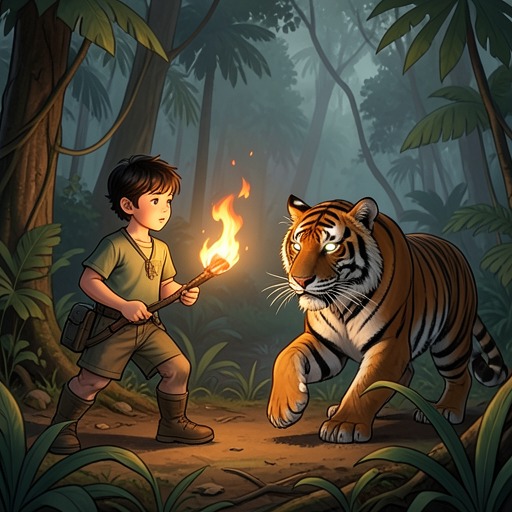
Mowgli responds to the Pack's betrayal by asserting the power it once taught him. With Bagheera beside him and the fire pot between his knees, he rejects the wolves who have abandoned their own law. He declares that he will go to his own people, promises not to betray the Pack to humans, and insists that no war will follow between them. Before leaving, however, he makes Shere Khan pay the immediate debt of his threats: he seizes the tiger by the chin, threatens him with the Red Flower, and beats him over the head with a blazing branch until Shere Khan whimpers in fear.
The scene reverses the Pack's hierarchy. A human child who was once defenseless before the cave entrance now controls the tiger who tried to claim him and speaks with the authority of a man among wolves. Mowgli's mercy toward the Pack contrasts with its failure of loyalty. He does not destroy the society that raised him; instead, he refuses its corrupted leadership and leaves after declaring that the jungle is closed to him.
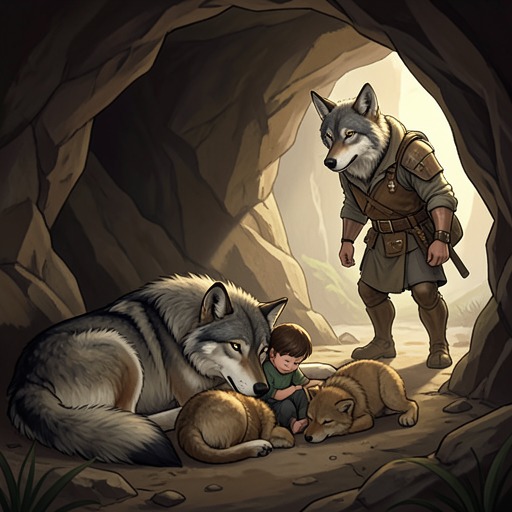
His departure is nevertheless a separation from a genuine family. At the cave, Mowgli cries on Raksha's coat while the four wolf cubs howl. The cubs promise that they will never forget him and will meet him at the foot of the hill when he becomes a man, even entering the croplands at night to play with him. Father Wolf asks him to return soon, calling him a wise little frog, while Raksha says that she loved him more than she had ever loved her own cubs. The Pack therefore remains divided in Mowgli's memory: its political body expels him, but its household preserves a bond deeper than the council's verdict.
Narrative Significance
The Seeonee Wolf Pack is the book's clearest experiment in a society where law is meant to restrain appetite and protect the collective. Its procedures at Council Rock, its inspection of cubs, its protection of young members, and its prohibition against man-killing all show an adaptive social order shaped by danger, territory, and shared memory. The Pack understands that a single reckless act can bring armed humans into the jungle, just as the wider animal world recognizes that human settlements, abandoned cities, and hunting grounds are spaces marked by competing systems of power.
At the same time, the Pack demonstrates how institutions can fail when their members cease to act according to their own principles. Akela's decline leaves a vacancy that Shere Khan exploits; the wolves' fear of conflict allows an outsider to influence succession; and Mowgli's difference becomes a convenient target for a faction seeking control. The Pack's collapse is not caused by the absence of law but by the abandonment of law's purpose.
Mowgli's life also makes the Pack a border institution between species and cultures. He learns the jungle as thoroughly as any wolf, yet his human nature remains the source of both his danger and his power. The Red Flower, which the wolves fear, enables him to defend Akela and confront Shere Khan, while the language and discipline acquired from the Pack allow him to leave without betraying it. The Seeonee Wolf Pack thus gives Mowgli his first social identity, teaches him the obligations of belonging, and finally teaches him that belonging may have to be refused when the community turns against its own law.