Segowlee Cantonment
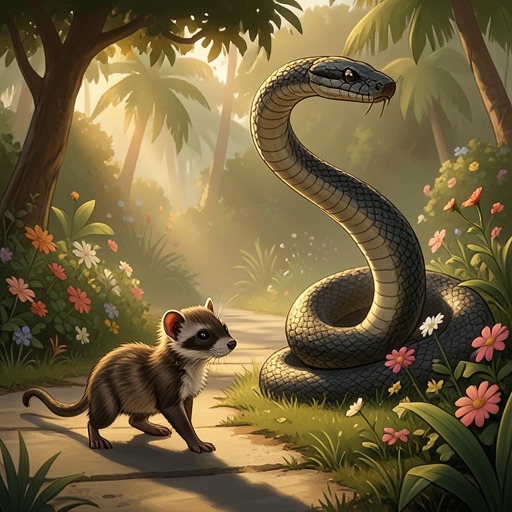
The Jungle BookSegowlee Cantonment is the military setting of Rikki-tikki-tavi’s great conflict with Nag and Nagaina, a place where a human household and a dangerous garden become a shared defensive territory. The cantonment’s cultivated grounds, rooms, and water channels bring wild animal struggle into domestic space, while Rikki-tikki-tavi’s presence turns the household into a protected boundary that no cobra is allowed to cross.
Setting and Domestic World
Segowlee Cantonment first appears as the place associated with Rikki-tikki-tavi’s origins: his mother had once lived in the general’s house there, and she had instructed him how to behave if he ever encountered white men. After a high summer flood sweeps the young mongoose from his family burrow and carries him down a roadside ditch, he is found unconscious on a garden path by a household with a small boy named Teddy. The cantonment therefore becomes a place of accidental refuge, where floodwater carries a creature out of one social world and into another.
The household receives Rikki-tikki-tavi as a living companion rather than as a captured pest. He rides on Teddy’s shoulder at breakfast and is given banana and boiled egg; he sits on the family’s laps and explores the rooms with energetic curiosity. His first day reveals the domestic geography he will later defend: he nearly drowns in the bath-tubs, investigates ink on a writing table, burns his nose on the big man’s cigar, watches kerosene lamps being lit in Teddy’s nursery, and remains alert on the pillow through the night. The father regards him as a better safeguard for Teddy than a bloodhound would be if a snake entered the nursery, even though Teddy’s mother fears that the mongoose might bite the child.
The Garden as a Frontier
Beyond the house lies a large garden that is only partly cultivated. It contains bushes as large as summer-houses, Marshal Niel roses, lime and orange trees, bamboo clumps, and thickets of high grass. To Rikki-tikki-tavi, this mixture of managed and overgrown ground is immediately a hunting-ground. The garden is not merely scenery: it is the open territory through which threats approach the household and the space in which the mongoose’s protective role is first defined.
The garden also contains the first visible signs of its existing inhabitants and rival claims. Darzee and his wife have made a nest by stitching two leaves together with fibers and filling the hollow with cotton and down. Their sorrow draws Rikki-tikki-tavi into the garden’s animal community, where he learns that the cobras Nag and Nagaina are not isolated intruders but forces already shaping the lives of the creatures around the house. The cantonment thus places human domestic order beside a densely inhabited animal world, with the garden serving as the contested middle ground.
The Bath-Rooms and the Cobra Threat
The decisive danger enters through the bath-room sluice. Rikki-tikki-tavi hears the faint scratch of snake scales and correctly suspects Nag or Nagaina. In Teddy’s bath-room he finds nothing, but in Teddy’s mother’s bathroom he discovers a brick pulled out at the bottom of the smooth plaster wall to form a channel for bath water. The opening provides the cobras with a concealed route into the house and makes the bath-room a threshold between the garden’s danger and the family’s sleeping quarters.
At that opening, Rikki-tikki-tavi overhears Nag and Nagaina planning the household’s destruction. Nagaina says that once the people are gone, the garden will belong to the cobras again; she instructs Nag to enter quietly and to bite first the big man who killed Karait. Their plan makes the cantonment’s human safety inseparable from control of the garden. The threat is not simply an attack by a snake on an individual victim: it is an attempt to reclaim the entire domestic territory by removing its human occupants and its mongoose defender.
Rikki-tikki-tavi’s Defense of the Cantonment
The story identifies Segowlee Cantonment as the setting of the war Rikki-tikki-tavi fights single-handed through the bath-rooms of the bungalow. Darzee helps him, and Chuchundra offers advice while remaining close to the wall rather than venturing into the middle of the floor, but Rikki-tikki-tavi performs the actual fighting. The cantonment’s ordinary architecture becomes the structure of a battle: bath-rooms, sluices, nursery spaces, veranda, garden paths, thorn-bushes, and the rat-hole all determine how danger can move and how the mongoose can respond.
Rikki-tikki-tavi’s victory changes the meaning of the garden permanently. After Nag and Nagaina are dead, he does not merely celebrate and depart. He keeps the garden as a mongoose should, using tooth, jump, spring, and bite, until no cobra dares show its head inside the walls. The cantonment therefore ends as a defended enclosure, but its security depends on continuous vigilance rather than on the disappearance of the wild world. Rikki-tikki-tavi remains the active guardian of the boundary between the household and the jungle-like life pressing against it.
Narrative Significance
Segowlee Cantonment concentrates the story’s central contrast between domestic comfort and predatory danger. Breakfast, family rooms, lamps, and a child’s nursery represent the human side of the space; grass, thorn-bushes, sluices, and hidden holes preserve the logic of animal pursuit. The setting allows those worlds to overlap without becoming identical. Rikki-tikki-tavi belongs to neither a purely wild nor a purely human order: he is welcomed into the house, yet his authority comes from mongoose instincts and combat skill.
The cantonment is also a place of witnessed danger. The family initially sees Rikki-tikki-tavi as a curious companion, while he perceives threats that remain hidden from them. His knowledge of the garden and the cobras converts unfamiliar sounds and architectural openings into evidence. By the end, the same walls that expose the household to invasion mark the territory Rikki-tikki-tavi has made safe, giving Segowlee Cantonment its decisive narrative function as both home and battlefield.