Teddy
The Jungle BookTeddy, the small boy living with his parents in the bungalow at Segowlee cantonment, is the first human character to receive Rikki-tikki-tavi as a companion. He helps turn a flood-stranded mongoose from a seemingly dead animal into a member of the household, and the relationship is soon reversed: Rikki-tikki becomes Teddy's vigilant guardian, defending him from Karait and later from Nagaina. Teddy therefore connects domestic affection with mortal danger, making the mongoose's larger struggle against the cobras a personal defense of a child and his family.
Identity and Introduction
Teddy is introduced during a high summer flood that washes Rikki-tikki out of the burrow where he lived with his parents. The current carries the mongoose down a roadside ditch until he clings to a floating wisp of grass and loses consciousness. When he revives on the hot garden path, Teddy mistakes him for a dead mongoose and proposes a funeral. Teddy's mother instead orders that the animal be taken indoors and dried, and Teddy's father discovers that he is alive but half choked. The family wraps him in cotton wool, warms him over a little fire, and waits to see what he will do.
Rikki-tikki's immediate response establishes Teddy as the center of his new domestic world. Driven by the mongoose family's motto, "Run and find out," he examines the cotton wool, circles the table, grooms himself, scratches, and jumps onto Teddy's shoulder. When Teddy is startled, his father explains, "That's his way of making friends." Teddy experiences the gesture physically, complaining that the mongoose is tickling beneath his chin, but he accepts the unusual arrival into his household.
Life in the Bungalow
Teddy's home becomes a place of exploration for Rikki-tikki, and Teddy is the animal's first human guide and companion there. Rikki-tikki spends the day roaming through the house, nearly drowning in the bath-tubs, putting his nose into ink, burning it on the big man's cigar while investigating how writing is done, and watching kerosene lamps being lit in Teddy's nursery. At bedtime he climbs up beside Teddy, though he remains restless because every noise demands investigation.
The family quickly begins to treat the mongoose as part of the household. Rikki-tikki rides on Teddy's shoulder at breakfast, receives banana and boiled egg, and sits on the laps of the family members. Teddy's parents initially differ over the danger of allowing such an animal near the child. Teddy's mother worries that Rikki-tikki might bite him, while his father insists that Teddy is safer with the mongoose than with a bloodhound if a snake enters the nursery. This domestic disagreement foreshadows the function Rikki-tikki will assume: not merely a pet, but a living defense against the garden's cobras.
Protection and the First Threat
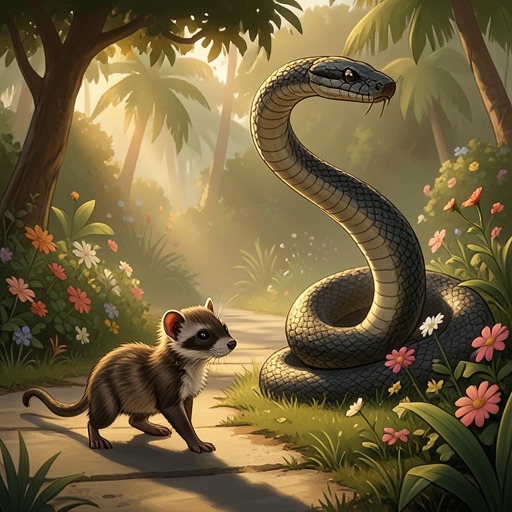
Teddy becomes the immediate reason the conflict with Karait matters. When the small dusty-brown snake lies in the garden and warns, "Be careful. I am Death!", Teddy stoops toward it without understanding the danger. Rikki-tikki attacks with the balanced rocking motion characteristic of his family. Karait's small size and speed make the encounter especially perilous, but when the snake lunges too far, Rikki-tikki springs onto its back, bites high behind the head, and paralyzes it.
Teddy is the witness who turns the sudden attack into a recognized rescue. He shouts to the house, "Oh, look here! Our mongoose is killing a snake." By the time Teddy's father arrives with a stick, Rikki-tikki has already defeated Karait. Teddy's mother picks the mongoose up from the dust and cries that he has saved Teddy from death, while Teddy watches with frightened, enlarged eyes. Rikki-tikki does not understand the family's ceremonial fuss and regards his action as ordinary work, but Teddy's safety gives the event its emotional and practical meaning.
Nagaina and the Household Crisis
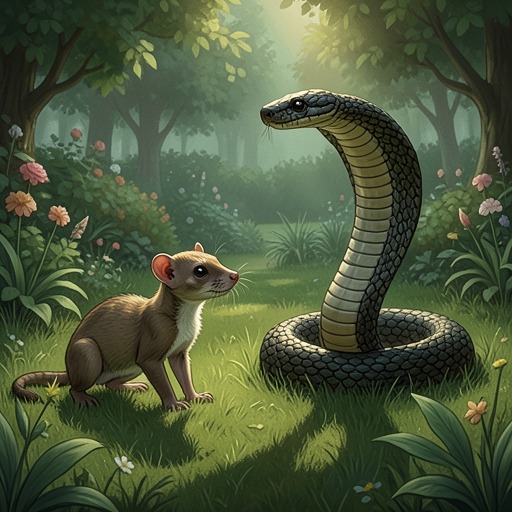
The later confrontation with Nagaina places Teddy directly within the cobras' revenge. After Rikki-tikki destroys most of Nagaina's eggs, Darzee's wife warns him that Nagaina has entered the veranda and intends to kill. Rikki-tikki carries the last egg in his mouth and rushes toward the house, where Teddy, his mother, and his father sit motionless, their faces white. Nagaina is coiled beside Teddy's chair, close enough to strike at his bare leg, and she uses the family's grief over Nag to threaten the entire household.
Nagaina addresses Teddy as the son of the man who killed Nag and orders him to remain still. Her threat is deliberately impossible: she says that she will strike if the humans move and will strike if they do not. Teddy's father can do little beyond whispering that Teddy must keep still. The child thus becomes both the cobra's chosen target and the scene's measure of helplessness; the bungalow, previously a place of curiosity and comfort, has become a trap controlled by a hidden predator.
Relationship and Ending
Teddy's relationship with Rikki-tikki is reciprocal even though the two do not share the same understanding of events. Teddy's family rescues and feeds the mongoose, gives him access to the house, and allows him to sleep beside the child. Rikki-tikki answers not with obedience but with alertness, investigation, and violence against threats. He treats Teddy's shoulder as a familiar perch, while the family gradually recognizes that his presence has practical protective value.
After Rikki-tikki kills Nagaina and returns to the bungalow, Teddy and his parents come out to meet him; Teddy's mother is still pale from having fainted, and the family nearly cries over the mongoose. That night Rikki-tikki eats everything given to him and sleeps on Teddy's shoulder. Teddy's mother tells her husband that he saved all their lives, not only Teddy's. The ending confirms the bond's final shape: Teddy began as the child who helped admit a half-drowned animal into the house, and became the child whose life the animal guarded through the full cobra war.