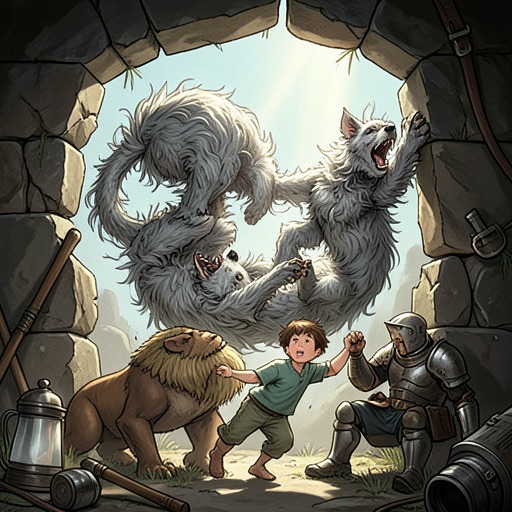
The Bandar-log kidnapping of Mowgli
The Jungle BookThe Bandar-log kidnapping of Mowgli begins as an opportunistic attempt by the Monkey-People to turn a child’s practical skill into an instrument of their imagined greatness. It becomes a full abduction when they seize Mowgli during his midday sleep and carry him away through the treetops, separating him from Baloo and Bagheera and setting the rescue at the Cold Lairs in motion.
Causes and the Bandar-log’s Motive
The Bandar-log are presented as a people without durable purpose. They torment injured animals, throw sticks and nuts for amusement, shriek senseless songs, provoke fights, and repeatedly promise themselves a leader, laws, and customs without ever sustaining them. Their memories do not hold from one day to the next, so their social order remains a succession of impulses rather than a working community. Their saying, "What the Bandar-log think now the jungle will think later," turns their vanity into a collective consolation.
Mowgli attracts them because he can do something they cannot: he can weave fallen sticks into small huts. The Monkey-People mistake this inherited woodcutter’s instinct for the foundation of a new civilization. They decide that he would be useful in their tribe and that, if they caught him, he could teach them to build shelters against the wind. Their fantasy immediately expands into the claim that they will finally have a leader and become the wisest people in the jungle, noticed and envied by everyone else. The kidnapping therefore grows from a characteristic Bandar-log contradiction: they want the prestige of order while remaining incapable of discipline or sustained intention.
The Seizure in the Tree-Tops
Before the abduction, Mowgli has become ashamed of his association with the Monkey-People and resolves to have nothing more to do with them. He sleeps between Baloo and Bagheera during the midday rest, but the decision cannot protect him from their sudden, collective action. The next thing he remembers is the pressure of hard little hands on his legs and arms, branches sweeping across his face, and the shock of looking down through moving boughs while Baloo wakes the jungle with his deep cries and Bagheera races up the trunk with every tooth bared.
The Bandar-log do not fight their pursuers on the ground. They retreat into the upper branches, where Bagheera cannot follow, and proclaim their escape as proof of their skill and cunning. Two of the strongest monkeys seize Mowgli beneath the arms and swing through the canopy, covering roughly twenty feet at a bound. His weight slows them, but the speed remains violent: they rush up trees until the highest branches crackle and bend, then fling themselves outward and downward over empty air, catching the lower limbs of the next tree with hands or feet.
The journey makes Mowgli pass through several physical and emotional states. At first he fears being dropped. Then anger replaces fear, although he understands that struggling would be useless. The motion makes him sick and giddy, yet he cannot help enjoying portions of the wild rush. The earth appears far below in brief glimpses; branches lash his face; sudden checks and jerks leave him suspended over nothing. The entire tribe sweeps along its elevated roads with Mowgli as its prisoner, turning the Monkey-People’s natural mobility into the machinery of confinement.
Mowgli’s Call for Help
Mowgli quickly understands that the monkeys’ pace will leave Baloo and Bagheera far behind. Since he cannot see the ground through the underside of the branches, he looks upward and spots Rann the Kite balancing over the jungle. Rann has been watching the forest for things that die, but he notices that the monkeys are carrying something and descends to investigate. Mowgli gives the call "We be of one blood, thou and I," using a recognized bond rather than attempting a futile struggle with his captors.
When the branches briefly reveal his face, Mowgli shouts to Rann, "Mark my trail! Tell Baloo of the Seeonee Pack and Bagheera of the Council Rock." The request converts the kidnapping from an isolated act into a rescue problem with a line of communication. Mowgli’s intelligence remains active even while his body is controlled: he identifies the one watcher who can travel above the canopy, sends a precise message, and relies on the wider network of jungle relationships taught through the Law of the Jungle.
Consequences and Narrative Significance
The abduction is a threshold ordeal for Mowgli. He is removed from the ground-level society of the wolves and carried into the Bandar-log’s unstable realm, where speed, noise, and height replace law and deliberation. Yet the episode also demonstrates that his training has prepared him for separation. The same learning that Baloo gives him includes the ability to speak across species and to understand the permissions, calls, and alliances that bind the Jungle People together.
The event exposes the contrast between the Monkey-People and Mowgli’s true companions. Baloo responds with a deep cry that wakes the jungle; Bagheera pursues with open teeth; Rann observes, understands, and carries the message onward. The Bandar-log, by contrast, celebrate being noticed and call their flight proof of cunning. Their excitement is real, but it has no stable objective beyond the immediate possession of Mowgli. The kidnapping thus makes their disorder visible in action: they can seize, boast, and flee, but their grand claim to wisdom rests on imitation, forgetfulness, and impulse.
As an episode in the larger narrative, the kidnapping joins the adventure, rescue, and discovery plots. It supplies the immediate crisis of Mowgli’s captivity, establishes the aerial roads of the Monkey-People, and reveals how a seemingly trivial skill can become the pretext for coercion. More importantly, it tests whether Mowgli belongs merely to the place where he was raised or can move through the entire jungle as a participant in its shared order. His captivity begins with the Bandar-log’s attempt to possess him, but his call for help shows that knowledge, memory, and reciprocal obligation are stronger than their momentary triumph.