The white-seal condition
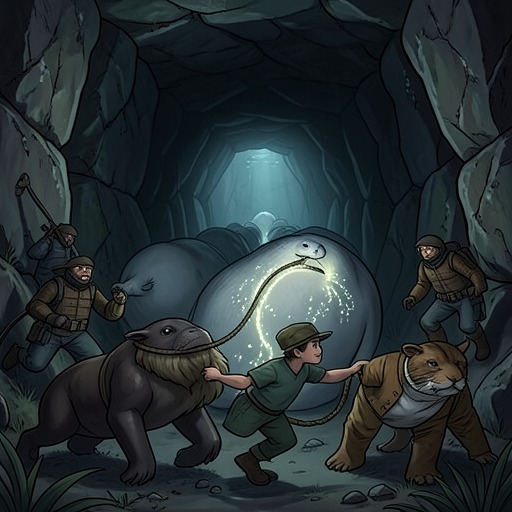
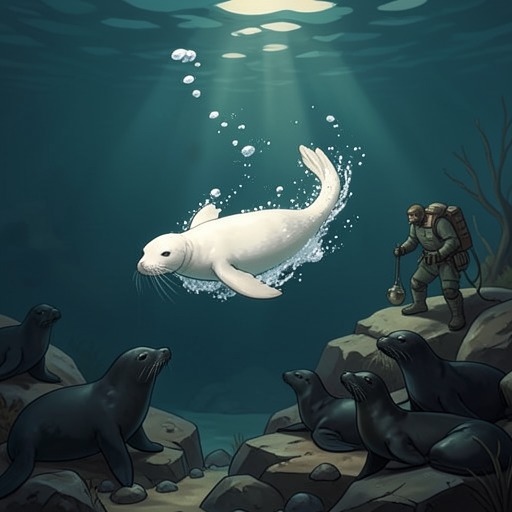
The Jungle BookThe white-seal condition is the rare physical state associated with Kotick's nearly pure-white coat, a difference that transforms him from an unusual young seal into a figure of danger, wonder, and potential deliverance. It begins as a family discovery at Novastoshnah, becomes a mark by which humans identify him, and develops into the outward sign of a life set apart from the habits and assumptions of the seal people.
Appearance and First Recognition
The condition is first noticed when Kotick, Matkah's baby, is born amid the immense seasonal confusion of Novastoshnah. He is described as all head and shoulders, with the pale, watery blue eyes of a tiny seal, but his coat makes Matkah examine him closely. She tells Sea Catch that their baby is going to be white. Sea Catch rejects the possibility as something unheard of, insisting that there has never been such a creature in the world, while Matkah answers that the new fact cannot be argued away: there is going to be one now.
The coat therefore enters the story as a contradiction to accepted experience. It is not presented as a chosen badge or an acquired distinction. It is a condition of birth, visible before Kotick has done anything to distinguish himself, and it immediately separates him from the ordinary black-coated seals around him. That involuntary difference later becomes inseparable from his sense of purpose: Kotick is not merely the seal who notices a wrong, but the seal whose body prevents him from passing unnoticed.
Difference in the Seal Community
Kotick's whiteness becomes more pronounced as he grows. After six months of learning the skills of deep-sea life from Matkah, he travels north from the waters near the Island of Juan Fernandez toward the beaches of Novastoshnah. His fur is then almost pure white. He is proud of it, but he does not make a boast of the distinction; when other seals ask where he got the coat, he replies that it grew.
The return to Novastoshnah makes the condition a public spectacle. Kotick dances the Fire-dance with the yearling seals, plays among the new grass, and hears the older holluschickie question the origin of his white coat. The seal community can recognize the fact but cannot explain it. Kotick belongs to the ordinary seasonal life of the rookery—swimming, playing, and returning to the beaches—yet his appearance continually interrupts that belonging. The coat is both a physical kinship marker and a sign that he cannot remain socially anonymous.
Human Fear and the Killing Grounds
The white-seal condition acquires its darkest meaning when Kotick first encounters human seal-hunters. He has never seen a man before when Kerick Booterin and Patalamon emerge from behind a sand dune to decide which seals will be driven to the killing pens. Patalamon immediately points out the white seal. Kerick turns pale beneath the oil and smoke on his face, mutters a prayer, and warns his son not to touch Kotick because no white seal has existed within his memory. He wonders whether Kotick might be the ghost of old Zaharrof, who was lost in a gale.
The hunters' superstition does not protect the other seals. Patalamon uses a pair of seal shoulder bones to stop a herd of holluschickie, and Kerick slowly drives them inland while hundreds of thousands watch without understanding what is happening. Kotick follows the herd, making his difference an act of witness as well as an appearance. At the killing grounds, the seals are cooled before slaughter so their fur will not come off in patches; men with iron-bound clubs then kill them and strip their skins. Kotick sees his companions transformed into piles of skins and flees back toward the sea in horror.
The episode gives the white coat an ethical and political force. The hunters do not merely see an animal; they classify him as an omen, while the ordinary seals are classified as a manageable resource. Kotick's exceptional body exposes the machinery that the rest of the rookery has normalized. His companions tell him that men have always driven the holluschickie and that he should not have gone to the killing grounds. Because none of them has seen the slaughter, however, the white seal's experience cannot be absorbed into their routine. His condition makes him conspicuous enough to be noticed, but also separate enough to understand what the community refuses to confront.
Legend, Destiny, and Leadership
The condition becomes linked to an older story when Kotick, discouraged after searching the Pacific for a safe island, meets an ancient seal who is dying on an island of green trees. The old seal identifies himself as the last of the Lost Rookery of Masafuera, where men once killed seals by the hundred thousand. He recalls a beach legend that one day a white seal would come from the North and lead the seal people to a quiet place.
This prophecy changes the meaning of Kotick's appearance. What had seemed to be an accident or an omen becomes a possible historical sign. The old seal does not claim that Kotick's future is guaranteed; he tells him to try once more, acknowledging that he will not live to see the promised day while others may. The condition thus creates an obligation rather than a privilege. Kotick's whiteness does not exempt him from the violence threatening the seal people. It makes him responsible for finding an alternative to it.
Kotick responds with renewed self-recognition. He knows that he is the only white seal ever born on the beaches and, as far as he knows, the only seal—black or white—who has thought of searching for new islands. The distinction now joins body, memory, and action: he is visibly unlike the others, personally marked by the slaughter, and willing to leave the familiar beaches in search of safety. His white coat becomes the material form of a leadership that the ordinary seals initially cannot imagine.
Narrative Significance
The white-seal condition operates as a recurring contrast between belonging and separation. Like a political boundary imposed on a body, it identifies Kotick as different before the community has any reason to judge his character. Yet the story does not reduce the condition to a defect. Kotick remains capable of learning the ordinary arts of seal life, returning to the beaches, playing with his companions, and growing into a full-grown sea-catch. His difference does not erase his membership in the seal people; it makes the injustice inflicted on that people impossible for him to ignore.
The condition also reverses human authority. Kerick Booterin treats the white seal as a supernatural threat, while the priest at the village interprets another returned child as evidence that what the jungle has taken, the jungle has restored. In both cases, humans try to explain animal or other-than-human difference through their own systems of omen, religion, and possession. The seal narrative instead grants the animal an independent perspective, memory, fear, judgment, and political aim. Kotick's coat is not merely a spectacle for human observers; it is part of the life of a seal who sees the consequences of human commerce and seeks a future beyond it.
By the time the old seal connects the coat with the legend of Masafuera, whiteness has accumulated three meanings: it is an unprecedented birth condition, the mark that exposes Kotick to human attention, and the sign by which a threatened community may recognize a guide. Its decisive importance lies in that progression. What begins as a fact that Sea Catch refuses to believe becomes the visible difference through which Kotick witnesses slaughter, rejects passive acceptance, and takes up the search for a safer home for the seal people.