Toomai witnesses the elephants' dance
The Jungle BookToomai witnesses the elephants' dance after following Kala Nag from the night camp into the Garo hills, an episode in which a child’s dangerous curiosity becomes an act of privileged vision. Carried into a hidden clearing where scores of wild elephants gather, Little Toomai sees the animals create their own trampled dance-ground, move in a vast communal rhythm, and vanish before dawn. His testimony turns an experience that no human had previously seen into a recognized marvel and earns him lasting honor among the elephant handlers.
The Call from the Night Forest
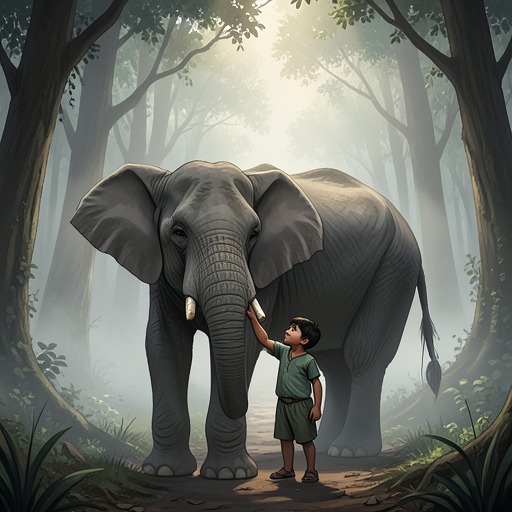
The event begins when Little Toomai hears the distant “hoot-toot” of a wild elephant while he lies beside Kala Nag under the moonlit sky. The sound reaches him as a tiny interruption in the stillness, but it awakens Kala Nag and every elephant in the lines. The other elephants rise, strain at their restraints, and trumpet; Kala Nag stands with his head raised toward the Garo hills, no longer answering his keeper’s customary commands. Big Toomai warns Little Toomai to tend him if he grows restless, then goes to sleep, leaving the boy alone with an animal whose attention has shifted from the camp to the forest.
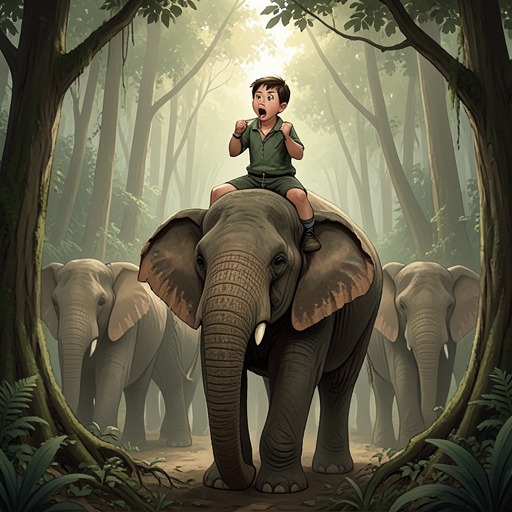
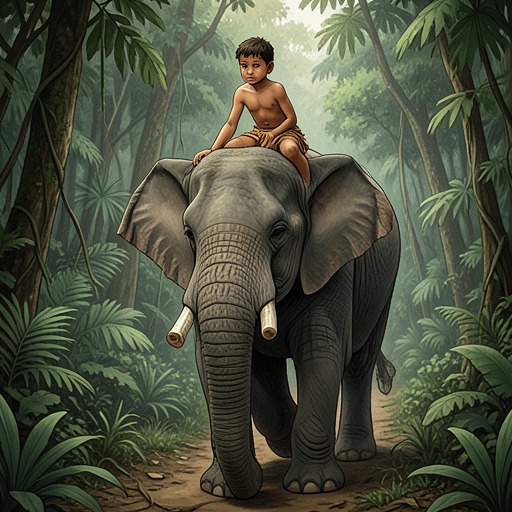
The decisive break comes when the coir string around Kala Nag snaps. Kala Nag slips out of the pickets with the slow silence of a cloud leaving a valley. Little Toomai follows barefoot, calling softly and asking to be taken along. Instead of abandoning him, Kala Nag turns back, lowers his trunk, lifts the boy onto his neck, and enters the forest. The gesture makes the journey a partnership: the elephant chooses the route, but the child is admitted as a passenger and witness.
The Journey into the Hills
Kala Nag first moves uphill almost without sound, brushing through high grass, wild-pepper vines, and bamboo as though the dense Garo forest were smoke. From the crest, Little Toomai sees treetops spread for miles beneath the moon and senses the forest’s nocturnal life around him, including a bat, a porcupine, and a digging hog-bear. The route then changes abruptly. Kala Nag plunges downhill with the force of a runaway gun, ripping through undergrowth, pushing saplings aside, and carrying creepers from his tusks while the boy clings close to his neck.
At the valley bottom, the ground becomes wet and unstable. Kala Nag crosses a river through mist, and Little Toomai hears splashing, trumpeting, grunting, and angry snorting from elephants hidden upstream and downstream. When Kala Nag climbs again, he is no longer making a path. A six-foot-wide track of bent grass shows that many elephants have passed only minutes earlier. A great wild tusker emerges behind them from the mist, and the surrounding forest fills with crashes and trumpet calls. The journey therefore reveals the dance before the clearing itself: the hidden assembly is already moving through the landscape, leaving a temporary road that joins the captive elephant’s world to the wild one.
The Hidden Dance-Ground
Kala Nag finally stops between trees surrounding an irregular clearing of three or four acres. The earth has been trampled as hard as a brick floor; trees in the center have rubbed bark and polished white wood; and no green blade remains within the open space. Under the moon, the ground appears iron gray except where the elephants cast black shadows. More and more animals emerge from the trees, entering the circle with ghostlike quietness even though their passage through the outer undergrowth is loud.
Little Toomai sees a whole elephant society rather than a uniform herd. White-tusked wild males carry leaves and nuts in the folds of their necks and ears. Fat females move with calves only three or four feet high beneath them. Young males display newly forming tusks, old-maid elephants stand lank and anxious, and scarred bulls bear the marks of former fights, solitary mud baths, and tiger attacks. Among the arrivals are Pudmini, Petersen Sahib’s pet elephant, who has broken her pickets, and another elephant marked by deep rope galls, apparently escaped from a hill camp. The gathering thus includes both wild animals and elephants drawn from human establishments, all temporarily released into a common nocturnal space.
Kala Nag enters the crowd clucking and gurgling, and the elephants answer in their own tongue. Little Toomai lies on his neck above broad backs, wagging ears, tossing trunks, crossed tusks, entwined trunks, and enormous shoulders rubbing together. When a cloud covers the moon, he remains surrounded in darkness; a trunk touches his knee, and he understands that there is no way to withdraw Kala Nag from the assembly. Human control, represented by chains, pickets, camp orders, and torchlit Keddah drives, has disappeared. The elephants are not performing for people, and their gathering does not depend on human permission.
The Rhythm and Its Meaning
The dance begins with a trumpet taken up by the whole assembly. For five or ten terrible seconds the sound passes through the clearing, after which a dull booming grows beneath it. Kala Nag lifts one forefoot and then the other, bringing them down in a steady one-two rhythm. Soon all the elephants stamp together, making a sound like a war drum at the mouth of a cave. Dew falls from the trees, the ground rocks beneath the repeated impacts, and the pressure of hundreds of feet becomes a physical force running through Little Toomai’s body.
The movement is not a single uninterrupted display. At intervals the elephants surge forward and crush juicy vegetation, then return to the hard earth and resume the pounding. Little Toomai cannot locate himself in the darkness, and the scene lasts about two hours, long enough for every nerve in his body to ache. Yet the dance also produces a material change in its surroundings. By morning, the clearing is larger: the elephants have stamped down grass and cane, reduced the vegetation to trash, slivers, and fibers, and compressed it into hard earth. Their ritual is therefore also an act of collective construction. The hidden community makes the space it needs through shared bodily labor.
At sunrise the booming stops as though light itself were an order. The wild elephants have vanished without a visible path, leaving only Kala Nag, Pudmini, and the rope-marked elephant. Their disappearance preserves the dance as a secret of the night while the altered ground remains as physical evidence. Little Toomai has not merely seen animals moving together; he has witnessed an autonomous social ceremony whose timing, participants, sound, and disappearance are governed by the elephants themselves.
Testimony and Consequence
Two hours after the dance, Kala Nag and Little Toomai return to Petersen Sahib’s camp. Kala Nag is footsore, while Little Toomai’s face is gray and pinched, his hair full of leaves and wet with dew. He tries to salute Petersen Sahib, announces that he has seen the elephant dance, and then falls into a dead faint from Kala Nag’s neck. His body records the cost of the vision even before his words explain it.
After recovering, Little Toomai tells the assembled hunters that the elephants trampled a larger dance-room and that the ground will show many tracks leading to it. His account is concrete and testable: he points to the enlarged clearing and the numerous trails as evidence rather than asking the men to accept a private fantasy. The hunters respond with astonishment, and the elephants raise their trunks in the full Salaamut of the Keddah, the salute ordinarily heard only by the Viceroy of India. The honor is directed toward Little Toomai because he has seen what no human had seen before: the elephants’ dance at night and alone in the heart of the Garo hills.
The episode’s significance lies in its reversal of ordinary human authority. In the camp, elephants are chained, fed, driven, and assigned work; in the hills, they choose their own direction, gather without human supervision, reshape the ground, and disappear before dawn. Little Toomai’s distinction does not come from mastering them but from being carried into a world that remains fundamentally theirs. His testimony makes that hidden world legible to human listeners without reducing it to a human ceremony, and the memory of the dance becomes the source of his exceptional standing among the people who work with elephants.