Two Tails
The Jungle BookTwo Tails is the elephant whose presence turns the military camp’s hierarchy into a comic and revealing drama of fear, discipline, and assigned labor. Although he is physically formidable and indispensable to the movement of heavy guns, he admits that he fears artillery fire and even a small barking dog. His self-knowledge complicates the camp animals’ assumptions about bravery: courage is not the absence of fear, but the performance of a necessary task within an ordered system.
Identity and Place in the Camp
Two Tails is an elephant serving in the military camp at Rawal Pindi, where thirty thousand men and thousands of camels, elephants, horses, bullocks, and mules gather for a review by the Viceroy of India. The camp is already defined by instability: rain has fallen for a month, horses break their heel ropes, camels run loose through the tents, and animals must be controlled amid mud, noise, and confusion. Against this setting, Two Tails belongs to the machinery of organized power, but he is also one of its most visibly individual and psychologically exposed participants.
His name is camp slang for an elephant, referring to the animal’s tail at each end. The troop-horse dislikes him precisely because of this unusual form, calling the arrangement unfair, while Billy the mule also edges toward the horse when Two Tails speaks. The joke gives the elephant a distinctive social identity before he contributes to the more serious discussion of fear and duty. He is not merely an anonymous beast in a military inventory; he has a voice, a reputation, and a recognizable vulnerability.
Fear and Self-Knowledge
The camp animals’ conversation begins with competing accounts of fear. Billy the mule admits that he can stampede for amusement when he has not been out for several days, yet insists that active service is different because Dick Cunliffe rides him and directs his movement. The camel is untroubled by gunfire when surrounded by men and other camels, but suffers bad dreams that can upset the camp at night. Two Tails occupies a more complicated position because he can imagine what artillery will do to him.
When the bullocks describe the only way they fight—pulling the big gun as soon as Two Tails trumpets—Two Tails becomes the subject of their explanation. His trumpet signals that he will not move nearer to the smoke on the other side, after which twenty yoke of bullocks haul the gun across the level plain. The elephant’s fear is therefore built into the practical organization of battle. His refusal to advance is not represented as a private eccentricity alone; it is a recognized condition around which other animals perform their work.
Two Tails explains that the battery captain has called him a "Pachydermatous Anachronism." He understands the phrase as meaning that he is "betwixt and between": unlike the bullocks, he can foresee what a shell burst may do. The remark makes his fear an effect of imagination rather than simple weakness. His massive body places him close to danger, while his awareness enables him to picture the danger before it arrives. The very intelligence that makes him more perceptive also makes him more afraid.
The Night Conversation and the Dog
Two Tails’ fear becomes most immediate when the narrator’s fox terrier, Vixen, finds him in the darkness. Vixen circles his pickets and yaps around his great feet, and the elephant shuffles, squeaks, and pleads with her to leave. He warns her not to sniff at his ankles, then tries to soothe her with the language used toward a harmless pet, calling her a good little dog while begging that someone take her away. The scene reverses ordinary expectations: an elephant, immense enough to serve beside guns, is intimidated by a small dog.
Billy seizes on the reversal and concludes that Two Tails is afraid of nearly everything. Two Tails does not deny the charge. Instead, his example helps the troop-horse defend a broader principle: it is fortunate that all the animals do not have to fight in the same way. A mule, horse, elephant, camel, and bullock each possesses a different body, skill, and fear, so military effectiveness depends on arranging those differences rather than eliminating them.
The young mule then asks why any of them must fight at all. The troop-horse answers that they fight because they are told to, while Billy reduces the same idea to "Orders." Two Tails thus belongs to a system in which personal fear and personal purpose are subordinate to command. His conversation exposes the cost of that system without presenting him as rebellious: he understands the order, recognizes the danger, and remains part of the institution that requires him to face it.
Obedience and Public Performance
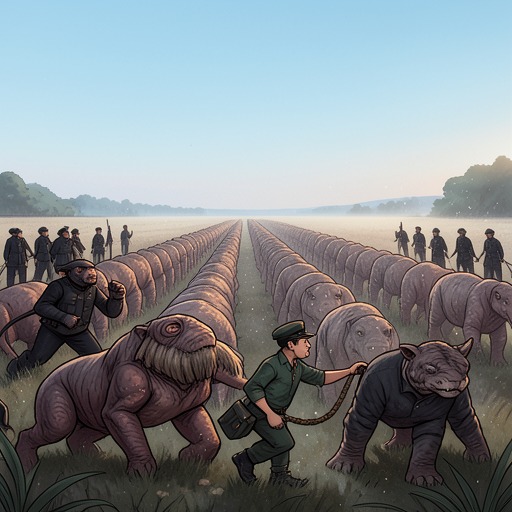
The next afternoon, the big parade converts the private conversation into public spectacle. Two Tails appears harnessed with two other elephants to a forty-pounder siege gun, while twenty yoke of oxen walk behind. The animals’ earlier discussion has prepared the reader to see this formation not simply as impressive pageantry, but as the visible result of coordinated obedience. Each animal contributes a particular capacity, and the combined movement makes fear operational rather than disruptive.
The review displays the entire military chain in motion. An officer explains that an order is given and obeyed: the mule, horse, elephant, and bullock obey their drivers; drivers obey sergeants; sergeants obey lieutenants; and authority rises through officers to the Viceroy, who serves the Empress. Two Tails is therefore both an individual character and an example in a political lesson about hierarchy. His body is incorporated into an apparatus that makes thousands of heterogeneous beings move as one.
The parade also contrasts inner experience with outward control. Two Tails may fear shells, darkness, and Vixen, yet in the public procession he occupies his assigned place beside the siege gun. The spectacle does not erase fear; it conceals or disciplines it. What the assembled officials see is order, while the earlier night scene has shown the trembling, argumentative, and self-conscious animal within that order.
Character Function and Significance
Two Tails is a compact but unusually expressive portrait of courage under compulsion. His physical power does not make him fearless, and his fear does not make him useless. Instead, the story separates capacity from temperament: the elephant can perform a military function while still imagining the catastrophe that function exposes him to. His description of himself as "betwixt and between" captures this double position, suspended between animal strength and reflective apprehension, between individual instinct and institutional command.
His characterization also gives the camp animals a form of collective philosophy. Their jokes, quarrels, and admissions create a many-voiced debate about what bravery means. Billy’s boastfulness, the troop-horse’s professional discipline, the camel’s composure, and Two Tails’ fearful foresight are not merged into a single moral definition. The eventual parade demonstrates the practical answer: an army works because different creatures obey different instructions and use different strengths.
Two Tails therefore matters less as a hero who overcomes fear than as a witness to the system that makes fear compatible with service. His trumpet, pickets, harness, and gun connect bodily vulnerability to military technology. The elephant is simultaneously a thinking animal, a comic companion, and a component of organized force. By placing his anxious voice beside the immense precision of the Rawal Pindi review, the narrative suggests that public order is built not from fearless bodies, but from frightened and various bodies trained, directed, and compelled to move together.