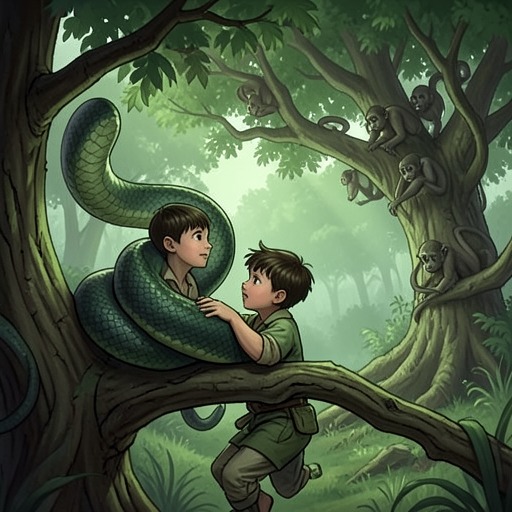
We be of one blood, ye and I
The Jungle Book“We be of one blood, ye and I” is the principal expression of reciprocal kinship in the jungle. Spoken by Mowgli in the learned accents or calls of different animal peoples, it identifies speaker and listener as members of a common moral community. The phrase is therefore more than a greeting: it is a claim to recognition, a request for protection, and a promise that assistance will be answered by obligation.
Meaning and Instruction
The expression belongs to the Master Words taught to Mowgli by Baloo and reinforced by Bagheera. Mowgli knows that the jungle has many tongues, and his education requires him to address each people in its own form. He gives the Hunting People’s words in the Bear accent; for birds, he repeats the formula with the Kite’s whistle; and for the Snake-People, he supplies an unmistakable hiss. The wording changes slightly with the speaker or animal language: the form addressed to Kaa is “We be one blood, thou and I,” but the governing idea remains the same.
Baloo presents this knowledge as a practical safeguard rather than ornamental learning. After Mowgli demonstrates the calls, Baloo explains that he obtained the Master Words from Hathi the Wild Elephant and arranged for Mowgli to learn the Snake Word from a water-snake because Baloo himself could not pronounce it. With these forms, Mowgli is reasonably safe from snakes, birds, and beasts, since the words announce that he understands the bonds and rules recognized by the jungle’s different peoples.
Use During the Bandar-log Kidnapping
The phrase first proves its force when the Bandar-log carry Mowgli prisoner through the treetops. At first he fears being dropped, then suppresses his struggle and begins to think strategically. Seeing Rann the Kite circling above the jungle, Mowgli gives the bird call for “We be of one blood, thou and I.” He follows it with a direct request: “Mark my trail!” and tells Rann to inform Baloo of the Seeonee Pack and Bagheera of the Council Rock.
The expression enables Mowgli to communicate across the physical separation created by the monkeys’ speed. Rann has never seen him before, yet the call identifies him as a legitimate participant in the jungle’s network of mutual recognition. The words do not magically free Mowgli; they make rescue possible by converting a captive child’s isolation into a message that another species can understand and carry onward.
Use in the Cold Lairs
At the Cold Lairs, an old deserted city buried in the jungle, Mowgli again relies on the expression when the rescue turns dangerous. The monkeys leave him in a broken summerhouse while they attack Bagheera, and the ruins are inhabited by cobras. After falling fifteen feet through the broken dome and hearing the snakes moving in the rubbish, Mowgli gives the Snake’s Call twice, saying, “We be of one blood, ye and I.”
The cobras answer by lowering their hoods and warning him to stand still, because his feet might harm them. The words establish a temporary truce inside a place where danger surrounds him. While Bagheera fights for his life outside, Mowgli remains quiet among the Poison-People, protected not by force but by his ability to speak within their social code. The expression thus operates as a portable form of belonging: Mowgli carries the jungle’s law into the abandoned human ruins.
Debt, Reciprocity, and Kaa
The most explicit statement of the phrase’s ethical meaning comes when Kaa appears. After the great Python has helped turn the battle against the Bandar-log, Mowgli answers Kaa’s warning with “We be one blood, thou and I.” He immediately adds that he owes his life to Kaa that night and promises that any future kill of his will belong to Kaa whenever the python is hungry.
This exchange transforms recognition into debt. Mowgli does not claim that all creatures are identical; Kaa remains a python, and Mowgli remains a manling. Their kinship instead permits difference while creating responsibility across it. Mowgli admits that he is too young to kill, but offers the practical service he can provide: driving goats toward those able to use them. He also promises to repay the debt owed to Kaa, Bagheera, and Baloo if any of them is ever caught in a trap. The phrase consequently binds rescue, memory, service, and future reciprocity into one compact declaration.
Wider Ethical Significance
The expression gains force from the jungle’s broader laws and dangers. The Law of the Jungle forbids beasts to eat Man except under narrowly defined conditions, partly because man-killing brings armed human intervention that harms every creature. The rule also frames Man as weak and defenseless, while warning that man-eaters become mangy and lose their teeth. Against this background, Mowgli’s formula does not erase conflict between humans and animals; it establishes a disciplined exception based on recognized relationship and conduct.
Its repeated use also contrasts with the Bandar-log, whose society lacks the stable discipline that governs the other jungle peoples. The Master Words connect memory, language, and obligation across species, whereas the monkeys’ disorder leaves Mowgli dependent on the very networks they disregard. The phrase makes the jungle intelligible as a society of distinct communities linked by protocols of mutual aid rather than as a collection of isolated animals.
For Mowgli, the words express an identity formed between worlds. He is a human child raised among the Seeonee Wolf Pack, trained by Baloo, protected by Bagheera, aided by Rann, and indebted to Kaa. His safety depends on learned animal languages and on his willingness to fulfill the obligations those languages imply. “We be of one blood, ye and I” therefore names a relational identity: belonging is enacted through speech, recognition, and repayment, not secured by a single species or birthplace.