Édouard
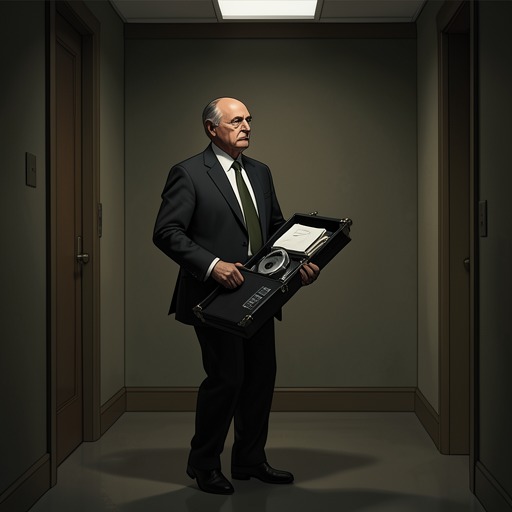
The KillerÉdouard is a thin, nervous, 35-year-old man dressed in mourning whose appearance and actions combine pronounced physical vulnerability with an important role in Bérenger’s investigation. He waits unseen in Bérenger’s room, coughs through their meeting, and helps bring forward documents that connect The Killer to his victims. The scene gives him a double presence: he is visibly ill and anxious, yet holds evidence that intensifies Bérenger’s confidence that the crimes can be exposed.
Identity and Stage Presence
The character description identifies Édouard as 35, thin, nervous, darkly dressed, and in mourning. In the staging of Act II, those traits are made concrete: he wears a black felt hat, black overcoat and shoes, a white shirt with a starched collar, and a black tie, with a mourning band around his right arm. He is very pale and feverish-looking. His right arm is slightly withered and visibly shorter than the other, a bodily difference the scene specifies through his movements rather than explaining or assigning it a cause.
The first view of him is deliberately withheld. In the dark, low-ceilinged Bérenger’s room, Édouard sits silently in a battered French Regency armchair in the gloomy recess to the right of the window. At the start of the act, neither he nor the chair can be seen. Only after Bérenger arrives and turns on the electric light does Édouard become visible. The room’s heavy, realistic, ugly decor and its pale light from the window mark a sharp contrast with Act I’s spare setting. Within this suddenly exposed domestic space, Édouard’s concealed presence turns an ordinary arrival into a discovery.
Waiting and the First Encounter
The Concierge’s voice is heard from the landing before the curtain rises; later, the key grates in the lock, the door opens quietly, and the Concierge mutters angrily before banging her own door as the dog squeals. Bérenger enters a dim, silent room and switches on the light. He jumps when he sees Édouard in the corner, still wearing his hat and overcoat, with his black briefcase at his feet. The staging makes clear that Édouard has been waiting there rather than arriving alongside Bérenger.
When Bérenger asks what he is doing there, Édouard answers that he was waiting for him and asks how he is. His response to the cold room is followed by a cough and the methodical care with which he handles his handkerchief: he spits into it, folds it neatly, and puts it away. His briefcase, which he picks up and keeps in hand, is already part of the encounter. He does not explain how he entered beyond saying he came through the door and opened it. The exchange establishes familiarity between the men, but the scene leaves the circumstances of his arrival otherwise unexplained.
Illness, Care, and Anxiety
Édouard’s coughing continues through the meeting, and he asks for a glass of water. Bérenger promptly leaves to fetch one, while Édouard raises himself on one elbow and checks the lock of his enormous black briefcase with an anxious hand. Reassured, he lies back, still coughing, though less loudly, and wipes his brow. The stage directions explicitly distinguish his illness from an attempt to deceive Bérenger: he is genuinely unwell, and the briefcase is one of his real concerns. His care for it therefore reads not as a trick but as a persistent anxiety alongside the physical distress.
This combination shapes his contribution to the scene. Bérenger’s care is practical and immediate, while Édouard’s attention repeatedly returns to the case and its contents. He is not presented as a composed investigator who controls the pace of events. Rather, he participates while coughing, resting, and managing a visible bodily impairment; the evidence he carries gives him importance without removing his fragility.
Evidence Against The Killer
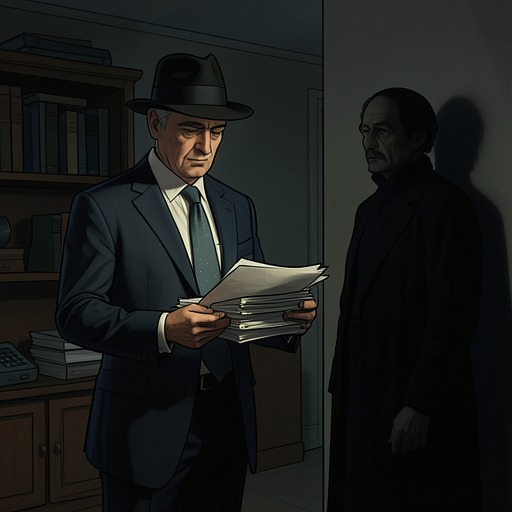
As Bérenger examines the gathered materials, he identifies an address, an identity card, a photograph of The Killer clipped to Colonel’s photograph, and an address book listing the names and addresses of the victims. Bérenger’s excitement rises as he concludes that the documents can help them catch The Killer. Édouard then produces a small, neat box, bringing additional papers into the investigation. The gesture is quiet but consequential: the material does not come from Bérenger’s search alone, and Édouard adds to the evidence at the very moment Bérenger is interpreting it.
The documents include the Killer’s diary. Bérenger reads entries recording an intention to kill on January 13, the pushing of an old woman with gold-rimmed spectacles into a lake on January 14, and later days when there was nothing to kill. The diary gives the investigation a record of the killer’s own planned and completed acts, while the address book links the violence to named victims. Édouard appears uneasy as Bérenger turns the pages. The contrast is pointed: Bérenger reads with eager excitement, while Édouard, who has produced the box, remains visibly worried. The scene does not explain that unease, so it cannot settle whether it arises from his illness, his concern about the evidence, or another cause.
The Missing Briefcase
When Bérenger and Édouard prepare to leave, Bérenger notices that Édouard no longer has his briefcase. Édouard first asks what briefcase Bérenger means, then remembers it and says it must be on the bench; it is not there. Bérenger is astonished, remarking that Édouard always has it with him. Édouard apologizes and attributes the lapse to their hurry. The missing case interrupts their departure and turns his earlier vigilance over its lock into a telling contrast with his later failure to keep track of it.
Bérenger tells Édouard to go back for the case while he goes to warn the Superintendent, asking him to hurry and join him. He also admits that he dislikes being alone on the road in a matter like this. Édouard agrees to retrieve it, but the evidence supplied here does not say what becomes of the case or whether he catches up with Bérenger. His last actions therefore leave him in motion between two roles already established in the scene: the frail man who needs care and the companion entrusted with evidence in an urgent pursuit of The Killer.