Édouard’s black briefcase
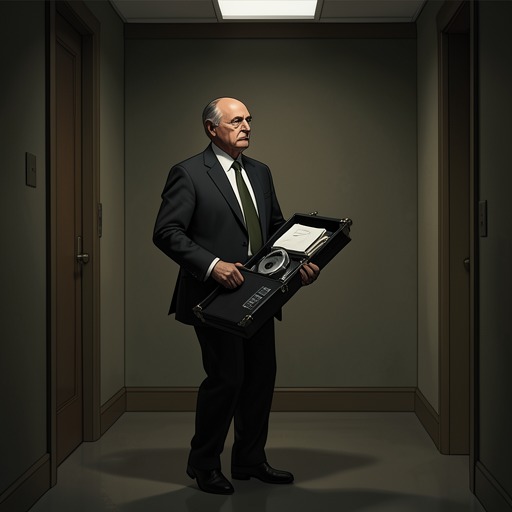
The KillerÉdouard’s black briefcase begins as an ordinary, almost inseparable part of his appearance, but becomes consequential when it opens and spills its contents before Bérenger. Photographs and cigarettes connect the familiar object to The Killer, making the briefcase a material route from suspicion to evidence. Its eventual disappearance, followed by the discovery that it was left behind at home, gives the object a second role: a marker of the pair’s hurried movement and of how easily an apparently indispensable possession can be misplaced.
Appearance and habitual use
The briefcase is established through Édouard’s handling of it rather than through an extended description. When Bérenger enters his dim room, Édouard is already waiting in his corner, wearing his hat and overcoat, with the briefcase at his feet. He picks it up as he rises, then puts it down briefly to spit into a handkerchief before methodically folding the handkerchief and returning the case to his hand. The sequence makes the briefcase part of a practiced routine: even as Édouard attends to his cough and his visibly shorter, slightly withered arm, he resumes possession of it.
Later, as the two prepare to leave, the case is described as heavy, bulging, and black. Édouard puts on his black-ribboned felt hat, buttons and dusts his dark overcoat, and picks up the case; Bérenger also puts on his hat and walks ahead. These small actions present the briefcase as one component of Édouard’s recognizable public appearance, carried alongside his formal clothes. Bérenger’s later surprise at its absence rests on this repeated association: he observes that Édouard is always carrying it.
The contents come into view
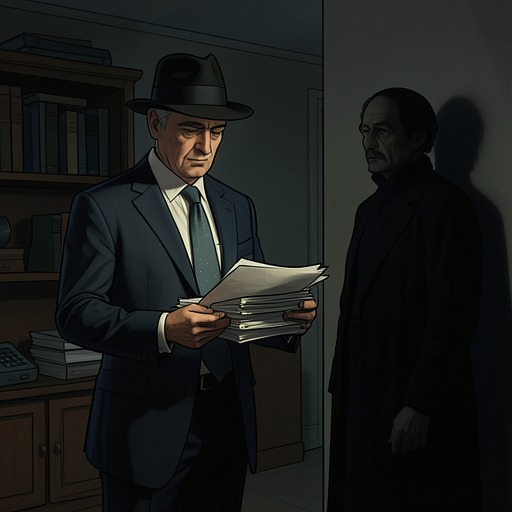
The case’s role changes when Édouard lifts it over a table and it opens, spilling some of its contents. Large photographs come out first. Bérenger examines one showing a moustached military man with decorations, including the Military Cross, and then finds more photographs bearing the same face. As further photographs pour onto the table, Édouard looks on and tries to get them back. Bérenger takes charge of the inspection, reaching into the briefcase himself and finding what he recognizes as the famous Colonel’s photograph. His surprise is sharpened by the fact that Édouard had the image in the case without having told him.
The spill turns a private container into an exposed surface. What had been concealed by the case’s ordinary use is suddenly available for Bérenger to inspect, while Édouard’s attempt to recover the photographs cannot immediately restore their concealment: more keep falling out. The briefcase is not merely present beside the action; its opening rearranges the scene, placing the evidence on the table and giving Bérenger control over its examination. The distinction between what Édouard carries and what Bérenger knows therefore changes in public view.
Evidence associated with The Killer
The photographs are not the only revealing contents. Cigarettes scatter across the table and onto the floor, and Bérenger identifies them as belonging to The Killer. Édouard protests that he did not know about them and reaches for the briefcase, but Bérenger stops him and demands that he empty it. The exchange makes the case’s importance more than a matter of the Colonel’s image: it holds objects Bérenger associates with the person he calls a monster.
The scene does not establish that Édouard knowingly collected or concealed these materials. His denial is explicit, and the earlier discovery of the photographs is itself new to Bérenger. The case consequently gathers together evidence without settling what Édouard knows about everything it contains. Its contents complicate the relationship between possession and knowledge: because the objects are inside Édouard’s familiar case, they implicate his belongings in Bérenger’s investigation, but Édouard’s response leaves his awareness uncertain. The physical contents are visible; their history and his understanding of them are not resolved by the spill alone.
Loss and retrospective recognition
When Bérenger and Édouard later set off, Bérenger notices that Édouard is painfully rising without the briefcase and asks where it is. Édouard first asks what briefcase Bérenger means, then remembers it and looks for it on a bench. It is not there. Bérenger points out how extraordinary this is for someone who is normally never without it. The moment reverses the earlier pattern of constant handling: the object that had seemed bound to Édouard’s movements has become an absence he must reconstruct.
An old man then tells Bérenger that he should have said they were looking for his friend’s briefcase with the documents, and explains that Édouard must have left it at home in their hurry to leave. Édouard accepts this explanation, saying he should have thought of it. The case’s whereabouts are thus supplied not by Édouard’s memory but by another person’s observation. After its contents have made it a source of discovery, its absence becomes a practical problem and a reminder that the pair’s hurried departure has disrupted the routine on which Bérenger’s expectation depended. Across these episodes, the briefcase shifts from a carried accessory to an opened container of troubling evidence and finally to a missing possession whose location must be inferred.