Bérenger’s final confrontation with the Killer
The KillerBérenger’s final confrontation with the Killer strips away the prospect of rescue and turns the pursuit of justice into a direct test of whether violence can be stopped by reason, kinship, or force. Bérenger tries each in turn: he asks why the Killer murders, pleads for him to stop, and finally aims two pistols. None changes the Killer’s conduct. The encounter ends not with an arrest or a shot, but with Bérenger laying down his weapons and the curtain falling as the Killer approaches.
The delayed arrest becomes a private encounter
After calling for Édouard, Bérenger receives only an echo. He concludes that Édouard will not come, looks at his watch, and finds that it has stopped. Rather than act alone, he resolves to put things off until tomorrow and says that Édouard will accompany him to have the Superintendent arrest the Killer. He then turns, loses his bearings, and suddenly sees the Killer close by. The shift is decisive: the arrest Bérenger has assigned to the next day is replaced by an immediate confrontation for which he is unprepared.
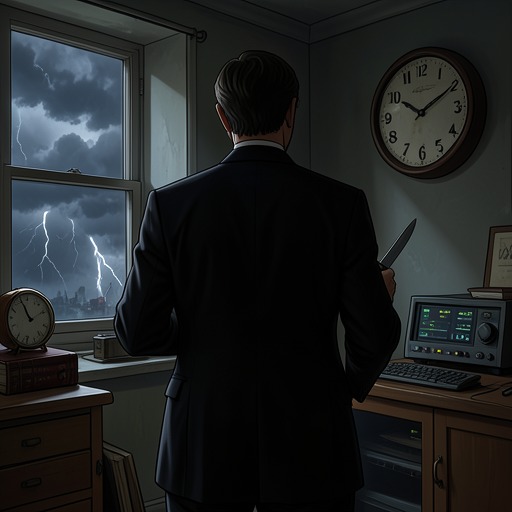
The scene’s setting makes that isolation visible. The changing scenery has stopped; almost nothing remains but a wall, a bench, and the suggestion of an empty plain beneath a faint glow on the horizon. The two figures are picked out in pale light against surrounding semi-darkness. The stage directions present the Killer as physically small and shabby: ill-shaven, wearing a torn hat and an old gaberdine, with one glittering eye and shoes worn through at the toes. He may appear on the wall or bench before calmly jumping down and approaching Bérenger. The directions also leave open a more unsettling possibility: perhaps the Killer is not present at all, and Bérenger is alone, speaking in the half-light. The scene thus makes the confrontation both concrete in its threatening detail and uncertain in its theatrical reality.
Questions, fellowship, and the plea to stop
Bérenger asks the Killer why he acts, but receives no explanation. The Killer shrugs and chuckles; his silence frustrates Bérenger’s effort to turn the encounter into an argument. Bérenger tests possible explanations aloud, asking whether the Killer thinks society is irredeemably rotten, whether revolutionaries are fools, or whether existence itself is a mistake. The questions multiply, but no answer comes. The silence is not a position Bérenger can debate or a motive he can expose; it leaves him trying to supply the terms of an exchange that the Killer refuses to enter.
Bérenger then describes his own change of feeling. He admits that he first wanted revenge for himself and for the others, and had wanted the Killer arrested and sent to the guillotine. But, he says, anger gave way within seconds to something close to love. Because the two belong to the same species, he argues, they are brothers; to hate the Killer would also mean hating himself. The Killer’s chuckle punctures this appeal without answering it. Bérenger insists on the existence of fellow feeling and human brotherhood, but the scene gives no sign that his conviction has reached the man before him.
His plea becomes more modest and more urgent. Bérenger asks the Killer to leave people alone, not because a persuasive justification has been found, but precisely because there is no reason to kill. He asks for a pause first of a month, then a week, then forty-eight hours—any interval that might let people breathe. The descending requests measure the collapse of his expectations: unable to win the Killer’s agreement through a shared account of humanity, Bérenger bargains for even a brief suspension of violence. The Killer chuckles and slowly takes a large, shining knife from his pocket, playing with it as Bérenger’s appeal gives way to abuse.
Pistols against the Killer’s resolve
Bérenger’s speech turns from pleading to threats. He drops to his knees, but specifies that the posture is not a plea for mercy: he says he is taking better aim. He draws two pistols and points them at the Killer, promising to shoot him and describing further acts of violent punishment. Yet the Killer does not move. He continues to play with the knife, chuckles, and gives a slight shrug. The stage directions emphasize the physical imbalance between them: Bérenger appears larger and stronger, while the Killer is almost dwarf-like. Bérenger himself initially leans on that contrast, insisting that he could knock the Killer down with a flick of his fingers.
The weapons seem to offer a way out of the failed conversation, but Bérenger cannot make them effective. He aims without firing while the Killer, only two paces away, quietly raises the knife. Bérenger recognizes that physical strength and bullets are no match for the Killer’s cold determination and stubborn will. The threat of force therefore reverses on the person making it: Bérenger has the pistols, yet the Killer’s stillness and raised blade govern the moment. The scene gives no exchange of gunfire and no successful attempt to disarm or arrest him.
The surrender and the curtain
Bérenger’s final change is enacted through his hands and posture. Still facing the motionless, chuckling Killer, he slowly lowers both pistols and lays them on the ground. He bends his head, remains on his knees, and lets his arms hang at his sides. His earlier declarations of strength and his promise to make the Killer pay give way to the recognition that he can do nothing. Meanwhile, the Killer draws nearer, still chuckling, with the knife raised. The play ends at that approach, before the confrontation’s physical outcome is shown.
The ending makes the encounter a reversal rather than a resolution. Bérenger has sought institutional action through the Superintendent, moral understanding through appeals to brotherhood, and immediate control through weapons; each route fails within the scene. The echo of Édouard’s name at its opening gives way to the Killer’s silent presence, and Bérenger’s plan to act tomorrow narrows into a helpless present. The curtain leaves the Killer’s violence unchecked and Bérenger without a means to stop it. Its final image is not a completed act of killing, but the moment when the effort to reason with or overpower the Killer has exhausted itself.