Death of Berenger the First
The KillerDeath of Berenger the First is presented not as a sudden physical collapse but as a staged passage from commanded movement to absolute stillness, and then from visible presence to absence. Queen Marguerite directs Berenger the First through a sequence of bodily responses; his speech, heartbeat, and breath are declared unnecessary. The final scene then removes Queen Marguerite, the Throne room, and the king himself, leaving only gray light. Death becomes both an event in the action and a carefully controlled transformation of the stage.
The Body Brought to Stillness
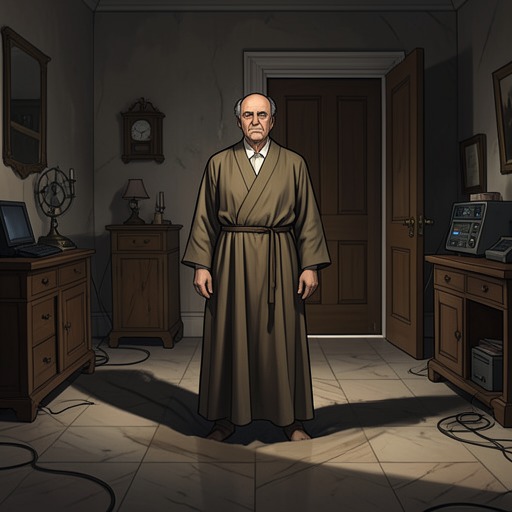
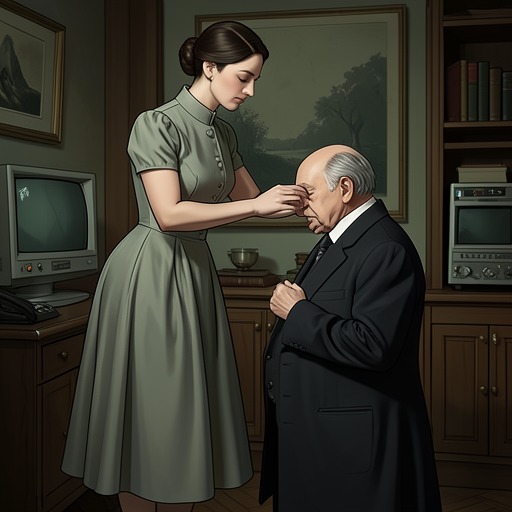
The scene begins with Berenger the First close to the throne, while Queen Marguerite instructs him to turn toward her, look at her, and stand straight. Her commands make looking part of the process: he is told to face her and gaze through her, as if the encounter requires him to confront something that cannot return his gaze. She then directs him to give her first one leg and then the other. As she issues these orders, Berenger the First stiffens his legs. The body is still responding, but its response is no longer represented as free movement; it is becoming rigid under instruction.
The sequence proceeds from the legs to the fingers. Queen Marguerite asks for one finger, then two, three, four, and five, before extending the demand to all ten fingers. She next names the right arm and the left, then the chest, both shoulders, and the stomach. The inventory moves across the body in parts, turning an intimate human figure into a series of components that can be called forth one by one. By the end of this catalog, Berenger the First is motionless, compared in the stage direction to a statue. The change is visible before it is explained: the body that answered commands has become fixed.
The Cessation of Life
Queen Marguerite presents that stillness as the completion of the process. She tells Berenger the First that he has lost the power of speech and no longer needs a beating heart or breath, treating the vital signs of life as requirements that have been dismissed. The phrasing makes death sound almost like the conclusion of a practical task: the preceding bodily demands have prepared him to take his place. The contrast is severe. The king has just been addressed through a detailed inventory of his limbs and organs; now those same bodily capacities are declared unnecessary.
This is not staged through a further visible struggle. Berenger the First is already motionless when Queen Marguerite identifies the loss of speech, heartbeat, and breath. The event therefore turns on a change in what his stillness means: first the result of following orders, it becomes the sign that bodily life has ended. The text does not supply a separate action of collapse or a medical explanation. Instead, the words and the fixed posture together establish the death, keeping the moment within the scene’s stark, ceremonial pattern of command and response.
The Disappearance of the Throne Room
After Berenger the First is seated on his throne, Queen Marguerite suddenly disappears on the left. The stage direction marks this disappearance before the room itself has vanished, changing the scene’s visible arrangement while leaving the king momentarily present. The doors, windows, and walls of the Throne room are then to disappear slowly and gradually during the final scene. Their removal is explicitly marked as important: the setting does not simply change between scenes but is dismantled in front of the audience.
The sequence narrows what remains. First Queen Marguerite is gone; then the familiar enclosing features of the Throne room disappear. The king stays seated on the throne for a short time, visible in a grayish light after the room around him has been removed. The stage direction insists that this interval should last long enough for his remaining presence to register. Berenger the First and the throne then disappear as well, fading into something like mist. The order matters: the room’s boundaries are withdrawn before the ruler and the object associated with his position are erased.
At the end, nothing remains onstage except gray light. The stage directions emphasize both the marked character of the disappearances and their slow, gradual execution. This is not a quick blackout that conceals the transition. The audience is to watch the doors, windows, walls, king, and throne cease to be visible, one stage of absence following another. The final image therefore extends the death beyond the body: after Berenger the First disappears, even the architectural setting that framed his last moments is gone.
The Death as a Theatrical Event
The scene links bodily extinction to the stripping away of visible supports. Berenger the First first loses the actions associated with a living body; then he remains briefly as a seated king after the room has dissolved; finally, neither the ruler nor his throne is left. The throne’s disappearance prevents it from serving as a permanent remainder of his authority, while the earlier removal of the room deprives his final presence of its ordinary setting. The sequence does not explain these changes naturalistically. It makes them legible through theatrical instructions that control how long each image persists.
The event’s dramatic force lies in that measured subtraction. Commands reduce the body to stillness; speech names the end of breath and heartbeat; stage action removes Queen Marguerite, the Throne room, and the enthroned king. Gray light is the sole remainder, not a new character or a surviving object. By ending with light alone, the staging carries the audience from the recognizable image of a monarch seated on a throne to an empty stage, making disappearance the final form of Berenger the First’s death.