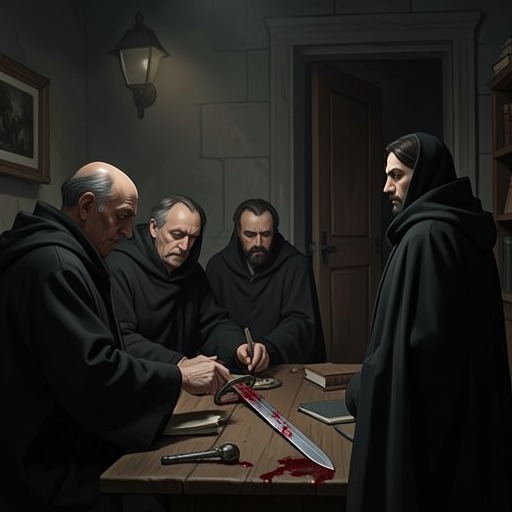
Duncan's army
The KillerDuncan's army is the royal force charged with defending Duncan's country and throne against Glamiss and Candor's rebellion. Its military strength rests conspicuously on Macbett and Banco, whom Duncan's officer calls brave, energetic, skilled generals. Yet the army is not presented only as an instrument of protection: the rebels resent Duncan's efforts to absorb Glamiss's men into the National army, while the soldiers whom Duncan praises are sent back to ordinary lives under their lords and masters. Military service thus secures the throne without dissolving the unequal order it serves.
Command and Military Dependence
When Duncan fears the consequences of defeat, the prospect of escape occupies him: he names foreign rulers and English courtiers among his enemies and wonders where he could hide. The officer answers not with a plan for Duncan to lead the defense himself, but with confidence in Macbett and Banco. Their repeated success has proved their worth, and Duncan accepts that he has little choice but to rely on them. The exchange establishes an important imbalance: Duncan commands the army as king, but its practical capacity to protect him is embodied in generals whose ability he needs.
The army's command structure is sketched rather than explained. Duncan issues orders, the officer advises him, and Macbett and Banco lead forces in the field; the play supplies no roster, numbers, or detailed account of military organization. What it emphasizes instead is the king's reliance on capable commanders and his habit of treating safety as an urgent personal concern. The country's defense and Duncan's own survival converge, but they are not quite the same thing: he is thinking about where he might flee even as his generals are entrusted with the fighting.
Recruitment and the Rival Force
The phrase National army appears during a dispute between Glamiss and Candor. Glamiss complains that Duncan is drafting his men into the royal force, describing the recruitment as draining him of manpower. The complaint gives the army a political dimension before the battle: its growth is experienced by a rival lord not simply as national defense, but as a loss of men and influence. Candor's terse identification of the force as the National army does not settle that conflict; it names the institution around which the contest for allegiance is taking shape.
Glamiss and Candor answer this pressure with their own preparations. Glamiss proposes polishing weapons, gathering men, and attacking at dawn; he predicts that Duncan will be beaten the following evening and that the two rebels will share the throne. His confidence makes the army the immediate instrument of a struggle over sovereignty, not a neutral body standing outside politics. The scene does not establish that the rebels' force has the same organization as Duncan's army, and the two should not be conflated. It does show that both sides depend on assembling armed men, while control over those men is itself a source of conflict.
A soldier later describes a harsher kind of recruitment in the opposing camp. He says that a mounted sergeant lassoed him as he came out of a pub; when he resisted, he was struck, tied up, and carried away. He was handed a sword and a pistol, but the pistol was out of ammunition, and he had apparently fired it all. He cannot name the generals and admits that he dropped his sword. His account concerns men made to shout for Glamiss and Candor, not proof of how Duncan's own army recruits. Set beside Glamiss's complaint about conscription into the National army, however, it makes the rival forces' use of compelled service part of the play's wider military absurdity.
Victory and the King's Tribute
Duncan's thanks after the struggle defines the army's public purpose: its soldiers have saved his country and his throne, and he honors those who laid down their lives. He addresses the dead and the living together, imagining that soldiers will return to humble villages, lowly hearths, or simple tombs. Their memory, he claims, will survive in photographs and in fame or anonymity, serving as an example across generations. The scale of this tribute is deliberately expansive; Duncan turns military loss into a story of lasting service to the crown.
The speech then narrows from posthumous honor to the soldiers' continuing place in society. Those who survive are told to earn their daily bread through labor, beneath the sun and under the watchful eyes of their lords and masters. The king's praise therefore does not promise them political power or a changed social position. Their sacrifice defends a throne described as theirs as well as Duncan's, but their return is to work and subordination. The contrast between the promise of undying memory and the modest conditions of ordinary life makes the tribute both ceremonially generous and politically revealing.
Political Significance
Duncan's army joins national defense to the preservation of royal authority: in Duncan's account, saving the country means saving his throne. Its dependence on Macbett and Banco further exposes how formal sovereignty and effective military power can diverge. Duncan gives commands and claims the soldiers' loyalty, yet he must entrust the campaign to generals whose demonstrated skill is the assurance offered to him when he fears defeat.
The play also places royal ceremony beside the costs and coercions of war. Glamiss sees recruitment into the National army as the depletion of his own power; a soldier in the rival force recalls being dragged from civilian life and sent into battle with ineffective equipment; Duncan answers the dead with a vision of photographs, future generations, and service under masters. Together, these details deny any simple separation between patriotic defense and political control. Duncan's army protects the kingdom, but the play asks whose power that protection secures and what becomes of the people who provide it.