Duncan’s assassination
The KillerDuncan’s assassination converts a staged ceremony of royal healing into a coup enacted in front of its intended victims. Banco, Lady Duncan, and Macbett enter disguised among the sick, reveal themselves together, and close around Duncan as he retreats toward his throne; the blows they strike make the language of accusation part of the killing itself.
The Healing Rite Becomes an Ambush
Duncan calls for the patients to be brought in, and the ceremony proceeds as a solemn public ritual. After the eleventh sick man, the tempo slows and the music fades. Two final patients enter from opposite sides in long hooded capes. One creeps behind the Officer, who has been calling for the next patient but fails to notice the approach. The procession has thus concealed the conspirators in the very line of people Duncan expects to receive his healing touch.
Disguise and Recognition
The ambush breaks open when the music suddenly stops. At the same instant, the monk throws back his hood or removes his mask, revealing Banco, who draws a long dagger. Duncan’s single-word response, “You?”, registers recognition before he can recover from the surprise. Lady Duncan also casts off her disguise and stabs the Officer in the back, while the other hooded beggar, Macbett, draws a dagger of his own. The attackers have not merely entered the ceremony unseen: they have occupied its roles, then discarded them together, turning the healing rite’s expected sequence into a coordinated assault.
Duncan’s question to Lady Duncan—“You, madam?”—makes the second revelation a betrayal within the royal household as well as a political attack. The Officer falls, and Duncan calls the three conspirators “Murderers!” Banco answers by calling Duncan “Murderer!” Duncan repeats the accusation, so that the exchange does not settle who has the moral claim; instead, it makes the killing a confrontation in which each side names the other as guilty. The accusation becomes the scene’s refrain even as the conspirators move from revelation to action.
The Circle Closes Around the Throne
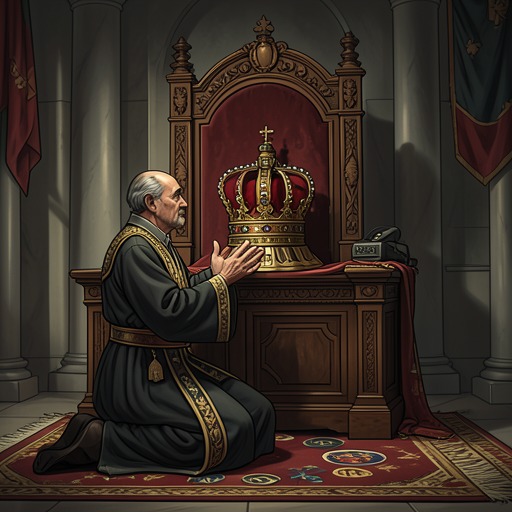
Duncan backs toward the throne as the three attackers slowly tighten their circle around him. The movement turns the throne from the center of a healing ceremony into the destination of a retreat: Duncan tries to ascend, but the conspirators keep closing in. Lady Duncan snatches off his cloak. Without it, he feels naked and exposed, and he backs up the steps trying to cover his body with his arms. The gesture leaves him struggling to protect himself even as the symbols of royal authority are about to fall away.
Duncan does not get far. His scepter falls in one direction and his crown in the other; Macbett pulls him down. The objects that marked his kingship are separated from him in the same action that brings him to the ground. Banco strikes first, shouting “Murderer!” Macbett stabs Duncan a second time, and Lady Duncan delivers a third blow, each repeating the accusation. Duncan’s own cries of “Murderers!” continue after the three attackers have stood over him, growing quieter and then feebler. The repeated word persists as his power and voice diminish, until the coup has made the accusation physical and the king is dead.
The Intimate Aftermath
After the three conspirators draw apart, Lady Duncan remains beside the body, looking down at her dead husband. Her response shifts the scene from the public struggle over kingship to a starkly personal association: she says that Duncan now looks just like her father, whom she could not stand. The remark does not undo her role in the killing—she has joined the attack and delivered one of its blows—but it makes the aftermath more than a simple image of political victory. The newly dead king is also her husband, and in death he becomes inseparable, in her perception, from a father she rejected. The coup ends not with reconciliation or a claim of triumph, but with Lady Duncan alone beside the body and an unresolved disclosure of hostility.