Duncan’s authoritarian rule
The KillerDuncan’s authoritarian rule converts the king’s personal command into the language and machinery of the State: land is taken, men are drafted, prisoners are ordered killed, and defeated opponents are made into public examples. The play also shows how this rule seeks assent as well as obedience. Its subjects repeat the logic of ownership and historical necessity, while the punishments that enforce it expose the violence concealed by those justifications.
Land, conscription, and resistance
Glamiss identifies two material grievances behind the rebellion. Duncan hunts on his land, ostensibly for the benefit of the State, and drafts Glamiss’s men into the national army. Glamiss dismisses the official justification as something the king merely claims, then describes the combined demands of seizure and recruitment as sucking him dry. Candor’s repetition of the State’s rationale cannot settle the dispute: the exchange instead stages a contest over whether royal action is public service or appropriation. The rebels’ repeated denunciation of Duncan makes that conflict openly political.
The witch later gives Macbett a sharper account of what the king’s war has done. Duncan took all Glamiss’s lands and half of Candor’s, while Macbett was used as an instrument against the two rebels. Macbett accepts the premise that they were rebels and insists that everything belongs to the king. His claim that king and realm ultimately belong to the people complicates that submission: the king is described as holding everything in trust, but no practical limit on his taking is supplied. The result is a justification that can make dispossession sound like common ownership while leaving the subjects who suffer it with no means of enforcing their supposed share.
Command and delegated violence
Duncan’s treatment of a captured enemy makes the hierarchy of command unmistakable. When Macbett reports that the prisoner has been taken alive, Duncan asks why he has not been killed and demands action. Macbett answers that he was waiting for the king’s orders. Duncan then supplies the authorization directly, ordering the prisoner’s beheading and pressing for Glamiss to be torn apart as well. Macbett’s initial restraint is not a refusal of violence but obedience held in reserve until the sovereign speaks; Duncan treats the killing as an ordinary consequence of command.
The witch’s description of Macbett as Duncan’s instrument reveals the political cost of that service. Macbett accepts that his life is the king’s to dispose of and defends the campaign against Glamiss and Candor, even though the king has taken their lands. Duncan’s rule thus distributes coercion down the chain: the monarch claims the right to command, while military agents carry out the force and can be left to bear responsibility for it. Macbett’s loyalty makes him useful, but the witch’s warning that otherwise he would lose his head shows that obedience is secured under threat, not simply by feudal devotion.
Defeat made into political doctrine
Candor’s defeat is staged as both a personal reckoning and an argument about power. Addressing those gathered to watch, he says that if he had been stronger he would have been the anointed king; because he lost, he is branded a traitor and coward. He calls himself a historical dead end and urges his audience to side with the stronger, advising the masses to wait until the fighting is over before joining the winner. His account turns defeat into a lesson in survival, but it also strips legitimacy of any independent moral measure: historical success becomes its own justification.
Candor does not present the rebellion as innocent. He admits guilt and argues that the rebellion was necessary, if only to demonstrate that he was a criminal. His image of his and his followers’ bodies fertilizing fields for future wheat makes political defeat part of a continuing cycle, but it offers no promise that the next harvest will produce a freer order. The speech’s bitter logic leaves resistance caught between the king’s power and the possibility that history will simply declare the victor right.
Punishment as public spectacle
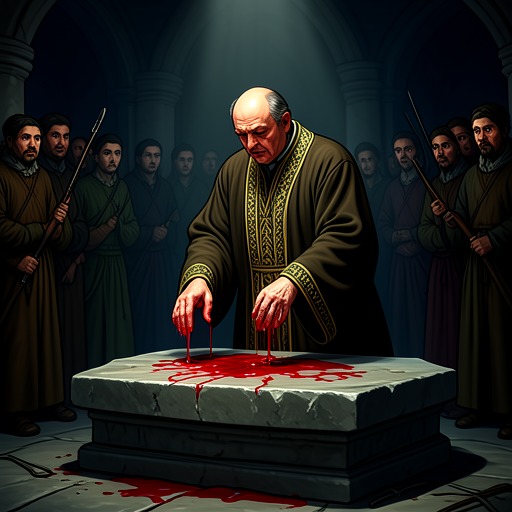
Duncan determines the defeated army’s fate while asking Lady Duncan whether she is bored by Candor’s long speech. He rejects torture, but not execution: he announces that justice requires Candor’s soldiers to die with him and gives the number as 137,000. The precise, enormous count makes mass killing sound administratively manageable; Duncan says they should finish by dawn. A large red sun slowly sinks as he claps his hands and orders the beheading. The stage image and the brisk command place spectacle and procedure side by side, making the scale of punishment harder to reconcile with the king’s casual manner.
Candor’s execution is therefore not merely the end of a rebellion. Duncan turns the defeated into an example for the assembled audience and presents their deaths as justice, while Candor has already asked posterity to learn from his failure. The two competing lessons meet in the scene: the king demonstrates what happens to those who lose, and Candor describes a world in which losing determines who is called criminal.
Rewards and the limits of loyalty
Duncan’s authority also appears in the distribution of favor. Banco protests that the king has failed to provide the promised title or lands, and says the failure is impossible to accept. Macbett first describes attempts to intercede through Lady Duncan and the Archduke, then proposes using more cogent arguments and, if necessary, still stronger ones. The exchange does not show those arguments being carried out, but it exposes how access to reward depends on continued negotiation with the sovereign rather than on an acknowledged obligation that Banco can enforce.
That grievance sits uneasily beside the regime’s insistence on loyalty. Duncan expects military obedience and can command immediate death, yet a promised reward remains uncertain; the distinction is between what the king can demand and what a subject can claim from him. In this way, Duncan’s rule is forceful without being secure. Its justifications invite subjects to accept royal ownership, State necessity, and the verdict of history, while its confiscations, withheld favor, and executions reveal how much those principles depend on the king’s power to decide.