Execution of Candor’s army
The KillerThe Execution of Candor’s army turns a defeated rebellion into a mass killing staged as both state punishment and public entertainment. Duncan orders Candor and 137,000 of his soldiers put to death; Banco works the Guillotine, while Macbett and Lady Duncan are made to watch. The scene’s scale, ritualized speed, and deliberate spectacle expose the violence behind Duncan’s authority even as Candor gives that violence a bleak historical rationale.
Background and Stakes
Immediately before the executions, Candor interprets his defeat as proof that History has sided against him. He says that victory would have made him an anointed king, whereas defeat makes him a traitor and coward, and concludes that “The logic of events is the only one that counts. Historical reason is the only reason.” He calls the rebellion necessary as an example, even while describing himself as guilty and his life as an empty husk. His speech does not undo the defeat or offer an escape: it frames the execution as the final consequence of losing, and warns that people can know who is stronger only after the fighting is over.
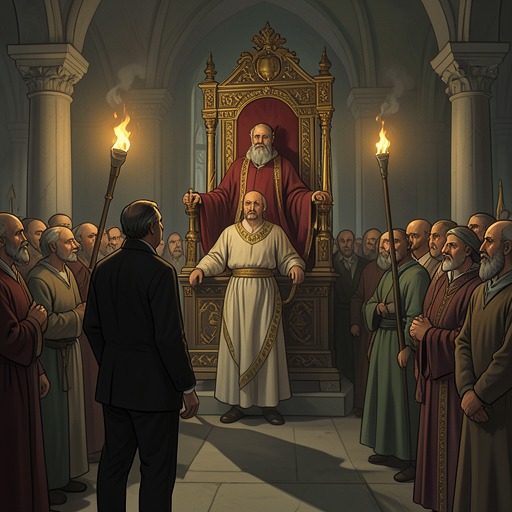
Duncan presents the death sentence as justice, extending it beyond Candor to the soldiers of Candor’s army. His remark to Lady Duncan that “There aren't very many of them. 137,000—not too many, not too few” makes the number itself part of the scene’s bitter irony. A force of 137,000 is at once acknowledged as enormous and dismissed as manageable. Duncan also insists on speed: they are to finish by dawn. The order turns the defeated army into a problem of administration, measured by a deadline as well as by its head count.
The Order and the Execution
Duncan first tells Lady Duncan that Candor will not be tortured, but put to death, teasing her with the promise of a more lavish entertainment. He then addresses the assembled company and declares the execution of the soldiers a demand of justice. After clapping his hands, he gives the order: “Go on. Off with his head.” The movement from private aside to public command makes the killing both a decision by the ruler and a performance for those gathered around him.
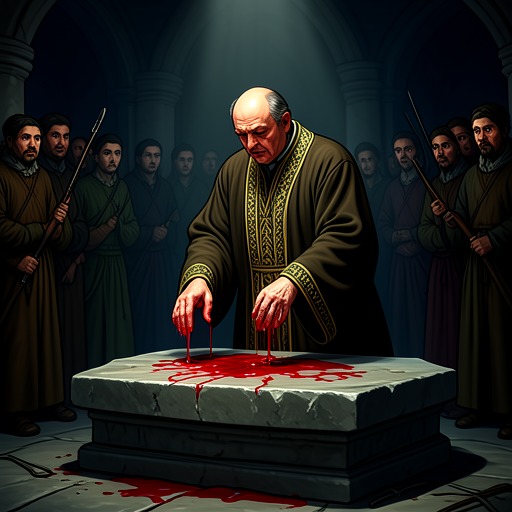
Candor’s last cry is “Long live the Archduke!” The salute does not prevent his execution; it accompanies it, leaving loyalty and defeat sharply juxtaposed at the Guillotine. Banco has already arranged Candor’s head on the device, having had to get rid of his ax to do so. The practical detail marks a change in his role: at this moment he is not using the ax but preparing and operating the instrument of execution.
The soldiers follow Candor in a continuous procession, one after another to the Guillotine. The stage direction notes that the same actors follow each other around, a theatrical means of making a vast execution playable as repeated movement. In the alternative staging proposed in the text, the scaffold and Guillotine could appear when Duncan gives the order; Banco would push a button, and the heads would fall. These are different staging possibilities, not additional events: both emphasize the mechanical efficiency with which Duncan’s command becomes killing.
Spectacle and Witnesses
Banco urges the procession onward with “Hurry, hurry, hurry, hurry!” After each repetition, the blade falls, and the heads accumulate in the basket. The repeated cue compresses the execution into a relentless pattern: command, fall, and another victim. The growing pile gives physical form to the count Duncan has treated so lightly, while the rhythm makes mass death seem almost like a procedure that can be accelerated to meet a deadline.
Duncan directs Macbett to sit beside Lady Duncan and makes sure that both remain visible to the audience. The staging allows them to sit with their backs to the Guillotine and still appear to watch the executions. Lady Duncan counts heads. Her counting, set against the continuous procession and the rising pile in the basket, turns attention from the ruler’s abstract total to the succession of individual deaths; at the same time, it places the act of witnessing within the spectacle Duncan has arranged.
Significance
The scene binds political victory to the power to decide who will be named a traitor and put to death. Candor’s account of historical reason treats the winner’s success as the logic that prevails; Duncan’s command supplies that logic with an immediate, physical consequence for the defeated. The rebellion’s failure is not merely announced but made visible in the execution of its leader and soldiers.
The contrast between Duncan’s calm instructions and the enormity of 137,000 deaths sharpens the scene’s indictment of authority. He speaks of justice, time, and numbers while Banco’s repeated actions carry out the sentence. By seating Macbett and Lady Duncan where the audience can see them, the staging also makes the watching of violence part of the event rather than a remote report. The procession, the basket, and Lady Duncan’s count show how spectacle can render mass killing legible—and how its orderly presentation does not lessen its brutality.