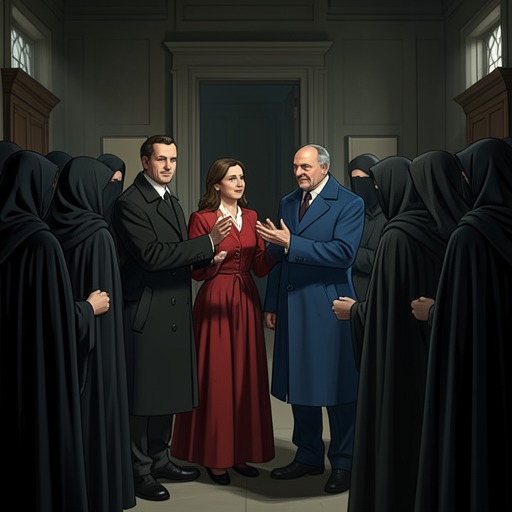
Glamiss and Candor plot to rebel against Duncan
The KillerGlamiss and Candor plot to rebel against Duncan by converting their mutual denunciation of his rule into preparations for an attack at dawn. The scene makes their rebellion both a concrete military undertaking and a study in compromised political motives: they call Duncan a tyrant, but Glamiss also treats the fact that Duncan holds power as proof enough, while anticipating that the two conspirators will divide the throne between them.
Anger and the First Call to Revolt
Glamiss and Candor begin from a shared conviction that the existing situation cannot continue. Each repeats the other's judgment, and the scene direction says that their anger and derision grow increasingly emphatic until their words can scarcely be made out. The text at this point functions less as a developed political argument than as a vehicle for escalating emotion: their agreement is audible in repetition and intensifying delivery before it is fully articulated as a plan.
That convergence sharpens into the shared cry, "Down with Duncan." Glamiss then gives the grievance a personal and territorial edge: Duncan hunts on his land. The contrast matters. The denunciation sounds like a public challenge to a ruler, but the particular complaint offered here concerns the king's use of Glamiss's property. The scene establishes opposition without presenting a broad account of Duncan's policies or of the population's grievances; its immediate foundation is the conspirators' anger and Glamiss's sense of injury.
From Grievance to Military Plan
The conspiracy becomes actionable when Glamiss lays out a timetable and a sequence of preparations. He proposes that they polish their weapons, gather their men, and prepare their armies; they will attack at dawn, and he predicts that Duncan will be defeated by the following evening. His promised reward is not simply the end of Duncan's rule: Glamiss expects himself and Candor to share the throne. The compressed schedule gives the rebellion urgency, while the projected division of sovereignty makes its political destination explicit.
Candor asks whether Glamiss truly believes Duncan is a tyrant. The question tests the moral language sustaining their alliance. Glamiss answers with a cascade of labels—tyrant, usurper, despot, dictator, miscreant, ogre, ass, and goose—then advances a deliberately circular proof: Duncan is culpable because he is in power. He adds that without this belief he would have no reason to depose him, and insists that his motives are honorable. The insistence does not resolve Candor's question so much as expose the strain within the justification. Glamiss presents the rebellion as principled while also naming the throne as its prize; the scene leaves both claims in view.
Oaths, Departure, and the Sound of Conflict
Glamiss proposes that the two men swear complete trust. They draw their swords and salute one another, each swearing on his sword to be absolutely loyal to the other. The ritual gives the alliance a formal shape: trust is spoken and enacted through the shared gesture of armed men. Yet this pledge follows a plan to divide the throne, so the oath binds partners whose cooperation is tied to personal advantage as well as common opposition to Duncan.
After sheathing their swords, they leave quickly in opposite directions, Glamiss to the left and Candor to the right. Their separate exits provide the scene's last visible action by the conspirators. A pause follows, with the stage empty; the directions call for elaborate changes of light on the cyclorama and sound that develops into a kind of musique concrète. Shots, flashes, the ripple of gunfire, and a conflagration in the sky then give the empty stage the image and sound of armed violence. These effects carry the rebellion beyond the spoken pact, but the scene does not specify the battle's result here. Its close turns an agreement into an approaching conflict without showing Duncan defeated or the conspirators in possession of the throne.
Political Meaning and Dramatic Construction
The scene's political tension lies in the gap between the language of liberation and the stated prospect of replacement. Glamiss calls Duncan's rule tyrannical, but when pressed for the basis of that judgment, his reasoning circles back to Duncan's possession of power. The planned outcome, meanwhile, is not described as a new political order: it is a shared throne for Glamiss and Candor. Their revolt therefore challenges Duncan's authority while leaving the desire to rule intact.
Form reinforces this tension. At first, the repeated declarations and increasingly indistinct speech make shared anger more prominent than coherent argument. The plot then acquires precision through orders, a deadline, and an expected division of power. Finally, the conspirators vanish, and theatrical sound and light take over where speech and visible action stop. The gunfire signals that their scheme has crossed toward violence, while the empty stage withholds the outcome. The rebellion is thus presented as a sequence of intensifying commitments—anger, denunciation, military preparation, oath, departure—whose immediate consequence is not a settled change of government but the onset of conflict.