Glamiss and Candor's rebel forces
The KillerGlamiss and Candor's rebel forces are the armed coalition raised to attack Duncan and take power. Their brief trajectory runs from confident preparations for a dawn assault to defeat and mass execution. The play gives the rebellion a double edge: its leaders denounce tyranny while planning to divide the throne, and its ranks include men who were swept into the battle by force. In the aftermath, Candor interprets the rebels' defeat as proof that political success, rather than any higher standard, determines what history calls right.
Formation and aims
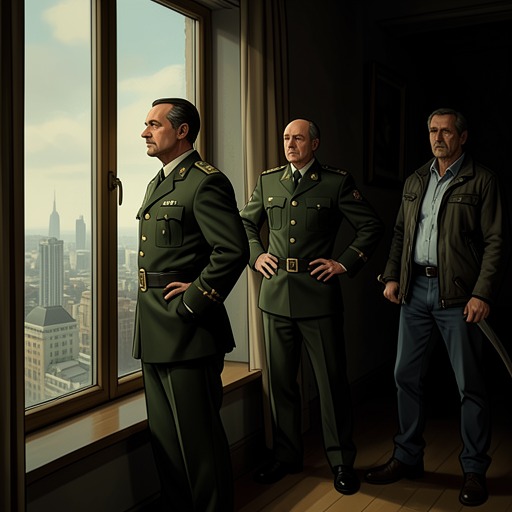
Glamiss turns the conspiracy into a military undertaking by calling for weapons to be polished, men gathered, and armies prepared. The attack is to begin at dawn; by the following evening, he expects Duncan to be beaten and the throne shared between himself and Candor. The plan makes the rebels' objective explicit: they are not merely seeking to remove a ruler but expect to participate in the power that follows.
Candor's question about whether Glamiss truly believes Duncan is a tyrant exposes the gap between public justification and political ambition. Glamiss answers with a string of denunciations, calling Duncan a tyrant, usurper, despot, dictator, miscreant, ogre, ass, and goose. He treats Duncan's possession of power as evidence of wrongdoing, then insists that his own motives are honorable because otherwise he would have no reason to depose him. The contradiction is built into the rebellion's justification: opposition to a ruler is presented as a moral cause, even as its leaders anticipate sharing the throne.
The battle and the uncertainty of command
The fighting is still under way when Duncan asks whether Candor has been defeated, whether Candor has been executed, and whether Glamiss has been killed as ordered. The questions reveal the stakes from the ruler's side, but the answers do not provide a clear battlefield report. The Officer can only say that the horizon is red and that the battle appears to be continuing at a distance. Duncan also fears that Macbett and Banco may have been routed, which would leave him exposed to foreign enemies and uncertain refuge.
The Officer counters this fear by stressing the generals' record: Macbett and Banco are described as brave, energetic, skilled strategists who have repeatedly proved their worth. Duncan accepts that he has little choice but to rely on them, yet immediately imagines precautions for escape. He asks for his best horse, specifying the one that does not kick, and for his most stable launch, equipped with lifeboats. He also wishes he could command the moon to be full and the stars to appear, since night travel seems safest, and considers bringing money and fleeing to Canada or the United States. His anxious preparations show how seriously the rebellion threatens the regime, even before its result is known.
Recruitment and the force's human cost
A soldier's account complicates any picture of the rebel army as a body of willing political adherents. He says that he had just come out of a pub when a mounted sergeant lassoed him. His companions escaped; he tried to resist, but was struck on the head, tied up, and carried off. He was then given a sword, which he appears to have lost, and a pistol that proves empty when he puts it to his head and pulls the trigger. He says that many men were on the field and that they were made to shout in support of Glamiss and Candor.
The episode presents recruitment as coercion rather than consent for at least some of the force. The soldier's missing sword and spent ammunition also make military participation look less like a chosen commitment than an imposed, disordered ordeal. When Duncan calls him a traitor and an enemy, the Officer cautions against cutting off his head before hearing the rest. The exchange places the soldier between the rebellion that conscripted him and the royal authority that treats him as an opponent; his account makes the category of rebel less politically uniform than the leaders' claims suggest.
Defeat, judgment, and aftermath
Candor's later speech accepts the defeat in stark terms: had he been stronger, he says, he would have been the anointed king; as the defeated side, he is classified as a traitor and coward. He describes himself as a historical dead end and argues that History was against him, while conceding that History is right in an objective sense. His conclusion is not that the rebellion lacked a cause, but that the logic of events rewards the stronger side and leaves no transcendental values to overrule the outcome. He even calls the rebellion necessary because it proved him a criminal, turning failure into an example for posterity while advising others to side with the stronger—though he acknowledges that strength is impossible to identify with certainty before the decisive moment.
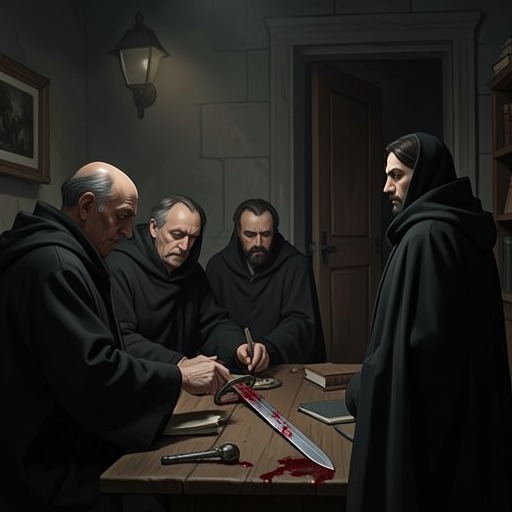
Duncan refuses to let this account delay punishment. He tells Lady Duncan that the speech is too long and that Candor will not be tortured, but then orders the soldiers of Candor's army executed alongside their leader in the name of justice. He specifies the number as 137,000 and says the executions should be completed by dawn. As a large red sun sinks upstage, he claps and gives the order for Candor's beheading. The scale and ceremony of the sentence turn the defeat into a demonstration of royal power, while Candor's language of historical necessity exposes the brutal circularity by which victory can be presented as justice and defeat as proof of guilt.