Lady Duncan
The KillerLady Duncan is the Archduchess whose real marriage and loyalty to Duncan are obscured when a sorceress takes her likeness and marries Macbett. The distinction between the woman and her borrowed image becomes a decisive political fact: the false queen helps usher Macbett toward the throne, while the real Lady Duncan returns from captivity to denounce him as a usurper and warn that his rule is about to fall.
Identity and First Appearance
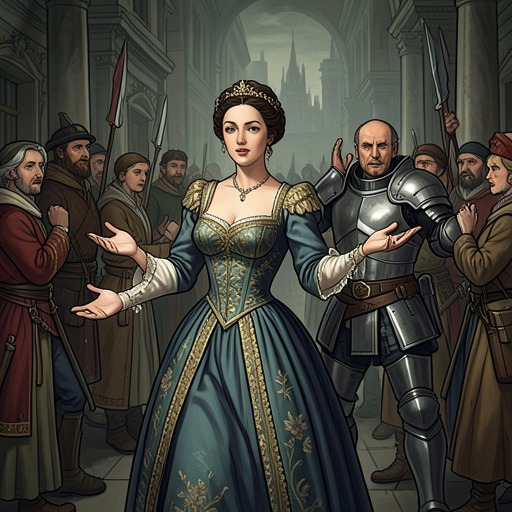
Lady Duncan first appears beside Duncan as the crowned Archduchess. She wears a long green dress decorated with a flower, and the stage directions single her out as the play’s only character who dresses with a certain flair. She stands in front of Duncan as he mounts a portable throne, with another figure on either side of him. Her position and distinctive clothing make her visible as a court figure in a world otherwise marked by warfare and political disorder.
Her public role is also active beyond the court. Near the battlefield, she arrives on horseback with a riding crop in hand. Banco recognizes her as the Archduchess, bows, kneels to kiss her hand, and expresses concern that she has come so close to danger. She explains that Duncan sent her to learn what is happening and whether the war has been won. Banco answers that victory is theirs. In this exchange she acts as Duncan’s messenger, carrying news between the sovereign and the military scene rather than remaining a silent ornament of the court.
At the Executions
At the executions of the defeated forces, Duncan invites Macbett to sit beside his wife. The guillotine’s work continues as heads collect in a basket, while a servant serves tea and buns to the assembled characters. Lady Duncan counts the heads without stopping, but her count leaps from seven to seventeen and then to thirty-three, which she repeats after admitting that she may have missed one. The bureaucratic ease of tea service sits beside the accumulating evidence of state violence; her counting makes the deaths both a spectacle and a running tally.
That tally continues while she nudges Macbett and plays footsie with him. The flirtation begins discreetly and grows conspicuous and indecent, even as the executions proceed. Macbett first edges away, embarrassed and confused; he then gives in, at once half-frightened and half-pleased, and becomes eager to participate. The scene places erotic provocation and political violence in the same frame. Duncan then returns to business, granting Macbett the title of Baron Candor and promising Banco the title of Baron Glamiss after Glamiss’s execution. Lady Duncan’s courtly proximity to Macbett thus precedes the later, more explicit use of her image in the struggle for power, although the play later makes clear that the woman who engineers that seduction is not the real Lady Duncan.
The Borrowed Image and the Throne
The distinction between Lady Duncan and her counterfeit is established at Macbett’s coronation. The First Witch is presented as Lady Duncan, with the Second Witch serving as her lady-in-waiting; Macbett kneels before the crowned figure. The woman in Lady Duncan’s likeness then offers him a dagger and frames it as the instrument of their rise to power. She urges him to act boldly, presents his desire for her as bound up with his ambition, and imagines him taking Duncan’s place while she becomes his mistress. The promised bloodstain on the blade is described as both a keepsake of success and a spur to further achievement.
This is a political seduction conducted through an assumed identity. The witch’s appeal depends on the authority and desirability attached to Lady Duncan’s face, voice, and body, but the ambition and promise of partnership belong to the impostor. When the real Lady Duncan later appears, she explains that a sorceress took her appearance and imprisoned her in the palace dungeons. The counterfeit therefore does not merely impersonate a queen: she occupies Lady Duncan’s place in Macbett’s marriage and uses that substitution to bind his desire to his seizure of the throne.
Captivity, Return, and Rejection
At Macbett’s feast, the genuine Lady Duncan reappears and refuses the title of Lady Macbett. She identifies herself instead as Duncan’s unhappy but faithful widow and insists that the wedding guests witnessed Macbett’s marriage to a sorceress wearing her face, voice, and body. The sorceress, she says, had thrown her into the palace dungeons and chained her there. Her chains have only just fallen and the bolts drawn back, apparently by magic. The apparent restoration of Macbett’s marriage is thus reversed: the woman before him denies that she is his wife and denies any part in his rule.
Her knowledge of events does not depend on supernatural omniscience. When Macbett questions how she could know what has happened, she explains that she learned it through a prison telegraph: her neighbors tapped messages in code on the wall. The detail gives her captivity a channel of communication and makes her return an informed challenge rather than a chance interruption. She knows what Macbett has done, calls him the murderer of his master and friend, and names him a usurper and impostor. She also tells him to look for his beautiful wife, now an old hag, turning the revelation back upon the sorceress whose appearance had enabled the false marriage.
Political Warning and Narrative Significance
Lady Duncan tells Macbett that the witch has abandoned him and that he will not remain king for long. She reports that Macol, Duncan’s son, has returned from Carthage with a large and powerful army, and that the whole country is against Macbett. This warning joins private betrayal to public resistance: the usurper has lost the supernatural ally who helped make his kingship possible, has no friends left, and faces the returning heir of the ruler he murdered. After delivering the warning, Lady Duncan disappears from the scene as Macol enters.
Her part in the play turns on the difference between a person and the political image that can be made to stand in for her. The counterfeit’s access to Lady Duncan’s appearance gives the witch a means to solicit Macbett’s ambition; the real woman’s return breaks that arrangement by exposing the marriage as fraud and naming the violence beneath the new sovereignty. Lady Duncan is therefore both a figure of courtly authority and the witness who strips Macbett’s authority of its disguise. Her allegiance to Duncan survives his death, while her final intervention makes clear that Macbett’s claim to rule cannot erase either the murdered king or the son who is coming to oppose him.