Macbett
The KillerMacbett’s rise from Duncan’s military servant to sovereign is also a descent into unrestrained violence: he helps suppress rebellion, conspires against his ruler, and tries to defeat the future foretold by the Witches through murder. His eventual death at Macol’s hand ends his reign but not the play’s cycle of violent succession.
Military Service and the Record of Violence
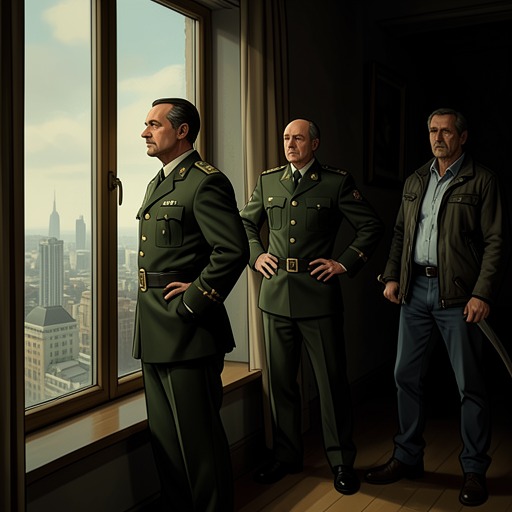
Macbett first appears amid a rebellion that the government has not yet fully contained. Candor considers attacking him, but Glamiss stops the attempt because their army is unprepared; when Macbett enters, Candor greets him as another of Duncan’s loyal subjects. Macbett’s position is thus established in the language of service even as the rebels’ hesitation places him within an active struggle for power.
Later, Macbett reports that Candor is in his hands and that Glamiss has been pursued to a nearby mountain, where he is surrounded. Duncan demands to know why the prisoners have not been killed and orders Macbett to have Glamiss beheaded. Macbett answers that he has acted according to Duncan’s orders, presenting himself as a subordinate whose military conduct is authorized by the sovereign. That posture of obedience sits uneasily beside the scale of violence he later recounts.
Exhausted and seated on a milestone, Macbett studies his naked sword and describes the devastation of the fighting. He says he has personally killed dozens and dozens, including twelve dozen officers and men who had done him no harm, and has had hundreds more executed by firing squad. He recounts burning forests where people had sought refuge, demolishing houses and burying their inhabitants in cellars, and driving hundreds of thousands to drown while trying to escape across the Channel. He attributes millions of further deaths to fear, suicide, anger, apoplexy, and broken hearts. The speech expands from his bloodied blade to a landscape overwhelmed by the dead, while he still calls the victims traitors and enemies of Duncan. His claim that he may have killed friends by mistake makes the indiscriminate violence plain without undoing his continued defense of it.
Prophecy, Reward, and the Turn Toward Ambition
The Witches meet Macbett while he is waiting for Banco. The First Witch hails him as thane of Candor, and the Second Witch as thane of Glamiss. Startled that the First Witch knows his new title, he wonders whether rumor has carried the news through the forest. Their greeting turns his military career into something that seems to have been anticipated: the titles are not yet his, but the Witches speak as if they already belong to him.
The prediction becomes more difficult to dismiss when Macbett learns that Glamiss is dead and Duncan intends him to inherit Glamiss’s title, though not his lands. Macbett says he had tried to prevent Duncan from dispossessing Banco, stressing that Banco is his friend and has served the sovereign loyally. Yet obedience pulls against friendship: Macbett reasons that refusing a reward from the king might itself count as contempt, especially when he does not refuse the king’s orders to go to war. The title carries no wealth because Duncan has annexed the lands, but accepting it still places Macbett in conflict with Banco and brings the Witches’ words closer to fulfillment.
Macbett is not simply convinced by the prediction. He asks how the Witches could know what was coming and wants to understand the chain of cause and effect that might put him on the throne; he says he would like to hear their explanation, if only to mock them. His skepticism therefore coexists with fascination. The prophecy has given his ambition a possible destination, while his questions let him treat that possibility as an intellectual puzzle rather than a choice for which he is responsible.
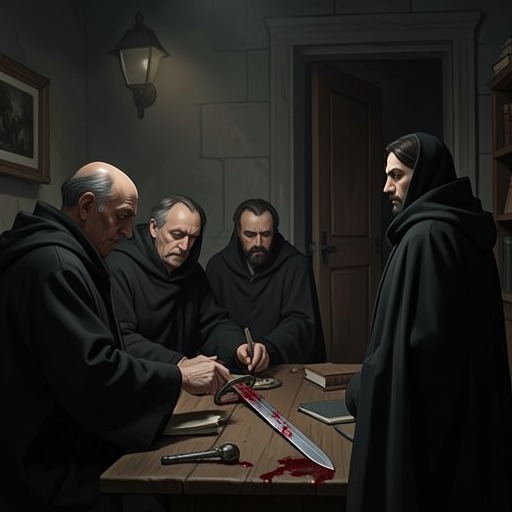
Lady Duncan makes the choice harder to evade. Holding out a dagger, she presents it as the instrument of their ambition and rise to power, urges Macbett to act boldly, and links his desire for her with the prospect of taking Duncan’s place. The blade, she says, will bear an enduring bloodstain that can serve both as a reminder of success and as an incentive for further deeds. Her appeal converts the Witches’ elusive forecast into a concrete offer of violence and intimacy: Macbett need only take the weapon and act.
Conspiracy, Kingship, and Downfall
Once Lady Duncan has made murder an explicit route to power, Macbett moves from hesitation to conspiracy. He and Banco decide that Duncan must be driven out and that they should govern their own affairs. Macbett proposes dividing the kingdom: he will take the throne, while Banco becomes his chamberlain—then revises Banco’s place in the imagined hierarchy, calling him third-in-command. Lady Duncan is the third conspirator. The three swear together to exterminate Duncan, turning Macbett’s old duty to his sovereign into a compact to destroy him.
The partnership with Banco does not survive the promise of power. Macbett has heard that Lady Duncan and her maid told Banco he would father a line of kings, a prophecy Lady Duncan had never shared with him. He takes this omission as evidence of a plot and fears that he has killed Duncan only to place Banco’s descendants on the throne. Instead of accepting the prophecy as a limit on his own ambitions, he decides to attack its source. Calling Banco a coward for repaying the favors he had intended to grant him, Macbett stabs him in the heart, then speaks of the future kings as a line cut off at its beginning. The murder is both an attempt to secure his dynasty and a betrayal of the comrade whose friendship he had earlier feared losing.
Macbett’s seizure of power is staged as public triumph. He and his bride appear in robes of state, crowns, and purple robes; Macbett carries the scepter as bells ring and the crowd cheers. The ceremony gives his rule the visible trappings of sovereignty, but its acclaim does not make the underlying succession secure. The man who once described himself as Duncan’s loyal servant has become king through conspiracy and murder, and the celebration cannot prevent opposition from gathering.
That opposition arrives with Macol, Duncan’s son, who has returned from Carthage with a large army. Lady Duncan tells Macbett that the whole country is against him and that he has run out of friends. Macbett nevertheless claims to fear no one. When Macol confronts him, he invokes the condition that has sustained his confidence: he can be beaten only when the forest marches against him. The stage answers with an image rather than a natural forest. Men and women approach carrying placards marked with trees, making the Witches’ prophecy appear to advance through a human crowd.
Macol draws his sword and declares that they have old scores to settle. Macbett turns at the sight of the approaching trees, and Macol stabs him in the back. Macbett falls; Macol orders that his body be taken away. The crowd’s cry that the tyrant is dead immediately gives way to acclaim for Macol as sovereign. Macbett’s death fulfills the prophecy in a deliberately theatrical form, while the rapid transfer of public loyalty suggests that his overthrow has not ended the violent cycle of rule he helped perpetuate.
Refrain and Self-Knowledge
The witches’ encounter gives Macbett a brief, unsettling language for the divide between judgment and action. He joins the First Witch and Second Witch in repeating “Video meliora, deteriora sequor.” The refrain is not an explanation of his conduct so much as its compressed pattern: awareness of a better course persists alongside movement toward the worse. Its repetition makes that contradiction ceremonial, as if recognition itself could become part of the ritual rather than interrupt it. Then the Second Witch removes what remains of the First Witch’s disguise—the pointed nose and hairpiece—leaving the scene’s appearance of supernatural authority exposed as theatrical artifice. Macbett’s choices, however, are not thereby undone; the visible mask can be removed while the course he has chosen continues.