Macbett’s murder of Banco
The KillerMacbett’s murder of Banco is the moment when a prophecy about future rulers becomes the immediate cause of a present killing. Banco has helped bring Duncan down and expects a reward, yet he also regrets his part in the murder and imagines that he may father a line of kings. Hidden nearby, Macbett hears this mixture of guilt and ambition, interprets the prophecy as a threat to his own rule, and stabs Banco in the heart. The scene converts uncertain dynastic possibility into decisive political violence: Macbett kills not for an act Banco has just committed, but to prevent the future he believes the witches have disclosed.
Causes and Political Background
Banco’s soliloquy sets out the political sequence as he understands it. The Witches’ predictions have come true in stages: Macbett is to become king, with Baron Candor and Baron Glamiss preceding him. Banco links Macbett’s rise to Duncan’s death, in which Banco admits he had a hand. He reasons that Macbett could not have taken power unless Duncan had died or constitutionally abdicated in his favor, and he considers such an abdication impossible. The prediction is therefore entangled from the outset with violence and with the limits of lawful transfer.
Banco also measures the distribution of rewards. Macbett, he thinks, has acquired wealth, fame, power, and Lady Duncan, who is to become Lady Macbett; Banco, by contrast, has only Macbett’s promise that he may become chamberlain. He doubts that promise, recalling that Macbett had pledged loyalty to Duncan before killing him. Banco recognizes the likeness between their betrayals and anticipates that others may judge him for his own role in Duncan’s death. His resentment at receiving less than Macbett is thus accompanied by an awareness that their political success rests on the same compromised ground.
Banco’s Prophecy, Remorse, and Plans
The Witches have predicted that Banco will father a line of kings, princes, presidents, and dictators, although Banco is neither married nor a father. He takes the prediction as consolation, but not as relief from his present circumstances. He says his earlier ambition had been limited to serving his king; after encountering the prophecies, he finds himself consumed by envy and jealousy, and describes ambition as a force carrying him beyond his control. The prophecy promises future dynastic importance while exposing how little he possesses in the present.
His remorse sharpens that contrast. Unlike Macbett, Banco has no success or fame to quiet his regret, and he says he cannot get his part in Duncan’s murder out of his mind. Still, he begins making plans: he intends to ask the Lady in Waiting to marry him, partly because he thinks her ability to foresee danger may help them avoid it. He imagines building a family, becoming chamberlain, curtailing Macbett’s powers, and serving as the power behind the ruler. His projected future joins dynastic expectation to political calculation; the prophecy has not made him king, but it has enlarged the life he thinks he might claim.
Macbett Overhears and Interprets the Threat
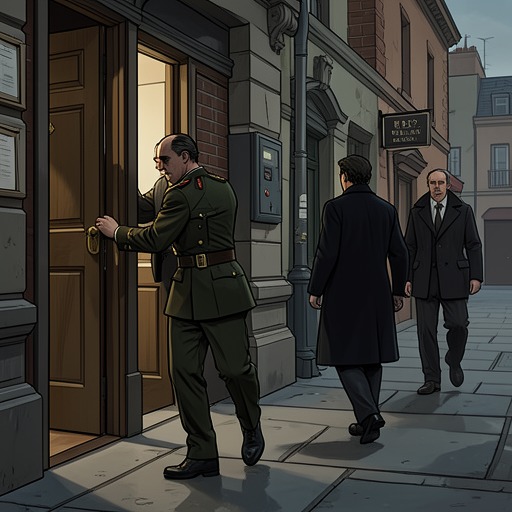
Macbett enters while Banco is alone and hides to listen, theatrically pretending to draw invisible curtains. The device makes the overhearing visible to the audience while Banco remains unaware that his private reflections have acquired a witness. Macbett hears both Banco’s doubts about the chamberlainship and his plan to constrain Macbett’s authority. What Banco presents as a possible future strategy, Macbett receives as treachery already taking shape.
The dynastic prophecy alarms him more deeply. Macbett says that his wife and her maid have told Banco he will father a line of rulers, and he is disturbed that his wife did not tell him. He wonders whether he killed Duncan only to place Banco’s descendants on the throne and imagines that the women are participating in a sinister plot. The scene does not establish that the prophecy is a coordinated conspiracy; it shows Macbett converting what he has overheard into that interpretation. His fear collapses a distant prediction about Banco’s descendants into a threat that can, in his mind, be stopped immediately.
The Killing and Its Consequences
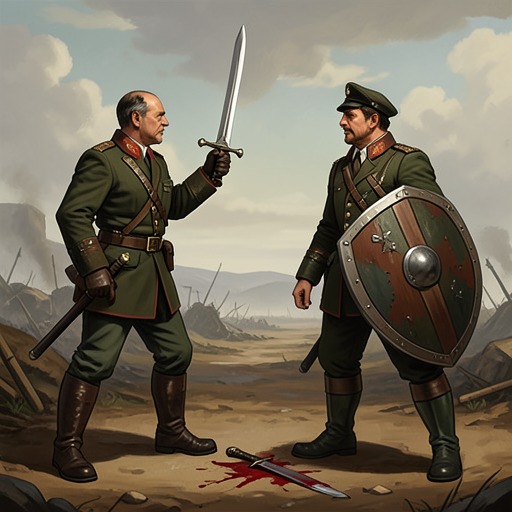
Macbett resolves to destroy the predicted line “at the fountainhead”—meaning Banco himself. He calls Banco back, and Banco answers that he is coming. Macbett accuses him of repaying promised favors with betrayal, then stabs him in the heart. Banco falls and appeals to God for mercy. The suddenness of the attack contrasts with the extended reasoning that precedes it: Macbett has turned suspicion and prophecy into a physical act before Banco can respond to the accusation.
As he leaves, Macbett asks where Banco’s future kings are and declares that they will rot with him, nipped in the bud. The image makes the murder an attempted destruction of an entire succession through the killing of its imagined origin. But the event only establishes Macbett’s intention to prevent the prophecy, not whether he can control what the Witches have predicted. The blackout follows the killing, and the next lighting marks a break in the action rather than showing any immediate political settlement.
Dramatic Significance
The scene gives Banco’s prophecy a double force. For Banco, it is a consolation and an invitation to imagine influence beyond his current rank; for Macbett, it is evidence of a danger that must be eliminated. Their different responses expose the gap between future possibility and present power. Banco is still negotiating for the chamberlainship and contemplating marriage, while Macbett, already ruling, uses the prospect of Banco’s descendants to justify removing Banco himself.
The murder also repeats the political logic that Banco has just described. Duncan’s death made Macbett’s accession possible; now Macbett kills a former accomplice because he fears that Banco’s future family could inherit what Macbett has seized. A prophecy that might have extended Banco’s influence across generations instead precipitates his death in the present. The scene’s central reversal is therefore not that the prediction is disproved, but that Macbett’s attempt to prevent its fulfillment becomes another act of violence in the chain of power begun with Duncan’s murder.