Macol’s accession and declaration of tyranny
The KillerMacol’s accession and declaration of tyranny make a change of ruler look like a change of regime, then expose it as the continuation and intensification of violence. A throne, bells, a bishop, and public acclaim frame the succession as legitimate ceremony; Macol’s own words and the returning guillotines make clear that his promised rule will be harsher than Macbett’s.
The transfer of power
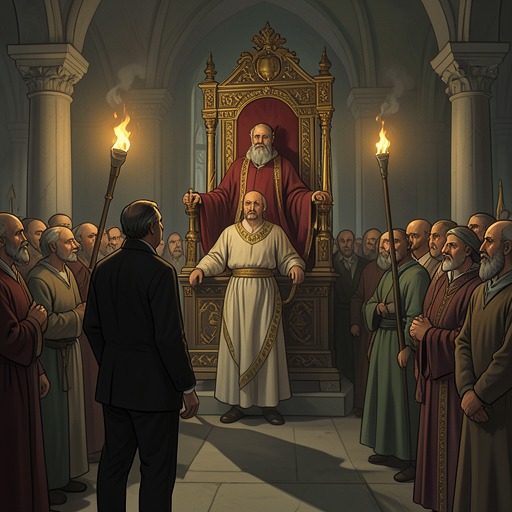
The ceremony begins with the removal of Macbett’s body and the arrival of a throne. A guest invites Macol to sit, while more guests enter and some display placards proclaiming, “Macol is always right.” The action replaces a dead ruler’s body with the furniture of sovereignty, making the transfer of power visible before Macol has spoken. The slogan, already phrased as unquestionable doctrine, turns welcome into an early demand for conformity.
Bells sound as Macol stands by the throne and the bishop enters. Macol asks whether the bishop has come to crown him, and the bishop confirms that he has. The exchange establishes the formal, religious aspect of the accession, though the staging does not show the crowning itself. The guests’ acclamations join Macol’s name to Banco’s dynasty and to the kingship, placing competing or overlapping claims within the same chorus rather than clarifying them.
A spectacle of victory
When Macol calls for silence, the crowd is poised to hear its new king. He presents his seizure of power as deliverance: the country, he says, had suffered beneath a yoke, with fresh wounds added day after day, and he has trodden upon the tyrant’s head. As he speaks, a man enters carrying Macbett’s head on a pike. The image gives literal form to Macol’s boast and makes the defeated ruler’s body part of the new ruler’s public case for authority.
The crowd’s response does not settle into uncomplicated celebration. One man says Macbett got what was coming to him; a woman proposes putting out his eyes with knitting needles. Macol answers dissent not with reassurance but with a threat to set soldiers and dogs on those who will not be quiet. The exchange rapidly recasts the cheering assembly as a population already subject to coercion: its voices can acclaim the new king, condemn the dead tyrant, or be suppressed by force.
The promise of a worse rule
The decisive reversal comes after Macol declares Macbett dead. Rather than promise repair, he announces that his country will have more vices than before and suffer in more varied ways under his succession. The statement overturns the conventional promise implicit in liberation from a tyrant: Macol claims the victory over Macbett, yet openly makes increased misery the program of the government that follows. The crowd answers with murmurs of discontent, amazement, and despair, registering that the speech has transformed apparent triumph into foreboding.
The stage makes that threat concrete. A forest of guillotines appears upstage, recalling their earlier appearance in the play and linking Macol’s reign to an established image of mass execution. The scenery does not merely illustrate an abstract warning; it places the instruments of punishment behind the new sovereign as he speaks. At the end of the announcement, Macol is left alone. The bishop, the only other person remaining, departs dejectedly, leaving the new ruler without the ceremonial company that had attended his arrival.
Sovereignty without restraint
Macol’s language escalates from national deliverance to personal dominion. He declares that he now has power and invokes the image of pouring concord’s sweet milk into Hell, turning the conventional language of peace into its deliberate negation. His closing claims enlarge the title of king toward emperor of emperors, as if authority could be made absolute by multiplying its names. The progression—from the crowd’s placards, through the threatened use of soldiers and dogs, to the guillotines and the boast of boundless power—shows how public ceremony gives way to openly declared tyranny.
The accession therefore offers no restorative ending to Macbett’s rule. Macol takes the throne amid acclamation, but the announcement exposes succession as a mechanism by which violence continues under a new name. The crowd’s fading response, the bishop’s dejected exit, and Macol’s disappearance into mist leave the promised order unresolved: the new king has claimed supreme power, while the stage has already supplied the image of what that power may bring.